In this episode, Kristin Barbato of Dynamo Energy Hub sits down with our CEO, Scott McCurdy, to discuss our innovation & leadership in emissions solutions and how we are responding to and outpacing this ever-changing industry and making our energy systems safer as we go.
Video Transcript:
Introduction:
Kristen Barbado cofounder and president of Dynamo energy hub interviews Scott McCurdy CEO of Encino Scott and his team monitor analyze and provide solutions to emissions of all kinds this effort plays a key role in tracking and reducing greenhouse gases and other pollutants Encino is constantly innovating rethinking all practices and inventing new ways for their customers to both comply with regulations and meet their own emissions goals. Scott McCurdy jumps into the details of this vital sector and what Encino is doing to raise the bar.
Interview:
Kristen: Welcome, we are getting ready to launch our newest little episode of Dynamo spotlight on Encino. I’m Kristen Barbado and I’m here today speaking with Scott McCurdy who’s the founder and CEO of Encino environmental services. So glad to have you join our little discussion today. I would love to learn a little bit more about Encino. How are you?
Scott: I’m great, Kristen thanks for having me. I really appreciate the opportunity, and you know we’re excited to be members of the Dynamo energy hub and appreciate all you guys do. Encino, in short, is really an emissions management solutions company. That’s a pretty easy way to summarize a broad set of solutions, so I’ll get into those in more detail as we go. We help companies with their environmental compliance efforts around the missions, continuous monitoring, emissions reduction, we have a new product for that, and then just generally advising and trying to be a partner to our customers to help them wade through the ever-evolving, ever-increasing landscape of all the regulations and voluntary initiatives, and other things that drive what they have to do, but also what they want do to improve and be able to compete on the world stage.
Kristen: That’s great! I’ve got a few questions I wanted to talk through with you today about Encino, what you’re working on, what’s exciting, but we have one question that’s been burning through the Dynamo team here; Is watching the movie “Encino Man” required for all of your employees before they join the company?
Scott: I’ve actually never heard that question before. I guess you could call me “Encino Man. I don’t even know if I’ve ever seen the movie. I remember the name but….
Kristin: You might lose some I.Q. points if you watch it, so maybe you shouldn’t.
Scott: I hope we’re a bit more advanced than that, but you may have triggered me – I may have to go watch it now.
Kristen: Alright so, for real, now that we actually know that it’s not based upon the movie, can you tell us a little bit about what are your services? I know it’s kind of broken down into compliance and advisory, but what does that really mean in terms of your impact in the energy transition?
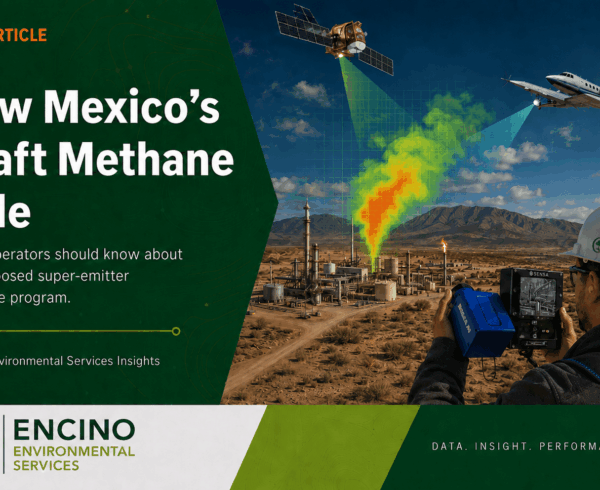
Scott: Sure, well you know I guess what I’d start with is that we’re an emissions management solutions company and we operate across several industries with oil and gas being our biggest. We also work in waste, such as landfills, which are historically pretty sizable emitters. Also, agriculture, such as dairy farms, you know there’s emissions there, and then we have a lot of industrial offerings that are really across all industries. We’ve got steel mills, paper mills, crematoriums, schools, hospitals and hotels. A pretty broad customer base. What I’d say about what we specifically do is, you know there’s tons of focus on regulations right now, but the reality is we started 14 years ago on the back of what were some pretty transformational regulations at the time around periodic emissions monitoring and reporting. That’s the core of our kind of compliance versus today, you know, we do what’s called Stack Testing or Engine Testing. This is where you go out to the field and you test different emission sources, different types of equipment, and sometimes that’s required to be done annually sometimes it’s every three years, five years, or ten years, it just depends, but basically looking at the exhaust and analyzing the emissions level ensuring that they’re in compliance, or not. With the permits and the regulations, the second piece of that compliance bucket for us is what’s commonly referred to as LDAR, which is leak detection and repair. You are starting to hear more LDAR with “Q” used which is leak detection and quantification. I’d say that’s really where we focus. LDAR is something that historically has been done by somebody who goes out to a site and walks around with either a sniffing device or some pretty sophisticated optical gas image cameras. OGI is the common industry term, and so we do a lot of that. Historically it’s been required on a quarterly basis. Then finally we tell our customers, they fix them, we validate it. But more and more customers are wanting to go above and beyond what’s required, and so we’re starting to see that, and we will help them baseline their emissions. There’re different global initiatives like the oil and gas methane partnership OG and P 2.0. There are around 150 companies that have signed on to that. And then obviously with some of the new regulations now there’s a waste emissions charge. So, if you’re big enough and have the right types of assets you actually will have to pay a fee or almost a tax if your emissions are over a certain level. So that business is expanding and that’s becoming more than compliance. The three buckets are really kind of merging together. So now we are doing some other things around flares. You know that monitoring the net heat value of flares is a big new thing in the regulations and we’re part of that. The second piece is really the monitoring side of things. Our compliance works great, but it’s always been periodic and tied to regulatory requirements. Now they’re people looking more and more at continuous monitoring or more frequent monitoring solutions. We’ve attacked that need in two ways. First, we have a joint venture and an investment in a satellite company called Satlantis. With Satlantis we’re actually able to monitor both visually and with infrared from a low earth orbit satellite. We’ve got two orbiting the earth now that are looking for methane and looking for methane detections. So that’s a service we can provide to our clients. The second is that we have a full suite of optical gas imaging or OGI camera solutions. We also have an investment in a company called SENSIA, who is an optical gas imaging manufacturer based in Madrid, Spain. SENSIA has technology for LDAR and fixed systems for gas detection, quantification, flare destruction or removal efficiency monitoring, which basically tells you how efficient the combustion process of a flare is, and another things like tank level monitoring, flame detections, build detections and surveillance safety applications. So, it’s really across the board on what those solutions can provide. Those solutions all have quantification. We use a tool called a high flow sampler that’s also pretty popular for quantification after you’ve found leaks. With these solutions we’ve tried to develop a portfolio of solutions so that companies can come to us, and we can provide multiple solutions. I’ve had companies tell me before, “You guys do everything.” Well, we don’t really do everything, but it is fair that we do almost everything. It’s not uncommon that a company might use five or six companies to do everything that we can, and it might even be different by basin, and so you know trying to have a fulsome suite of solutions makes it easier so they can do more with less vendors. Obviously, this is one of our goals. You know the third piece of what we do is on the reduction side. This is something that’s new and we just recently came out with our first product outside of the cameras called a Thief Hatch. You can drive around and see storage tanks all over the place. Oil and gas storage tanks typically have what’s like a little lid on top. You’ll walk up a ladder and then right at the top of the ladder typically is this little lid. This lid can be opened and closed to take measurements and check levels and everything. But really what those are designed for is kind of a pressure relief device. As pressure builds inside a tank these hatches allow the tank to basically belch. They open very briefly, release pressure and then they’re supposed to close. Sometimes they don’t close. Sometimes they do, but you know part of the issue historically has been they’re made of metal. When you put the dissimilar metal between the tank and the Hatch together, in a corrosive environment, what happens is that they corrode which leads to emissions. It also leads to more corrosion and more maintenance on the Hatch. Our Composite Thief Hatch is made from an aerospace grade composite material and eliminates those dissimilar metals and reduces maintenance, which improves safety and environmental impact because you don’t have to send people out as much to deal with them. So that’s our first kind of endeavor into the actual reduction space and not just services. And then just a whole host of advisory services, you know, we just help our customers in any way that we can. I think they see us as experts in their field and sometimes it’s our solution, sometimes it’s not, but we can be a good industry partner. That was a long answer, so I’ll let you ask another question.
Kristin: Following along the same line as we’re thinking about what’s happening with these ambitious improvements across the board, with all these different types of customers, that you encounter what makes you different?
Scott: I think our goal really is a few things. One you know we want to help our customers produce energy in the in the cleanest way possible. Oil and gas especially get politicized a lot, but you know I’ve never heard someone who said less emissions is bad, right, you know. Across the board everybody believes that, right? So, there can be debate on how you get there, but I think there’s a common goal there. And being able to recognize the longevity that that oil gas has, and all these other sources of oil and gas, like landfills and dairy farms, and helping them all operate efficiently from a not losing product standpoint, but also reducing emissions standpoint, is a key driver of us and our culture and what we try to do.
Kristen: It seems like in this time frame as you’ve been growing that you have a tenant of keeping data open and auditable. This transparency concept – Why is that so important, and I feel like that’s something that is unique about what you do.
Scott: The methane monitoring space, or continuous monitoring space has really blown up in the last three to four years, meaning tons of solutions providers tons, tons of people trying to tackle that challenge. When things were first coming out, there were a lot of questions, “Well, how does it work?” and “What’s the science behind it?”, “How do you know it’s correct?”. With our systems they tend to be visual, so you kind of see it or you don’t, but a lot of the other systems are blind. Some companies were very open about how their systems work, some would say “Hey look this is what it does, but you know everything else is protected by IP.” We can’t control that, our emissions testing business that we started is compliance based and we’ve always had to be pretty transparent, so we wanted to pick technologies that we could continue being transparent with because customers are using it for regulation compliance and carbon credits now. The more transparency and the more confidence there is in and the accuracy of, say carbon intensity of gas, then the more valuable our services become.
Kristen: So, it’s not just the environmental, there’s also an economic aspect to it. Especially quantifying this correctly it becomes really important. One thing that I’m curious about is what is in the new frontier of decreasing emissions and how are you addressing some of these new issues that are presenting themselves or the compliance that’s required?
Scott: Like I said, there are a ton of new things out there. The EPA just issued their new regulations commonly referred to as OOOOb, OOOOc, subpart W, those are all really around just finding leaks, analyzing emission sources and reporting them accurately. If I break it all down accurately, that’s really. It’s way more complicated than that. There are new things that have to be tested. There are more things that have to be tested and helping our customers both figure out what the regulations require and then helping provide solutions is probably our biggest initiative right now. More broadly, there’s tons of efforts out there, you know the electrification of engines, there’s hydrogen, there’s direct air capture and carbon capture, and sequestration. Those are big things that can have a huge impact but take a lot of planning and a lot of investment. We’re much more focused on what we can find and fix today, and a lot of small reductions equal big reductions. Things like the Thief Hatch; that’s really our goal is “Hey this is this is a small thing that has to be replaced frequently anyway – by a better one.”
Kristen: Good point! So, do you have any exciting solutions or announcements that have recently happened or even some success stories and case studies that you’d love to explain? Give us tangible idea about how this can work for customers?
Scott: I would say we have a good core product set, and I would say probably the most exciting thing that’s happening right now for us is finding new ways to use things we already have and have been providing. To give you an example there’s a new regulation around monitoring the net heat value of flares and so we’ve been able to take some of the equipment we use in our engine testing and create a solution for that. There’s this new waste emissions charge, and so we’ve got customers that are looking at their assets and saying “OK, based on our asset base, we’re going to have to spend this much money on waste emission charge. What if we put together a program where we monitor these assets and we prove that they’re operating better than the factors we have to use, or prove that they’re not, replace them with something better, and be able to reduce that?” Customers have always been able to see an ROI, but it’s becoming easier to have the ability to calculate what that ROI is with some of the monetary “sticks and carrots” that are that are out there now. I think just being able to apply our technology in different ways and provide different solutions to customers is the most exciting thing for me. And just more broadly, if you look back five years most of the stuff that’s being used in the field was sitting in a university Think Tank somewhere being developed and now it’s being now it’s actually developed commercially, and what’s it going to be in five more? We’re finding emissions from space right now. The technology is moving fast. You’ve got to vet it because not all technology works and is good and is available. But I think the space is incredibly exciting and it’s not going anywhere, and you know, I think it helps everybody do better.
Kristen: That’s wonderful! When you think about emissions monitoring or emissions you’ve mentioned several things that are pretty exciting. I mean, using satellite to measure this now or infrared camera, it’s so much different than it had been when it was somebody walking the field just testing things in a much more antiquated way. This is something that has existed for a long time as a problem, but I think with the newer technologies and analytics that a company like you get to use, what is something that you’d say to the layman that is something that not enough people know about emission solutions and why they’re important?
Scott: Sure, I think your point is good. You know it wasn’t that long ago and it’s still done to some extent today, where people, they call them AVO, which is audio, video, olfactory surveys, where they just walked around – they look, they listen, they smelled, and that’s how they tried to find quantify. And that’s what’s that’s what’s pretty amazing about what we’re able to do now is, not only we’re able to see something that’s invisible, but we’re getting better and better, and actually quantifying, which is amazing in itself. If I said, “What would most people not know?” First off, I would say there’s not really one thing out there that’s perfect for every situation. We get tired of hearing it, but it’s commonly said, “There’s no silver bullet.” for finding emissions and quantifying emissions. There are satellites, there’s planes, there’s drones, there’s lasers, there’s blind point sensors that sit on the fence line, there’s cameras, there’s all kinds of solutions and some are great in certain environments, and some don’t really work in others. Some give you a nice visual image and some just tell you there’s a leak somewhere and you go find it, but there’s different price points for those things. I think finding the best solution set for your situation is something that people need to understand that they have to do, and companies have to do.
Keristen: And that’s something that Encino helps customers do, right?
Scott: We help them figure out what mix of products and services works best for them and identify the unseen value. There are customers that are hyper adduction or have higher risk that warrant a more sophisticated solution and then you have others that are lower risk, but you need to keep an eye on them – that maybe you can get away with something that’s lower cost. I think the other piece I would say is data. There’s lots and lots of data. All these instruments produce data and some, depending on what you want to do with it, you need a pretty advanced solution to receive the data, to track the data and manage your emissions inventory overtime. There’s a lot of great software solutions out there. We have some in-house and we’ve got some really good partnerships. That’s something else that people have to think about. Not only are you detecting leaks but when you’re having to report an inventory of leaks and now, you’re trying to use real data, not emissions factors, where you just calculate emissions based on the type of equipment you’re using and the frequency, it’s a lot to manage. Some companies are starting-up groups that are very similar to their accounting group for carbon accounting.
Kristen: Companies are becoming much more aware of how they need to respond to these types of compliance issues and, of course, as operations and their economics are getting more complicated, with them it makes sense that they might have to start-up a group or hire somebody like Encino to start making sense of these complexities and simplifying them and also having the right analytics for the right types of solutions when you are detecting issues. So, Scott that’s terrific! Can you tell us is there a last thought that you’d like to leave with us with in terms of how to work with Encino how to get in touch with you?
Scott: Our website is Encinoenviron.com. We’ve got good LinkedIn presence – we try to post both the kind of fun things that we’re doing but also content around regulations and showing off our technology, so I would certainly encourage anyone interested to follow us on LinkedIn – that’s a great place. Our website has all of our contact details to operate all around the US and we’re starting to get more and more international inquiries. I’m really excited to have the opportunity to do this. I’m really excited about the space we’re in and what we’re trying to do to help our customers. I appreciate you having me today.
Kristen: Oh, that’s great! Such rapid growth in this area and it’s really nice to see Encino leading the way in terms of products and services that can help your clients with an ever-changing more complex type of industry. Thanks so much for joining us today! Thank you so much for being part of Dynamo energy hub! We love having you guys and look forward to seeing you at one of our next events.
Scott: That sounds great, and we appreciate all y’all do.