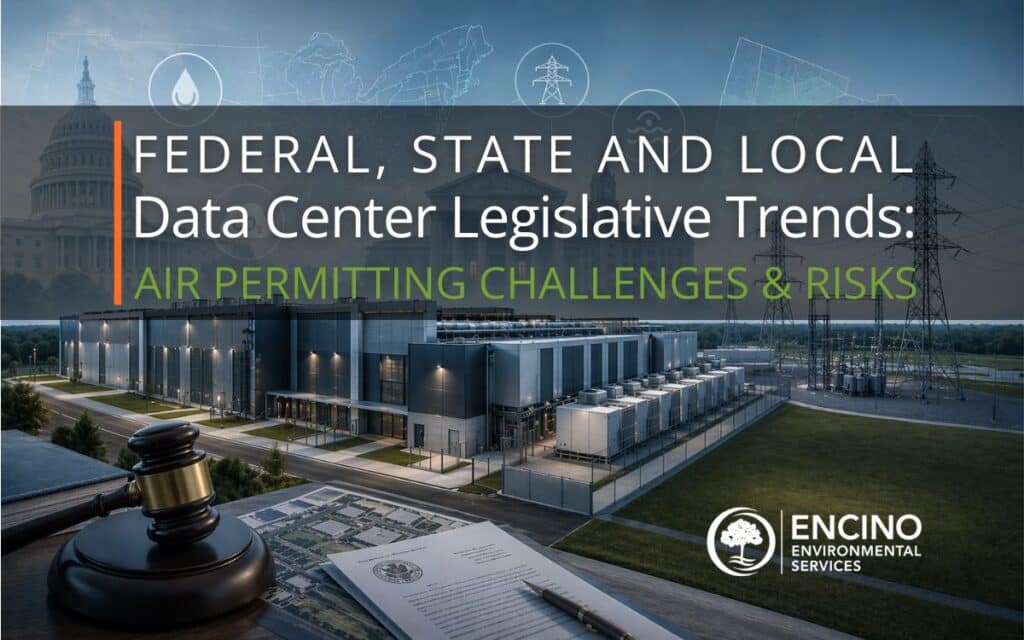
Emerging Legislation at Federal, State, and Local Levels Create New Challenges and Risks for Data Center Air Permitting
Emerging legislative trends affecting data centers across federal, state, and local levels in the U.S. are complicating the permitting of new projects and compliance for existing centers. As of November 2025, the United States leads the global data center market by a wide margin, with 5,427 facilities in operation. Worldwide, there are just over 12,000 data centers, meaning the U.S. accounts for roughly 45% of the global total.
Driven by emissions and water use concerns, regulators at all levels of government in the U.S. are rapidly taking up legislative and regulatory initiatives. Most are focused on environmental sustainability and protecting consumers from the impacts of seemingly insatiable demand for electricity from AI data centers.
The Big Picture: Policy is rapidly shifting from growth incentives to constraint, accountability, and community impact management.
This article focuses on the major regulatory and legislative trends and initiatives impacting data center permitting and compliance at federal, state, and local levels with a focus on intended goals and potential tensions.
Federal Permitting Trends for Data Center Infrastructure
Faster permitting to support AI and national competitiveness
The federal government is prioritizing speed-to-build for AI infrastructure. The Trump Administration’s Executive Order 14318, Accelerating Federal Permitting of Data Center Infrastructure, signed on July 23, 2025, focuses on streamlining permitting for data centers, transmission lines, and supply chains.
The goal is to compete globally in AI and cloud infrastructure. The objective of faster permitting, however, is generating tension with environmental concerns and community oversight.
“Cost allocation” – making data centers pay for grid impacts
At least two bills have been introduced recently in the U.S. House of Representatives focused on data center impacts on consumer ratepayers.
The Protecting Families from AI Data Center Energy Costs Act (H.R.6529), introduced by Representative Greg Landsman (D-OH) would require the Federal Energy Regulatory Commission to hold a technical conference on protecting residential ratepayers from increased costs associated with large loads, and for other purposes.
The Stopping Hikes In Electricity from Large Load Demands Act, or SHIELD Act (H.R.7066) introduced by Representative Mike Levin (D-CA) aims to prevent data centers from shifting grid upgrade costs to ratepayers. Further, H.R. 7066 would provide incentives for data centers to use zero-emission electricity.
This is one of the most important structural shifts in federal policy: data centers are now considered “large load infrastructure” having financial obligations to inoculate retail consumers from utility price hikes.
As of this writing, both House bills have been introduced in the House but have not advanced in the process.
Emissions
The Clean Cloud Act of 2025 (S.1475) introduced by Senators Sheldon Whitehouse (D-RI), Ranking Member of the U.S. Senate Committee on Environment and Public Works (EPW), and Senator John Fetterman (D-PA), would set an emissions performance standard for the electricity used by cryptomining facilities and data centers and utilize the revenues generated to help consumers save on utility bills and invest in long-term storage, among other objectives.
Senate Bill S.1475 has been introduced but has not yet advanced.
FERC scrutiny of grid interconnection and large loads
On October 23, 2025, the Secretary of Energy, acting under Section 403 of the Department of Energy Organization Act, directed the Federal Energy Regulatory Commission (FERC) to initiate an Advance Notice of Proposed Rulemaking (ANOPR) addressing the timely and orderly interconnection of large loads to the interstate transmission system.
Currently, FERC is seeking comments on DOE’s proposed principles and the issues they raise, including how to ensure large loads can interconnect to the transmission system in a manner that is timely, orderly, reliable, and non-discriminatory.
Comments can be submitted on the FERC’s Docket No. RM26-4-000.
We anticipate this process will likely result in new rules for co-location, behind-the-meter power, and queue prioritization.
LEARN MORE: Clean Air Act Resources for Data Centers
State-Level Permitting Trends for Data Center Infrastructure
Initiatives at the state level are moving faster than federal actions.
Shifting from incentives to regulation and accountability
Historically, most state legislation affecting data centers was focused on providing tax incentives for attracting data center projects. Today, that focus has turned to the environmental impacts of facilities, including energy use, water consumption, as well as ratepayer protection.
In early 2026, more than 300 bills had been filed in 30 states focused on data centers. Several states, including New York, South Dakota, and Oklahoma, have proposed data center moratoriums that would temporarily halt new construction while policymakers evaluate impacts on utilities, the environment, and local communities.
Given the volume of bills, as a practical matter it is impossible to list them all here. However, we advise readers to contact us with any questions concerning proposed legislation or laws impacting their operations.
Moratoriums and “pause to study” policies
States are increasingly telling the data center industry: “Stop, let’s evaluate first.”
Lawmakers in at least 11 states, including Georgia, Maryland, Michigan, New Hampshire, New York, Oklahoma, South Carolina, South Dakota, Vermont, Virginia and Wisconsin, have introduced legislation this year that would temporarily ban data centers.
While some of the measures would establish an indefinite moratorium, others would ban new data centers for several years. The Vermont measure, for example, would ban new data center projects through July 2030.
So far in 2026, 12 states have taken up data center moratoriums and 11 of them have been unsuccessful. Maine, however, is expected to pass a bill pausing new data centers until late 2027, which would be the first ever statewide moratorium.
Energy tariffs and “large load pricing”
Most agree that ratepayers shouldn’t be paying higher electric bills to satisfy data centers’ ravenous appetite for power. To that end, in 2025 over 65 special tariffs have been proposed and/or approved across more than 30 states.
Some utility regulators are requiring data centers to “bring their own” generation or grid capacity (self-generation), which could complicate air permitting requirements depending on the type of generation technology used (e.g., diesel fueled generators, natural gas turbines, etc.)
These developments demonstrate that data centers are no longer being treated like typical commercial customers, but as unique because of their significant and growing power requirements.
Rolling back incentives (tax breaks under pressure)
Once considered jobs and growth engines, data centers were courted by the states with tax incentives to attract facilities and the economic benefits that come with them. That sentiment, however, has turned to ratepayer and environmental protection.
As a result, some states are reconsidering subsidies. For example, Governor Pritzker of Illinois announced in February 2026 a two-year suspension in state tax incentives for new data center projects.
The broader trend includes incentives tied to intermittent power sources (i.e., renewable energy) or eliminated altogether.
Mandatory sustainability and reporting requirements
The European Union’s Energy Efficiency Directive (EED) plays a central role in regulating data centers in member nations. The EED requires data centers to report key operational efficiency metrics, including power usage effectiveness (PUE) and water usage effectiveness (WUE), and to implement measures that optimize both electricity and water consumption.
Although there is no federal equivalent of the EED, but many look to the European directive as a model for future regulations in the U.S., including state-level initiatives. For example, Virginia now ties its tax exemptions directly to corporate commitments to procure renewable energy, making environmental performance a condition for financial benefit.
The trend is clear – the posture many state governments towards data centers has pivoted from incentives to accountability.
Local Government Permitting Trends for Data Center Infrastructure (Where the Real Battles Are)
Zoning crackdowns and the end of “by-right” development
Perhaps the most contested battles are happening at the local level, impacting where data centers can be constructed and operated.
Some selected examples of this trend include:
Loudoun County, Virginia. Loudoun County known as “Data Center Alley” is home to the largest concentration of data centers , but like many jurisdictions has pivoted to more local control over these facilities. Growing scrutiny from residents has prompted the Loudoun County Board of Supervisors to tighten requirements for new data center applications.
In March 2025, the Loudoun County Board of Supervisors voted to eliminate by-right zoning for data centers. Previously, certain areas allowed by-right development, meaning projects required only staff-level review and no public hearing. Under the new rules, all data center proposals must undergo, a staff-level review, a public hearing, and receive a recommendation from the Loudoun County Planning Commission.
West Virginia. This state has moved in the opposite direction of many other states. In 2025, the legislature passed a sweeping bill aimed at accelerating data center development. Key provisions include FOIA exemptions for data centers, the creation of economic development programs supporting microgrids, and the establishment of specialized tax valuation structures.
The most controversial element, however, is the bill’s preemption clause. It prohibits counties and municipalities from enacting or enforcing local regulations related to the development or operation of data centers and microgrids. In addition, the legislation directs a majority of data center–generated tax revenue to the state rather than to local governments, further centralizing both authority and financial benefits at the state level.
This year, West Virginia passed another law into effect further embracing data centers, and strengthen boost the state’s coal and natural gas sectors while more than tripling its electricity generation capacity to 50 gigawatts by 2050.
Atlanta, Georgia. The Metro Atlanta area is the second largest data center hub in the country, but rising concerns over protecting ratepayers and resources is driving city leaders to put more restrictions on facilities.
In late 2024, the Atlanta City Council unanimously approved an ordinance requiring developers to obtain a special use permit for data centers and banning their construction within the Atlanta BeltLine, a high-profile redevelopment corridor linking 22 miles of trails and green space to neighborhoods, transit, and popular dining and entertainment destinations.
Meanwhile, neighboring Douglas County and Clayton County enacted temporary moratoriums and additional restrictions on new data center development as they reassessed their zoning regulations.
Huron County, Michigan. Huron County commissioners approved a three-year moratorium on new data center construction.
Bottom line – the real action on new data center legislation is happening at the state level and project developers are advised to make policy-making at the local level a key part of site selection.
Cross-Cutting Themes (Most Important Takeaways)
Four major themes cut across the regulatory landscape for data center project developers:
- Energy is the #1 regulatory driver. Accelerating regulatory and legislative action flows from massive electricity demand, grid reliability concerns, ratepayer protection from large increases in utility bills.
- “Who pays?” is replacing “how do we attract?”. The states are at the forefront of a not-so-subtle shift from subsidies to cost internalization. Data centers are increasingly expected to fund transmission, generation, and infrastructure upgrades.
- AI is accelerating everything. Policy urgency is tied to surging demand for electricity from AI computing platforms driven by national competitiveness, but is also creating rising tensions that are translating into local resistance based on environmental concerns and ratepayer protection.
- Fragmentation across jurisdictions. At the federal level, most policy is pro-growth and pro-speed with legislation that would slow the advancement of data centers on a slow track, given the current composition of Congress. At the state levels, regulation in blue states is on the rise with most red states being open for business. Localities, in all states, which bear the impacts of facilities, tend to be the most restrictive and in some cases even oppositional.
The result is a complex, multi-layer approval risk.
What This Means for Data Center Developers
As data center regulations continue to evolve across federal, state, and local jurisdictions, early and informed permitting strategy is critical to avoiding delays, cost overruns, and compliance risk. Encino helps developers and operators stay ahead of shifting requirements with proactive permitting and air quality compliance support tailored to complex, large-load projects.
Data center project developers are facing rising complexities for permitting and site selection. We advise developers to consider these four major factors:
- Site selection typically begins with developing a regulatory strategy
- Power strategy (generation and procurement) is central to successful projects
- Community engagement is no longer optional, ignore local concerns at your peril
- Incentives are less reliable than they were 3-5 years ago, making projects stand on their own
To achieve permitting and site selection success, Encino maintains a dedicated, full-time Permitting and Compliance team composed of seasoned air quality professionals with deep industry experience. Our team understands the operational and regulatory demands of data centers and brings the expertise needed to navigate complex permitting challenges. The result is efficient, strategic solutions tailored to each project.
Benefits of engaging with Encino:
- Secure permit approvals in a timely manner.
- Keep development projects and operations running on time and on budget.
- Expert guidance to stay in compliance amid a complex and changing regulatory landscape.
- Fill resource gaps and/or meet peak workloads.
LEARN MORE: Permitting and Regulatory Reporting from Encino
Start with a public policy assessment
Whether you’re planning a new data center project, evaluating a current site, or navigating permitting, Encino can help you build a smart, effective permitting capability.
Contact us today to schedule a consultation and take the next step toward data center project success.