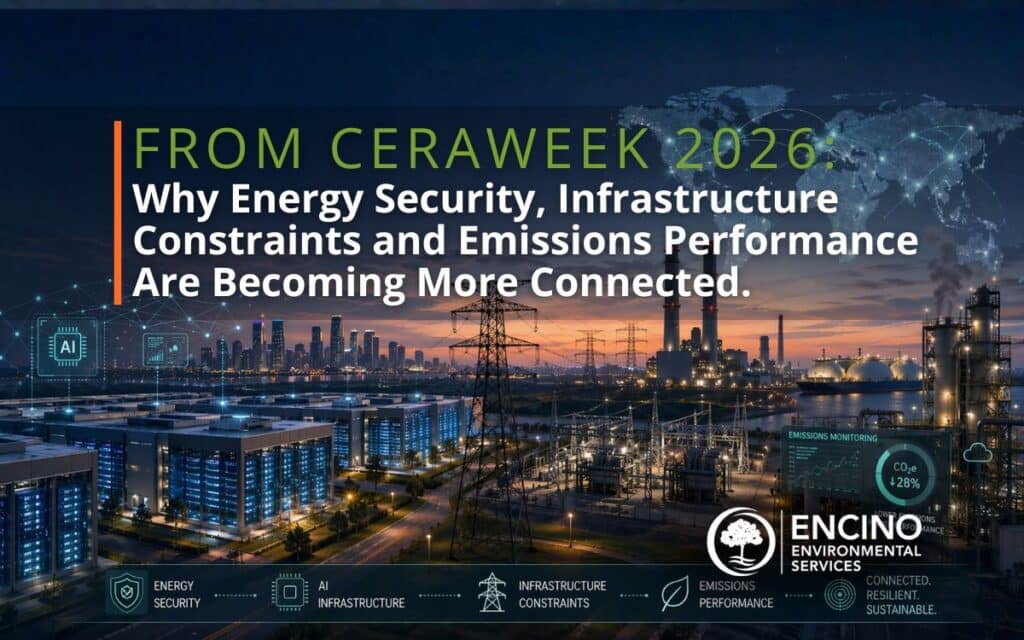
CERAWeek 2026 brought together 11,000 participants from more than 2,350 companies across 90 countries under the theme “Convergence and Competition: Energy, Technology and Geopolitics.” The size of the event was impressive, but the real takeaway was the direction of the conversation. This year’s discussions reflected an energy market being shaped all at once by AI-driven power demand, infrastructure bottlenecks, geopolitical uncertainty, and growing pressure to make operations more resilient and more efficient.
Highlights
- AI is no longer just a technology story. It is now a power, infrastructure, and operations story.
- Speed to power, permitting, and project execution are becoming a competitive advantage.
- Geopolitical volatility is keeping energy security and supply resilience front and center.
- Natural gas and LNG remain central to near-term reliability discussions.
- Emissions performance is becoming more closely tied to operational performance, asset reliability, and decision-making.
AI Is Now an Energy Story
One of the clearest messages from CERAWeek 2026 was that AI is no longer a separate conversation from energy. The official conference recap pointed to the accelerating convergence of technology and energy, especially the surge in electricity demand from data centers and AI. CERAWeek’s AI and Digital theme echoed that point directly, noting that utilities, power companies, and hyperscalers are all looking for ways to respond to fast-rising data center demand.
That shift is changing the conversation in a very practical way. The energy industry is not just being asked to produce more power. It is being asked to deliver that power faster, more reliably, and in ways that can support large, energy-intensive facilities without creating new operational or regulatory problems. S&P Global’s post-event analysis described energy capacity and AI as central themes of the conference, with companies focused on immediate supply challenges and the longer-term buildout needed to support growth.
Infrastructure Constraints Are Moving to Center Stage
A second major theme was the growing importance of infrastructure speed and execution. The official CERAWeek summary described infrastructure, especially the urgency of building at scale, as a critical enabler. The conference’s public overview also highlighted permitting challenges across pipelines, transmission, and project development. In other words, access to energy is only part of the story. The ability to move projects from concept to reality is becoming just as important.
Reuters reporting during CERAWeek showed how quickly this is playing out in the real world. NextEra said it had secured land in Texas for a major gas-fired plant intended to support a large data center campus, and noted that additional land and permits would still be required before the project could move ahead. That is a good example of where the market is today: demand is moving fast, but execution still depends on infrastructure, permitting, and the ability to build with speed.
We saw the same tension in another Reuters report from the week, which described how data centers are being pushed to become more flexible as grid strain increases. Utilities and regulators are beginning to test whether large data centers can reduce power use during peak demand periods, while studies suggest U.S. data center electricity use could more than quadruple by the end of the decade. That tells us the pressure is not theoretical. It is already influencing how operators, developers, and grid stakeholders think about growth.
Energy Security Is Back in the Conversation
CERAWeek 2026 also made it clear that geopolitical risk remains a defining force in energy markets. The official event recap said the conference was shaped by rising geopolitical risk, while S&P Global’s post-event analysis described a fragile and complex macro backdrop, with Middle East tensions and broader supply concerns influencing how companies viewed the market.
For operators and investors, that changes the tone of the discussion. Energy security is no longer just a policy topic. It affects supply chains, project timing, capital allocation, and the broader question of resilience. When risk rises, efficiency, reliability, and better visibility into operations become more valuable because they support stronger decisions in a less predictable environment.
Natural Gas and LNG Still Have a Major Role
Another consistent signal from the conference was that natural gas remains central to near-term reliability planning. CERAWeek’s Natural Gas and LNG theme described gas as both a backbone and a backup for power systems facing rising demand from AI and broader economic growth. That framing fits with the broader conference conversation around speed, scalability, and reliability.
That same logic helps explain why LNG remains part of the conversation as well. In a market shaped by power demand growth, infrastructure constraints, and geopolitical uncertainty, LNG continues to be viewed through the lens of supply resilience and flexibility. For facilities operating in or around LNG value chains, the bar is not simply meeting demand. It is doing so while managing compliance obligations, operational complexity, and emissions performance in a way that stands up to scrutiny.
Emissions Performance Is Becoming an Operational Conversation
The conference’s Managing Emissions theme was framed around affordability, security, costs, returns, and project bankability. That is a useful signal. It suggests the market is placing more value on emissions strategies that are practical, measurable, and operationally relevant.
For many facilities, emissions are not just a reporting issue. They can also be a performance signal. A fugitive emission, inefficient combustion condition, or recurring compliance problem is often the result of an underlying operational cause. Finding and fixing that cause can help reduce emissions, but it can also support uptime, reduce waste, improve efficiency, and strengthen decision-making. That is one of the more important shifts coming into focus: emissions performance and operational performance are becoming harder to separate.
Key Takeaway from CERAWeek 2026
If there was one broader message from CERAWeek 2026, it is that compliance, operations, infrastructure, and strategy are becoming more tightly connected. AI-driven power demand is reshaping energy planning. Infrastructure constraints are influencing timelines and competitiveness. Geopolitical volatility is reinforcing the value of resilience. And in that environment, better emissions data and better operational visibility can support more than compliance. They can help facilities make smarter decisions.
That is why we see emissions performance as part of a larger operational conversation. The companies that will be best positioned for what comes next are not just the ones watching regulations. They are the ones investing in reliable data, understanding what it is telling them, and using it to improve both environmental performance and operational outcomes.
Supporting Critical Infrastructure & Industrial Operations
Encino supports critical infrastructure and industrial operations with emissions testing, monitoring, compliance, and advisory solutions designed to help clients navigate complex requirements while making informed operational decisions. Our work spans industries including oil and gas, LNG, data centers, manufacturing, landfills, and agriculture, with capabilities that include engine emissions performance testing, stack testing, continuous emissions monitoring, satellite methane detection and leak detection and repair (LDAR), and broader compliance support.
As the themes from CERAWeek 2026 continue to play out, we believe the most valuable support does more than help clients react. It helps them generate credible data, interpret it with confidence, and turn it into practical next steps for compliance, performance, and long-term resilience.
Sources
- CERAWeek – AI and Digital Theme:https://www.ceraweek.com/en/themes/ai-and-digital
- CERAWeek – Managing Emissions Theme: https://www.ceraweek.com/en/themes/managing-emissions
- Reuters – “NextEra secures land in Texas for giant gas plant to power data centers, CEO says”: https://www.reuters.com/business/energy/ceraweek-nextera-secures-land-texas-giant-gas-plant-power-data-centers-ceo-says-2026-03-23/
- Reuters – “Stressed US grid forcing data centers to get more flexible”: https://www.reuters.com/sustainability/boards-policy-regulation/ceraweek-stressed-us-grid-forcing-data-centers-get-more-flexible-2026-03-26/
- S&P Global Market Intelligence – “CERAWeek 2026: Energy and AI converge”: https://www.spglobal.com/market-intelligence/en/news-insights/research/2026/03/ceraweek-2026-energy-and-ai-converge