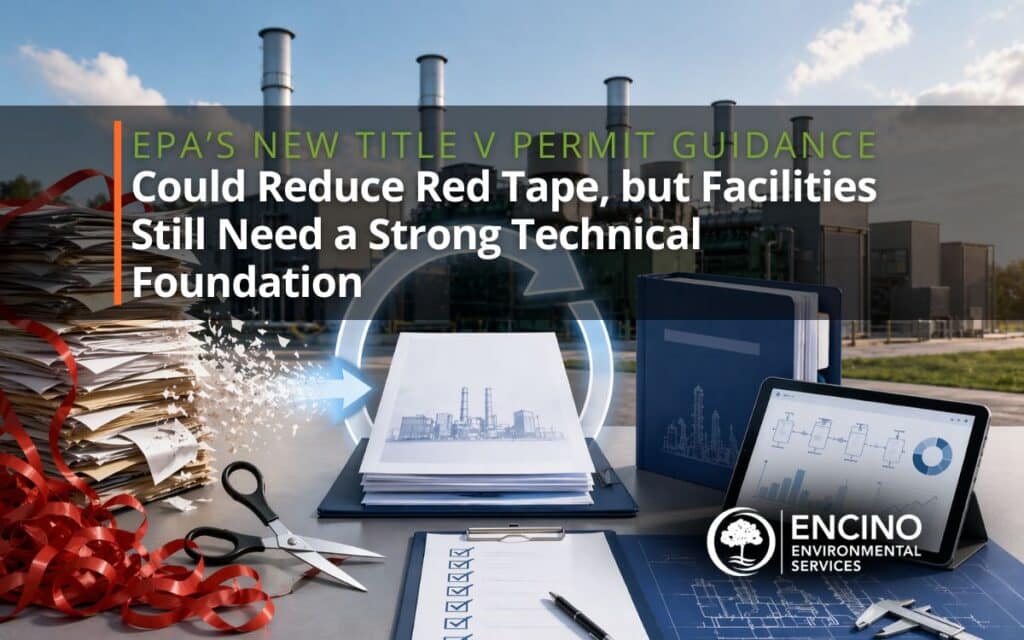
EPA has issued new guidance aimed at streamlining Clean Air Act Title V operating permit renewals when permit terms and underlying applicable requirements have not changed. For facilities with truly unchanged permits, that could mean a more efficient renewal process and less time spent recreating information that permitting authorities already have.
This is a practical reminder that permitting efficiency still depends on the strength of the underlying technical record. A streamlined renewal process can be helpful, but only when a facility has a clear understanding of what has changed, what has not, and what information is still needed to support a complete and defensible application. That is where strong permitting support, emissions expertise, and technical documentation continue to play an important role.
Key Takeaways
- EPA’s April 16, 2026 memorandum says permitting authorities may streamline Title V renewals when permit terms and underlying applicable requirements are unchanged.
- In those cases, applicants may be allowed to essentially resubmit a prior application with a current date and cross-reference or incorporate material from previous applications.
- EPA also says the Statement of Basis for a draft renewal permit can focus on what is new or different, rather than re-explaining every unchanged permit term.
- This is guidance, not a new rule, and permitting authorities still retain discretion to request supplemental information needed to evaluate completeness, determine applicability, and ensure compliance.
What EPA’s New Guidance Says About Unchanged Title V Renewals
EPA added a new memorandum, dated April 16, 2026, to its Title V Operating Permit Policy and Guidance Document Index titled Guidance on Streamlining Clean Air Act Title V Operating Permit Renewals. In it, EPA reaffirms its long-standing position that Title V renewals for unchanged permits do not need to become a full rebuild of the original application record. The memo is intended to help state, local, and Tribal permitting authorities focus time and resources where they are most needed.
The guidance states that when there are no changes to permit terms or underlying applicable requirements since the last permit application, permitting authorities may allow applicants to essentially resubmit the prior application with a current date. EPA also says applicants may be allowed to cross-reference or incorporate by reference material submitted in previous applications, provided those materials are available for public review.
EPA further clarifies that the Statement of Basis that accompanies a draft permit does not need to proactively explain the legal and technical basis for every unchanged permit term during a renewal. Instead, permitting authorities are encouraged to focus on explaining requirements that are new or different.
Where the Streamlined Approach Ends and Permit Authority Discretion Begins
This guidance could help reduce administrative burden for facilities renewing permits that are genuinely unchanged. Title V renewals still follow the same general procedural framework as initial permit issuance, including requirements for a complete application, public participation, and EPA review. Title V sources must also submit renewal applications at least six months before permit expiration.
But this is not a blanket shortcut, and it is not a substitute for technical rigor. EPA explicitly states that the memorandum is not a rule or regulation, does not change any legally binding requirement, and may not apply the same way in every situation. EPA also makes clear that permitting authorities still have the ability and discretion to request supplemental information necessary to evaluate completeness, determine applicability, and ensure compliance with other applicable requirements.
That distinction is significant for facilities planning upcoming renewals. A permit may look unchanged at a high level, while the underlying facts tell a more complicated story. Equipment changes, updated emissions calculations, revised monitoring practices, changes in throughput, modifications tied to NSR permitting, or evolving applicability questions can all affect whether a renewal is truly routine. In practice, the facilities best positioned to benefit from streamlined renewals are often the ones that have done the work to keep their compliance and technical records organized and current.
How Facilities Can Prepare for a More Efficient Renewal Process
For operators, environmental managers, and permitting teams, EPA’s message is straightforward: unchanged renewals should not get bogged down by unnecessary duplication. It is a welcome signal for facilities trying to manage workloads, reduce delays, and keep permitting resources focused on substantive changes rather than paperwork for paperwork’s sake.
At the same time, the guidance reinforces the value of knowing your permit record well. When a renewal package can rely more heavily on prior applications and supporting documents, it becomes even more important that those documents are accurate, organized, and still aligned with actual operations. Streamlining works best when the technical foundation underneath it is solid.
Bridging the Gap Between Permitting Strategy & Support
This is the kind of regulatory update that may sound administrative on the surface, but it has real implications for how facilities prepare for renewals and support permit defensibility. Encino helps clients bridge the gap between permitting strategy and the technical support needed behind it.
When a facility is preparing for Title V renewal, that can include reviewing what has changed since the last application, identifying where legacy information is still valid, and helping teams understand where updated emissions, testing, monitoring, or applicability support may still be needed. In many cases, the opportunity is not just to move a renewal forward more efficiently, but to do so with a stronger foundation and fewer surprises during agency review.
In other words, EPA’s new guidance may make some renewals more efficient, but it does not eliminate the need for a clear, technically sound record. Facilities that know their permit history, understand their current operations, and can support their renewal narrative with confidence will be in the best position to take advantage of that flexibility.
Final Perspective
EPA’s new memorandum is a useful clarification for the Title V community. It reinforces a common-sense principle: if a permit is truly unchanged, the renewal process should reflect that. It also highlights something just as important for industry. Simpler renewals still depend on strong technical support, sound documentation, and a clear understanding of the permit record behind them.
Sources
- EPA, Title V Operating Permit Policy and Guidance Document Index: https://www.epa.gov/title-v-operating-permits/title-v-operating-permit-policy-and-guidance-document-index
- EPA, Guidance on Streamlining Clean Air Act Title V Operating Permit Renewals (April 16, 2026): https://www.epa.gov/system/files/documents/2026-04/guidance-on-streamlining-clean-air-act-title-v-operating-permit-renewals.pdf
- eCFR, 40 CFR 70.5 Permit applications:https://www.ecfr.gov/current/title-40/chapter-I/subchapter-C/part-70/section-70.5
- eCFR, 40 CFR 70.7 Permit issuance, renewal, reopenings, and revisions: https://www.ecfr.gov/current/title-40/chapter-I/subchapter-C/part-70/section-70.7
- eCFR, 40 CFR 70.6 Permit content:https://www.ecfr.gov/current/title-40/chapter-I/subchapter-C/part-70/section-70.6