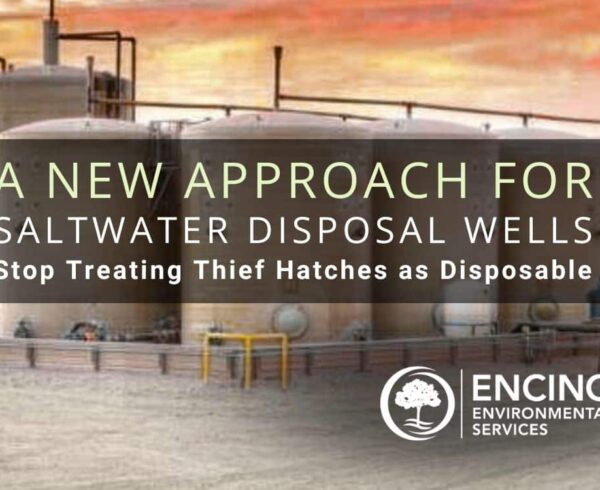
Access hatches, commonly known as “thief hatches,” are critical components of liquids storage tanks, but they are also at the center of updated regulations from the Environmental Protection Agency (EPA) designed to reduce methane and VOC emissions from oil and gas production facilities.
An oil thief, also known as an oil sampler, petroleum sampler, or slurry sampler, is a manual device used to sample crude oil for quality testing. Thief hatches are openings at the top of storage tanks that permit access so pumpers can drop an oil thief to take a physical sample for assessing basic sediment and water content (BW&W). Additionally, thief hatches are used when manually gauging fluid levels in tanks on oil runs, to calculate sales volumes.
Thief hatches also serve as pressure safety devices on the tank. When closed and latched, the spring-loaded seals protect against excessive pressure or vacuum. If excessive pressure builds up in the tank, the hinged hatch cover will break its seal and lift, allowing the pressure to escape to the atmosphere.
These small access points on storage vessels play a pivotal role in preventing fugitive emissions, making them a focal point for regulatory scrutiny and technological innovation.
Thief Hatch Vulnerabilities
Although necessary, thief hatches represent a particular vulnerability when it comes to fugitive emissions from tank batteries.
These are some of the more common reasons for emission events involving thief hatches:
- Accidentally left open after sampling or measuring liquid levels
- Improper seating
- Worn, aged hatches and seals
- Corrosion
- Warping or morphing from extreme temperature changes over time
Fugitive emissions, stemming from open or malfunctioning thief hatches, pose significant environmental and economic risks. As a result, the EPA has specific regulations on the use, design, and monitoring of thief hatches.
Ultimately, malfunctioning, aging, and open thief hatches are stealing from you by letting what is typically the most valuable gas stream on the wellsite escape the sales meter – tank vapor rich in valuable NGLs.
Relevant EPA Regulations
The EPA’s updated regulations in NSPS 60 OOOOb (quad-o) that went into effect in May 2024 impose stringent requirements for thief hatch design and performance, as well as how hatches are to be handled in well site inspections.
Here is a summary of some of them:
- Emissions Limits. (a) The performance standard for a single Storage Vessel or Tank Battery with Potential to Emit (PTE) of 6 tons per year (tpy) or more of VOC is a 95% reduction of both VOC and methane and (b) for a single Storage Vessel or Tank Battery has a Potential to Emit (PTE) of 20 tpy or more of methane, then the standard is a 95% reduction in methane. Note that these emission limits now apply to the combined emissions from tank batteries, not just individual tanks.
- Inspection Requirements. First, facilities must conduct initial screenings within 90 days of startup or modification. At small well sites with an uncontrolled storage vessel, a visual inspection of all thief hatches and other openings on the storage vessel that are fugitive emissions components must be conducted in conjunction with the monitoring survey to ensure that they are kept closed and sealed at all times except during times of adding or removing material, inspecting or sampling material, or during required maintenance operations. If evidence of a deviation from this requirement is found, you must take corrective action. 60.5397b(g)(1)(ii).LEARN MORE: Leak Detection and Repair (LDAR) ServicesLEARN MORE: Fugitive Emissions Monitoring Requirements
- Covers and Seals. On a storage vessel (tank), the cover and all openings on the cover (e.g., access hatches, sampling ports, pressure relief devices and gauge wells) shall form a continuous impermeable barrier over the entire surface area of the liquid in the storage vessel. 60.5411b(b)(1).
- Must Remain Closed. Each cover opening shall be secured in a closed, sealed position (e.g., covered by a gasketed lid or cap) whenever material is in the unit on which the cover is installed except during those times when it is necessary to use an opening to add material to, or remove material from the unit, inspect or sample the material in the unit, to inspect, maintain, repair, or replace equipment located inside the unit, or to vent liquids, gases, or fumes from the unit through a closed vent system to a closed vent system, control device or to a process. 60.5411b(b)(2).
- Design Requirements. Each storage vessel thief hatch shall be equipped, maintained and operated with a weighted mechanism or equivalent, to ensure that the lid remains properly seated and sealed under normal operating conditions, including such times when working, standing/breathing, and flash emissions may be generated. You must select gasket material for the hatch based on composition of the fluid in the storage vessel and weather conditions. 60.5411b(b)(3).
- You must design and operate the cover with no identifiable emissions. 60.5411b(b)(4).LEARN MORE: EmVision™ Quantitative Optical Gas Imaging Continuous Monitoring System
READ MORE: EPA’s Updates to 40 CFR Part 60 Subpart OOOOb
Risks of Tank Battery Emissions
Open or faulty thief hatches can be the source of several risk factors for operators, including:
- Fugitive emissions
- Potential Super-Emitter Events
- Higher operational costs for leak detection and repair (LDAR)
- Exposure to significant Waste Emissions Charge (WEC) fines
- Tarnished company reputation that can invite higher levels of scrutiny and regulatory penalties
The Solution – Enviromech™ Composite Thief Hatch
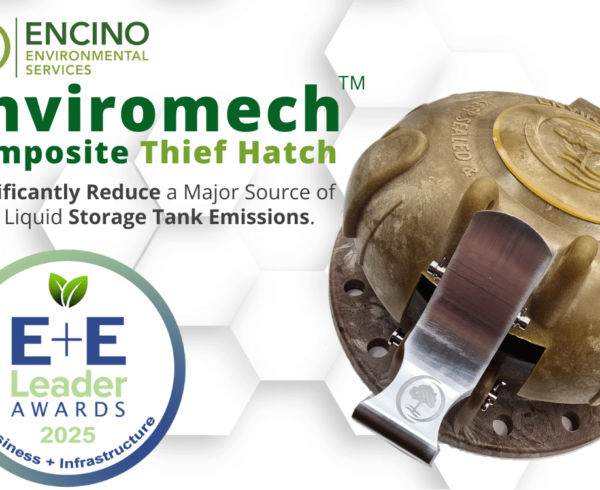
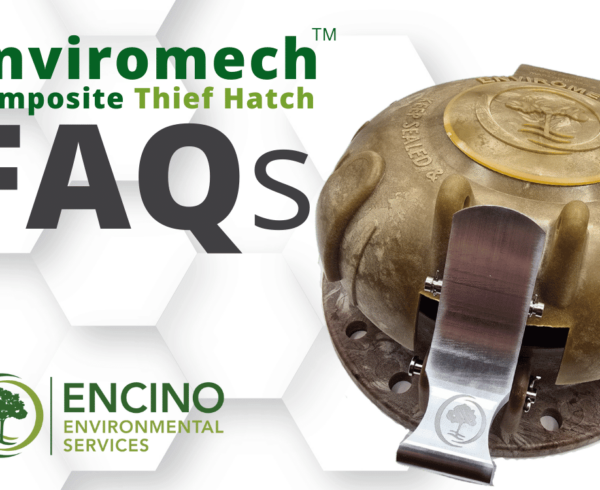
The Enviromech™ Composite Thief Hatch from Encino Environmental is a simple, low-cost solution for thief hatch emissions issues. Made from a proprietary composite material and manufactured in an 9100/ISO:9001 facility in the USA, the Enviromech composite thief hatch can significantly mitigate the risk of fugitive emissions from oil and condensate storage tanks, produced water storage tanks, and can be used for both new tanks and retrofitting existing ones.
Benefits:
- Substantially less prone to warping or morphing from temperature changes
- Highly corrosion resistant anti-static material
- Long-term mechanical integrity
- Simple, low-cost solution
- Ensures a complete seal
LEARN MORE: Enviromech™ Composite Thief Hatch
LEARN MORE: Emissions Monitoring Solutions from Encino Environmental
The Encino Advantage
Encino offers the most comprehensive lineup of environmental performance solutions, services, and expertise for mitigating emissions from Energy operations with a focus on Oil & Gas and Biogas markets. We are a pioneer in emissions monitoring in the Energy sector, providing clients with a complete range of environmental services to help companies comply with regulation requirements and voluntary sustainability objectives.
Our offerings include:
- CEMS (Continuous Emissions Monitoring Systems) via artificial intelligence (AI)-enabled Optical Gas Imaging (OGI)
- Satellite Monitoring for Methane and Visual applications via Satlantis micro satellites (EmSat™)
- Emissions performance testing for Engines, Combustors, and Industrial Stacks
- LDAR (Leak Detection and Repair)
- Composite Thief Hatches (Enviromech™) composite thief hatches for a durable, long-term seal of liquid storage tanks
- Advanced environmental data software
Our solutions help ensure regulatory compliance and ESG strategies and objectives. Encino operates across the U.S. covering all major oil and gas basins and select international markets.
We view ourselves as an oilfield services company, dedicated to helping operators improve their environmental and economic sustainability for providing the world with reliable and affordable energy.
The Enviromech Composite Thief Hatch can help you mitigate the risk of tank battery emissions resulting from faulty, malfunctioning, and aging thief hatches, and reduce operating costs.
Contact us today for a free consultation and evaluation of how Encino can help you achieve environmental performance that generates economic results.