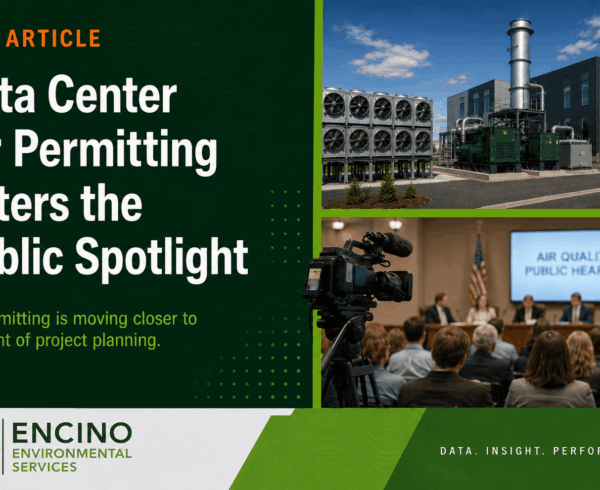
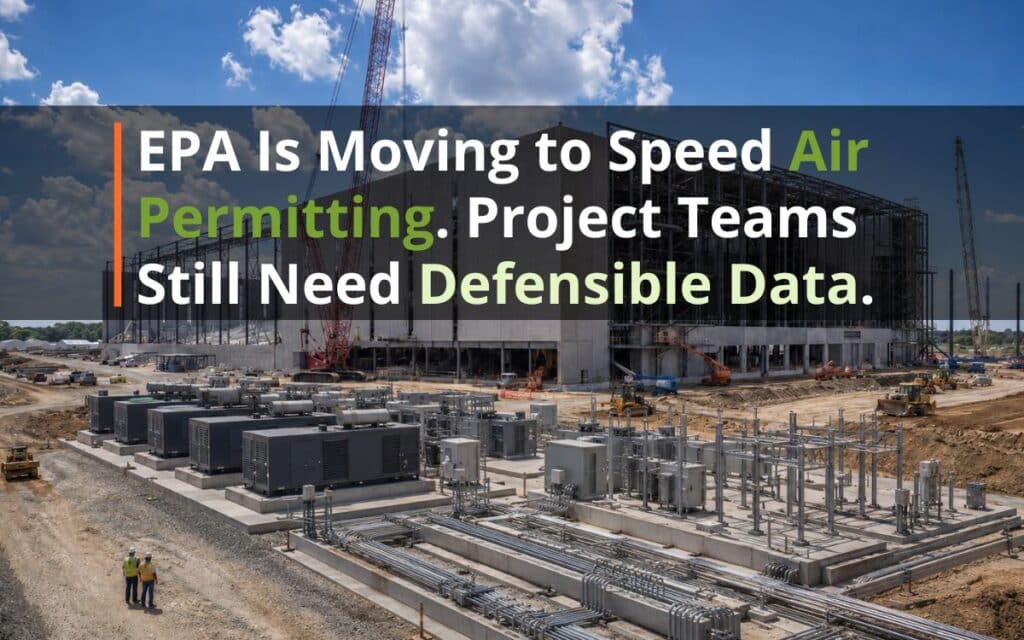
EPA recently issued two actions aimed at reducing air permitting delays: new Title V guidance and a proposed change to how “begin actual construction” is interpreted under New Source Review. These actions may help permitting authorities and project teams move faster, especially for data centers, power generation, manufacturing, and industrial expansions.
However, faster review does not reduce the need for accurate emissions calculations, complete permit applications, clear documentation, and a defensible compliance strategy. For projects involving data center air permitting or data center air quality permitting, emissions planning should happen early, before project schedules and construction decisions are locked in.
EPA’s latest permitting actions signal a faster review environment
EPA is continuing to focus on Clean Air Act permitting efficiency. On May 11, 2026, EPA issued guidance clarifying the agency’s review process for Clean Air Act Title V operating permits. According to EPA, the guidance is intended to streamline and expedite approvals by allowing state, local, and Tribal permitting authorities to conduct public comment periods at the same time as EPA’s review of proposed Title V permits in certain circumstances. EPA also stated that the Clean Air Act does not require the agency to use the full 45-day review period in every case.
That same day, EPA proposed a revision to the federal New Source Review program’s definition of “begin actual construction.” EPA said the proposal would clarify which construction activities may occur before a major NSR permit is obtained, specifically for non-emitting components or structures such as certain cement pads, wiring, piping, and support structures. EPA specifically connected the proposal to power generation, data centers, and manufacturing.
Together, these actions point to a broader permitting theme: EPA wants to reduce unnecessary delays while keeping the Clean Air Act permitting framework in place.
Faster air permitting still depends on strong support
The latest Title V guidance may help reduce review delays when a permitting authority does not expect major issues with a proposed permit. But Title V permits still consolidate applicable air pollution requirements for major industrial sources into a federally enforceable operating permit, and EPA notes that these permits typically must be renewed every five years.
If a permit record is incomplete, unclear, or difficult to support, a faster process will not solve the underlying issue. Facilities still need to understand applicable requirements, emissions limits, monitoring obligations, recordkeeping conditions, testing needs, and operational constraints.
The same is true for NSR. EPA’s proposed “begin actual construction” clarification is focused on non-emitting components or structures. It does not remove the need to evaluate the emissions-generating equipment that may trigger permitting requirements. EPA states that the NSR program requires certain stationary sources to obtain permits before beginning construction, and that the program applies to both new construction and modifications of existing sources.
For project teams, the practical message is clear: early site work may become easier in certain cases if the rule is finalized, but emissions planning still needs to be done carefully.
Data center air permitting should begin early in the project timeline
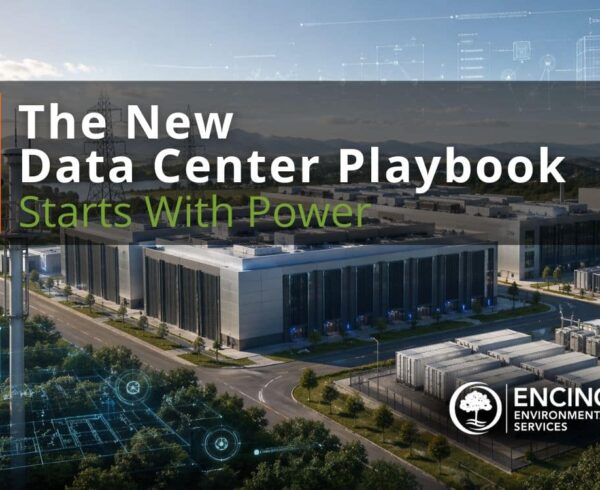
Data center projects involve backup generators, stationary engines, combustion turbines, or other on-site power assets. Those sources can raise questions tied to NSR, Title V, RICE NESHAP, NSPS requirements, potential-to-emit calculations, testing, and operational limits.
That is why data center air permitting and data center air quality permitting should not be treated as late-stage compliance tasks. Air permitting can affect:
- Site selection: Air permitting requirements can vary by state, local permitting authority, air quality designation, nearby receptors, and the project’s expected emissions profile. A site located in one jurisdiction may face different permitting thresholds, review timelines, public engagement considerations, or modeling requirements than a similar site located elsewhere. For data center developers, construction site selection should account for whether the location can support the planned generator layout, exhaust stack configuration, fuel storage, setbacks, and long-term power needs without creating avoidable permitting risk.
- Equipment selection: Equipment selection may include the type, size, number, fuel source, and emissions profile of backup generators, stationary engines, combustion turbines, boilers, heaters, or other combustion sources. It may also include emissions controls, stack configuration, engine rating, operating limits, and whether the project relies on diesel, natural gas, battery storage, utility-supplied power, or a hybrid approach. These decisions can affect potential-to-emit calculations, permit applicability, control requirements, testing obligations, and future operating restrictions.
- Construction timing: EPA’s NSR proposal directly names data centers as one of the project types that could benefit from clearer rules around non-emitting construction activities. If finalized, the proposal may provide more clarity around which non-emitting components or structures, such as certain pads, wiring, piping, or support structures, may be able to move forward before a major NSR permit is obtained. However, that does not remove the need to evaluate the emissions-generating equipment tied to the project. For project teams, air permitting can influence which parts of construction can begin, which parts may need to wait, and how construction sequencing should align with permitting milestones.
- Generator strategy: Generator strategy refers to the overall plan for how backup or on-site power generation will be sized, fueled, permitted, operated, limited, tested, and documented. Project teams may need to evaluate how many generators will be installed, whether they will be diesel or natural gas, how often they are expected to run, whether they are limited to emergency use, and how maintenance testing, commissioning, planned outages, or grid-support scenarios will be handled. These assumptions can influence emissions calculations, permit limits, runtime tracking, recordkeeping obligations, and long-term compliance.
- Testing plans: Testing plans should be reviewed before equipment decisions and construction schedules are locked in. Depending on the applicable permit and regulatory requirements, data center projects may need initial performance testing, stack testing, engine emissions testing, periodic testing, or ongoing monitoring and recordkeeping. Testing plans may also need to align with commissioning schedules, startup dates, operational limits, and any requirements under NSPS, RICE NESHAP, Title V, NSR, or state-specific permit conditions. The earlier these requirements are understood, the easier it is to avoid schedule conflicts and compliance gaps.
- Long-term operating flexibility: Long-term operating flexibility refers to the facility’s ability to operate, test, maintain, expand, and respond to power needs over time without exceeding permit limits or requiring avoidable permit revisions. Data centers may need flexibility to conduct maintenance testing, respond to emergency events, support commissioning, manage planned outages, address grid reliability issues, expand capacity, or add power assets in the future. If those needs are not considered during permitting, the facility may face restrictive runtime limits, additional permit modifications, or operational challenges after startup.
For data center developers, owners, and engineering teams, the question is not only whether a project can move faster. The better question is whether the project can move faster without creating avoidable air permitting risk.
EPA’s NSR proposal directly names data centers as one of the project types that could benefit from clearer rules around non-emitting construction activities. But the emissions-generating side of the project still needs a defensible basis.
For data center developers, owners, and engineering teams, the question is not only whether a project can move faster. The better question is whether the project can move faster without creating avoidable air permitting risk.
What project teams should review now
When permitting timelines tighten or construction schedules accelerate, project teams should review the assumptions behind the permit strategy.
That includes confirming the emissions profile of engines, turbines, heaters, boilers, or other combustion sources. It also includes reviewing potential-to-emit calculations, operating scenarios, fuel use assumptions, control requirements, testing needs, and recordkeeping obligations.
For Title V renewals or modifications, facilities should also confirm that permit terms still reflect current operations. If the permit does not match what is happening in the field, the renewal process can expose issues that should have been addressed earlier.
For new projects or expansions, teams should align permitting, engineering, operations, construction, and compliance early. The goal is to avoid treating air permitting as paperwork after major decisions have already been made.
Defensible data is still the foundation
EPA’s recent actions may support a faster permitting environment, but they do not reduce the need for credible emissions data. A defensible air permitting strategy depends on clear calculations, accurate source information, realistic operating assumptions, and documentation that can support agency review. It also depends on field testing and monitoring when required or when useful for confirming performance.
Encino helps clients connect permitting strategy with real operating conditions. That includes air permitting support, emissions testing, engine testing and stack testing, regulatory guidance, and documentation support for facilities navigating Title V, NSR, data center air permitting, and data center air quality permitting.
As permitting programs evolve, the strongest project teams will be the ones that combine speed with discipline. Moving faster is helpful. Moving faster with defensible data is better.
Sources
- EPA, EPA Issues Guidance on Streamlining Clean Air Act Title V Operating Permit Process to Expedite Approvals.
https://www.epa.gov/newsreleases/epa-issues-guidance-streamlining-clean-air-act-title-v-operating-permit-process - EPA, “EPA Proposes Redefining ‘Begin Actual Construction’ to Remove Unnecessary Impediments to Building and Advance Economic Progress.”
https://www.epa.gov/newsreleases/epa-proposes-redefining-begin-actual-construction-remove-unnecessary-impediments - Reuters, “US EPA moves to speed clean air permits for power plants, industry.”
https://www.reuters.com/legal/litigation/us-epa-moves-speed-clean-air-permits-power-plants-industry-2026-05-11/ - EPA, “Compliance Requirements for Stationary Engines.” https://www.epa.gov/stationary-engines/compliance-requirements-stationary-engines