EPA recently finalized revisions to narrow technical portions of the 2024 oil and natural gas methane rule, commonly referred to as OOOOb and OOOOc. The revisions focus on temporary flaring and net heating value monitoring for certain flares and enclosed combustion devices.
EPA also issued guidance clarifying limited circumstances where associated gas flaring may continue after the May 7, 2026 phase-out deadline. These changes may give operators more flexibility, but they also reinforce the need for strong field documentation, reliable emissions data, and clear records that explain operating conditions, testing decisions, and compliance assumptions.
OOOOb and OOOOc are still moving
EPA’s methane rules for the oil and natural gas sector remain in motion.
On April 4, 2026, EPA finalized revisions to two narrow technical aspects of the 2024 Clean Air Act rule for oil and natural gas operations, commonly known as OOOOb and OOOOc. EPA stated that the 2024 rule established New Source Performance Standards for new, reconstructed, and modified sources, along with Emission Guidelines for states to develop plans for existing sources.
EPA described the April 2026 action as a technical reconsideration focused on temporary flaring provisions for associated gas in certain situations and requirements for continuous monitoring of the net heating value of vent gas from flares and enclosed combustion devices.
The agency has also stated that it is developing additional proposed amendments to address other issues raised by industry and stakeholders.
For operators, that means methane compliance planning is not standing still. Requirements may continue to change, but field data and documentation still need to be ready.
Flaring flexibility still requires documentation
One of the most important April 2026 changes involves temporary flaring.
EPA’s prepublication final rule describes changes that extend the baseline time limit for temporary flaring of associated gas in certain situations from 24 hours to 72 hours. The same document also describes allowances beyond 72 hours when exigent circumstances, such as extreme weather, prevent safe access to a well site to resolve an emergency or maintenance issue.
The rule also states that owners and operators must include records such as a written description of the exigent circumstance, steps taken to resolve the issue, the date and time it occurred, and the total duration of flaring.
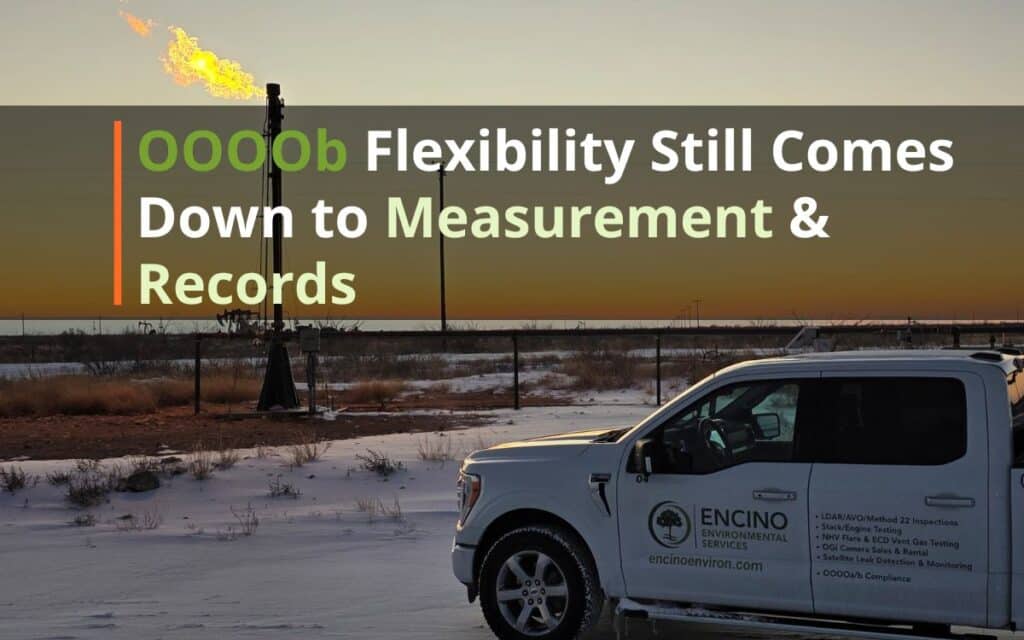
EPA also issued May 1, 2026 guidance clarifying that current federal regulations allow oil and natural gas producers to continue routine flaring of associated gas at new oil wells in limited circumstances after the May 7, 2026 phase-out deadline.
This is where operators need to be careful. Flexibility does not mean a lack of accountability.
If an operator relies on a temporary flaring provision or a limited flaring allowance, the record needs to explain what happened. That includes the cause, duration, operating conditions, response actions, and why the event qualified under the applicable provision.
In practice, that can turn flaring documentation into a field-readiness issue. Operators need people, systems, and processes that capture the right information while the event is still fresh.
NHV and ECD requirements should be reviewed carefully
The April 2026 revisions also address net heating value monitoring and alternative performance testing for flares and enclosed combustion devices. EPA’s final rule page states that the agency finalized discrete technical changes to the requirements for continuous monitoring of the net heating value of vent gas from flares and enclosed combustion devices, along with the alternative performance test option.
NHV helps indicate whether the gas being sent to a flare or enclosed combustion device has enough heating value to support proper combustion performance. When inert gases are introduced into the stream, they can dilute the vent gas and reduce its net heating value. That reduction can affect how operators evaluate control device operation, combustion performance, and compliance obligations.
Under the April 2026 revisions, EPA adjusted the NHV monitoring and testing provisions so that NHV sampling is not required for every flare or enclosed combustion device in the same way. However, NHV monitoring or an alternative performance test may still be required when inert gases are added or when other operating scenarios decrease the NHV content of the inlet gas to the flare or enclosed combustion device.
Examples may include acid gas removal system amine regenerator still column vent gas combined with affected facility vent gas, glycol dehydration unit reboiler vent gas combined without water removal, high-water-content vent streams from certain storage vessels, and enhanced oil recovery sites using water or carbon dioxide flooding.
Operators should also be careful when inerts are intermittent. If inert gases were not present during the initial NHV demonstration, introducing them later may trigger a re-evaluation. If sampling did not occur during the period with the highest expected percentage of inerts, increasing the percentage of inerts later may also trigger a re-evaluation.
That makes NHV planning a site-specific exercise. Operators should review which flares and enclosed combustion devices may still require continuous monitoring, grab sampling, an alternative performance test, or supporting documentation. They should also confirm whether gas composition, process changes, intermittent inert gas introduction, water content, assist air, or operating conditions affect the testing or monitoring approach.
Texas operators should also watch TCEQ guidance
For Texas operators, federal methane requirements should also be viewed alongside TCEQ implementation guidance.
TCEQ posted NSPS OOOO-series implementation guidance on April 10, 2026. The guidance document is listed by TCEQ as the “NSPS OOOO-series-implementation-guidance-memo.”
That makes state-level interpretation and implementation another important part of operator planning.
Facilities should avoid looking at OOOOb, OOOOc, LDAR, flaring, NHV, and control device obligations in isolation. Federal requirements, state implementation, permit conditions, and site-specific operations need to be reviewed together.
This is especially important for operators with assets across multiple basins or states. A requirement that looks straightforward at the rule level can become more complex when applied across different facilities, permits, equipment types, and operating conditions.
Measurement readiness is the safer strategy
The current regulatory environment can make it tempting to wait. A shifting rule does not reduce the need for reliable emissions data. In many cases, it increases the need for organized records because operators may need to explain why a requirement applied, why an allowance was used, or why a particular testing or monitoring approach was selected.
Measurement readiness gives operators a better position. It supports LDAR programs, OGI and QOGI surveys, NHV testing, ECD performance reviews, emissions testing, and field documentation. It also helps connect what happened in the field to what gets reported, reviewed, or discussed with regulators.
For operators, the best question may be simple:
If someone asked for supporting records on a flaring event, LDAR finding, NHV determination, or control device performance issue, could the team find the data and explain it clearly?
If the answer is uncertain, now is the right time to close the gap.
How Encino supports operators
Encino helps oil and gas operators build stronger measurement and documentation programs through LDAR support, OGI and QOGI surveys, NHV testing, enclosed combustion device (ECD) performance testing, engine and stack emissions testing, satellite methane monitoring, and regulatory guidance.
EPA may continue to adjust portions of OOOOb and OOOOc, but the need for credible field data is not going away.
More flexibility can be useful. Better documentation makes that flexibility defensible.
Sources
- EPA, “2026 Final Rule to Reduce Burden on the Oil and Natural Gas Industry.” https://www.epa.gov/controlling-air-pollution-oil-and-natural-gas-operations/2026-final-rule-reduce-burden-oil-and
- EPA, “Actions and Notices about Oil and Natural Gas Air Pollution Standards.” https://www.epa.gov/controlling-air-pollution-oil-and-natural-gas-operations/actions-and-notices-about-oil-and-0
- EPA prepublication final rule, “Final Rule: Reconsideration of Standards of Performance for New, Reconstructed, and Modified Sources and Emissions Guidelines for Existing Sources: Oil and Natural Gas Sector Climate Review.” https://www.epa.gov/system/files/documents/2026-04/san-12031_final-rule_nsps-eg-oooobcrecon1_preamble.pdf
- EPA, “EPA Clarifies When Oil and Natural Gas Producers Can Flare After Phase Out Deadline.” https://www.epa.gov/newsreleases/epa-clarifies-when-oil-and-natural-gas-producers-can-flare-after-phase-out-deadline
- TCEQ, “NSPS OOOO-Series Implementation Guidance Memo.” https://www.tceq.texas.gov/downloads/permitting/air/memos/nsps-oooo-series-implementation-guidance-memo.pdf/view
- Alliance Technical Group, “EPA Finalizes Revisions to OOOOb/c: What the Latest Changes Mean for Oil and Gas Operators.” https://www.alliancetg.com/post/epa-finalizes-revisions-to-oooob-c-what-the-latest-changes-mean-for-oil-and-gas-operators