 What You Need to know.
Forecasters are upping their estimates of electricity demand, acknowledging the impact of several trends. In May 2025, the U.S. Energy Information Administration (EIA) reported it forecasts U.S. annual electricity consumption to increase in 2025 and 2026, surpassing the all-time high reached in 2024. This growth contrasts with the trend of relatively flat electricity demand between the mid-2000s and early 2020s.
The International Energy Agency (IEA) also reported it expects U.S. electricity demand to grow at an average annual rate of about 2% over the period 2025-2027. The more recent forecast represents an upward revision of their January 2024 forecast that projected 1% growth for the 2025-2026 period. IEA now forecasts U.S. electricity demand in 2026 to be approximately 100 Terawatts (TWh) higher than in their previous forecast a year ago.
Several factors are driving the forecasted increase in electricity, including the expectation of strong demand growth in data centers, greater electrification of transportation and heating, an improved economic growth outlook, and greater demand from the industrial sector as American manufacturing ramps up.
A key issue is where is all the new generation capacity going to come from and will it be able to meet industry demand fast enough?
READ MORE: After more than a decade of little change, U.S. electricity consumption is rising again (EIA)
READ MORE: Entering the Age of Electricity (IEA)
Microgrids: The Engine of Energy Resilience
Microgrids are taking the center stage as demand grows for resilient, low-emission energy. These self-contained power systems—capable of running independently or in coordination with the main electrical grid—are gaining momentum in commercial, industrial, and utility sectors. Why? They reduce reliance on centralized power, boost reliability, and support sustainability goals, even amid complex permitting and regulatory hurdles.
The growth of microgrids has been spurred by several converging factors:
- Grid instability and extreme weather events that have exposed the vulnerabilities of centralized power systems.
- Corporate ESG (Environmental, Social, and Governance) mandates pushing for lower carbon emissions and greater energy transparency.
- Cost reductions in distributed generation and storage technologies, making microgrid deployment more financially viable.
Microgrid Applications in Key Industries
Once thought of as backup power solutions, microgrids are increasingly becoming the primary source of power for many organizations seeking clean and reliable power on demand.
- Oil and Gas. Oilfield electrification is a dominant trend among oil and gas operators for powering production facilities, including gas lift, electric submersible pumps, pump jacks, and other electrically powered equipment. As operators push outside of the defined fairways of asset plays into more remote locations unserved by utilities, they often face long wait times.
In fact, HART Energy reported in November 2024 that operators in the Permian Basin faced a two-year wait for a connection to an electrical grid, according to a 2022 report from the Texas Public Utilities Commission.
- Data Centers. Data centers have been around for decades, but recent innovations in artificial intelligence (AI) have accelerated expectations of electricity demand. As we noted in our previous article Data Center Emissions Monitoring, Goldman Sachs estimates a ChatGPT query needs nearly 10 times as much electricity to process as a Google search. As mentioned above, both the U.S. EIA and the IEA acknowledge data center power demand to be a primary driver in rising power consumption.
READ MORE: Data centers are building their own gas power plants in Texas
- Commercial and Industrial Facilities. Large-scale manufacturing plants, healthcare facilities, and commercial buildings (i.e., office and apartments) deploy microgrids to ensure uptime during outages and reduce peak demand charges. Many incorporate combined heat and power (CHP) systems to maximize fuel efficiency by capturing and using waste heat.
- Military and Government Installations. Defense operations rely heavily on energy security. Microgrids support mission-critical resilience by ensuring continued operation even during prolonged grid failures. Many military bases use microgrids powered by a mix of renewables and natural gas gensets.
- Remote and Islanded Communities. In off-grid or remote locations, microgrids provide essential electrification solutions. Hybrid systems combining solar, wind, and diesel/natural gas generators are common, reducing reliance on costly fuel imports.
- Utilities and Campuses. Utilities use microgrids to manage demand and stabilize the grid during peak periods, while college and corporate campuses deploy them to optimize internal energy usage and promote sustainability.
Gensets and Power Sources in Microgrids
Primary Power Systems
Kent Draper, Chief Commercial Officer at Australian data center developer IREN with projects in West Texas told the Texas Tribune in June 2025, “There is such a shortage of data center capacity and power. Even the large hyperscalers are willing to turn a blind eye to their renewable goals for some period of time in order to get access.”
While renewable energy and battery storage are increasingly part of the microgrid equation, traditional generation sets (gensets) continue to play a crucial role in ensuring reliability and dispatchability. These include:
- Stationary Reciprocating Engines. Widely used in microgrid applications, these engines are often powered by diesel or natural gas. Natural gas engines are favored for their lower emissions profile and are well-suited for urban environments with tighter air quality restrictions.
- Natural Gas Turbine Generators. Ideal for continuous or high-load applications, gas turbines provide stable power with relatively low emissions. They are commonly integrated into CHP systems to maximize efficiency.
- Diesel Generators. Diesel gensets are valued for their durability and fast start-up capabilities, making them ideal for backup and emergency power. However, they are subject to more stringent emissions regulations and often require diesel particulate filters or other post-combustion controls.
- Backup Power Systems / Emergency Power Supply Systems (EPSS). Stationary reciprocating engines are a popular choice for Emergency Power Supply Systems (EPSS) due to their low cost, reliability, and fast startup. Most run on diesel, which triggers stricter air quality and emissions regulations, including limitations on how often they can be run (typically not more than 100 hours annually outside of declared emergencies).
Microgrid Air Permitting Factors
Sorting out regulatory compliance requirements for any single microgrid can be a complex endeavor, dependent on a combination of factors related to the (a) equipment used, (b) emissions generated, and (c) local, state, and federal regulations. Here are the key factors:
Type of Generators Used
- Fuel Type: Natural gas, diesel, biogas, or propane have different emission profiles and regulatory thresholds.
- Technology Type: Reciprocating internal combustion engines (RICE) vs. combustion turbines vs. fuel cells.
- Manufacturer Certification: EPA-certified engines vs. non-certified units affect permitting complexity.
Size and Capacity of Equipment
- Horsepower (HP) or megawatt (MW) ratings: Larger generators typically face stricter requirements.
- Aggregate Capacity of all sources used in the microgrid is often a factor for various thresholds.
Emission Rates and Pollutants
- Key pollutants that are regulated include NOx, CO, PM10/PM5, SO2, VOCs, and Greenhouse Gases (GHGs) (CO₂, CH₄, N₂O).
- The Potential to Emit (PTE) of a microgrid is determined by factoring in the types of pollutants emitted by the regulated equipment on site and their estimated maximum emission rates.
- Permit requirements often hinge on whether emissions exceed major source thresholds (e.g., 10/25 tons per year for hazardous air pollutants under U.S. Title V permit designation).
- Emission controls such as selective catalytic reduction (SCRs) catalysts, oxidation catalysts, or ultra-low NOx burners may reduce permitting burdens.
Operating Hours and Duty Cycle
- Primary power or backup-only use? Emergency standby generators used less than 100 hours per year typically qualify for less stringent rules and may even be exempt in some cases.
- Load and fuel profile affects emissions totals and applicability of permitting thresholds.
Location and Attainment Status
- Air Quality Control Region (AQCR) status: Is the site in a non-attainment area for ozone or for Particulate Matter?
- Proximity to sensitive receptors: Schools, hospitals, residential areas, or Class I protected areas can trigger stricter review (e.g., within 3,000 feet from sources).
Regulatory Jurisdiction
- Federal and State environmental agencies, and sometimes local air quality districts each have different permitting thresholds and requirements.
- States like California (via AQMDs) or Texas (TCEQ) have their own regulations often more stringent than federal ones.
Cumulative and Facility-Wide Impacts
- Is the microgrid part of a larger industrial facility? The permitting agency may require analysis of total facility emissions.
Microgrid developers and operators can benefit from seeking expert advisory on air permitting, because the regulatory requirements for microgrids are complex and non-compliance can lead to expensive and embarrassing mistakes.
For example, in May 2025, Elon Musk’s xAI had to remove a significant number of natural gas turbines from a microgrid intended to power its Memphis data center after being reported for operating the turbines without the proper permits. A statement from the issued by the Memphis Chamber of Commerce said, “The temporary natural gas turbines that were being used to power the phase one GPUs prior to grid connection are now being demobilized and will be removed from the site over the next two months.”
READ MORE: xAI removes some of controversial gas turbines from Memphis data center
Encino Advisory Solutions
Encino helps clients get the most out of their investment in environmental performance solutions while meeting their compliance obligations. No matter what technology you are using, we can help you get the most out of it.
- Microgrids using stationary reciprocating or natural gas powered gensets will require air permitting and ongoing emissions compliance. We have the expertise to help you develop a strategy for successful permitting and compliance obligations.
- Permitting and Regulatory Advisory. Experienced advisory for emissions reduction strategy including tools and resources for preparing compliance assessments and permits.
- Data Services and Management. Data services to synthesize multiple data sources into a comprehensive view of your emissions profile from the ground up to space and establish one source of truth for emissions data.
- ESG and GHG Reporting. Reporting for ESG and Compliance needs based on comprehensive, reliable, and verifiable data.
READ MORE: Encino Environmental Advisory Services

Emissions Performance Engine and Stack Testing
If your data center uses reciprocating engines in an Emergency Power Supply Systems (EPSS), then you may be subject to emissions testing and compliance regulations.
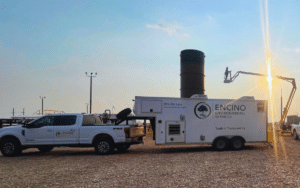
Encino operates advanced mobile emissions performance engine testing laboratories that are compliant with US EPA testing protocols to measure criteria pollutants and speciated GHG compounds, including methane and carbon dioxide (CO2). Our proprietary systems, managed by highly skilled Encino technicians, deliver near real-time data, expediting diagnosis and enabling the implementation of performance optimization strategies.
- Reliable and comprehensive engine testing.
- Electronic Reporting into EPA’s CEDRI.
- Measure and understand the emissions profile of key assets and infrastructure.
- Can be combined with and to expand measurement coverage.
- Near real-time data for quick diagnosis and performance optimization.
READ MORE: Emissions Source Testing Across the Energy Value Chain
READ MORE: CEDRI Reporting FAQ
Conclusion
Microgrids offer a compelling solution for organizations seeking energy security and emissions reductions. By combining reliable genset technology with renewables and smart controls, and by addressing air and environmental permitting requirements from the outset, companies can ensure that their microgrid investments are resilient, compliant, and aligned with broader sustainability goals.
Contact us for a free consultation and evaluation of how Encino can help you ensure a successful microgrid project from start to finish.