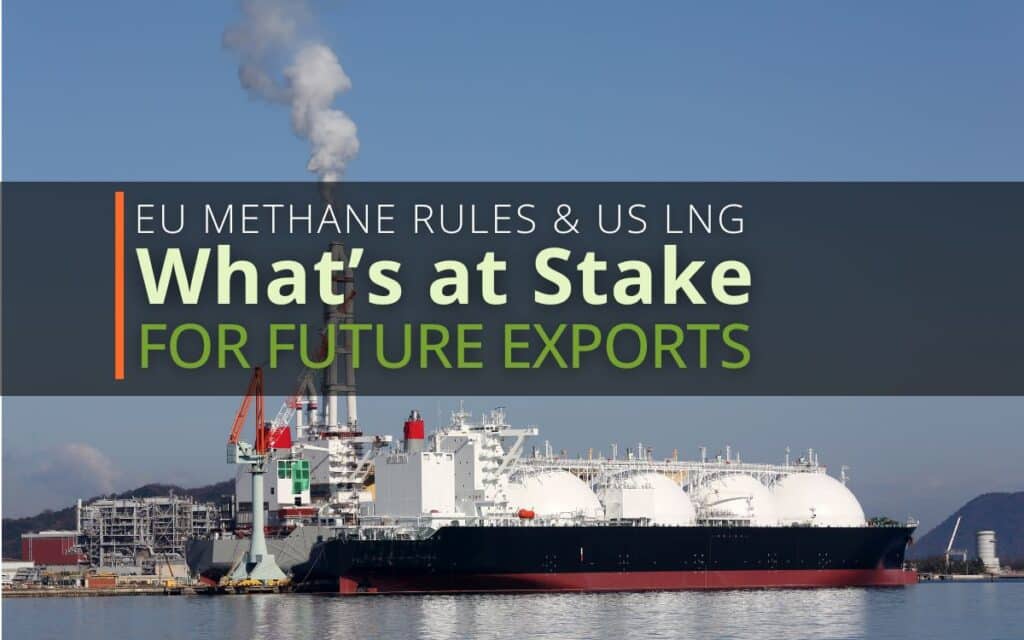
What’s at Stake for Future Exports
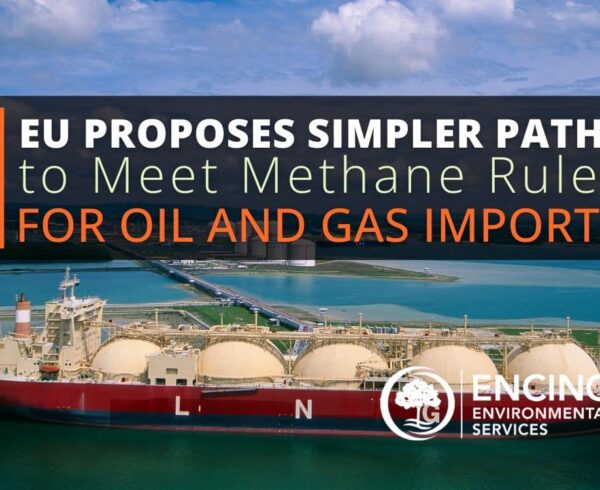
S&P Global’s Path to Net Zero article by Corey Paul and Matt Hoisch (Sept. 30, 2025) explains how Europe’s new methane rules for imported fuels are creating fresh uncertainty for US LNG exporters. Beginning Jan. 1, 2027, the EU will require LNG importers to prove that their gas meets monitoring, reporting and verification standards equivalent to those applied to EU producers; however, many of the detailed reporting requirements are still undefined. This is especially challenging for US suppliers because LNG terminals draw from a vast, co-mingled pipeline network, which makes it difficult to trace emissions back to specific producers. Even companies that already follow high measurement-based standards say they cannot be sure they will qualify under the current design of the EU rules; as a result, some European buyers are slowing contract negotiations while they try to understand future compliance risks.
At the same time, US policy is moving in a different direction; recent efforts to scale back federal greenhouse gas reporting could force companies that want to serve Europe to build their own measurement and verification systems or rely more heavily on third-party auditors, which adds cost and complexity. Despite this tension, both sides have a strong interest in keeping US LNG flowing to Europe; EU officials have signaled they want to “remove irritants” as they finalize the rules, and researchers and policy groups are working on new protocols and frameworks to make emissions data more transparent and comparable across borders. How the EU ultimately implements its methane regulation, and how the US chooses to handle emissions reporting at home, will shape the future of LNG trade between these two key partners.
Read the full S&P Global article by Corey Paul and Matt Hoisch here (subscription may be required):
https://www.spglobal.com/energy/en/news-research/latest-news/lng/093025-path-to-net-zeroeu-methane-law-us-emissions-stance-challenge-lng-sector
Encino Environmental Services helps LNG operators navigate this evolving landscape by pairing field-proven emissions testing with advanced methane detection and monitoring technologies. Our teams support facilities across the LNG value chain with engine and stack testing, LDAR programs, continuous and mobile emissions monitoring, satellite-enhanced methane detection and flare performance monitoring, all supported by advisory services for permitting, regulatory reporting and OGMP 2.0 aligned methane reporting. The goal is simple; provide auditable, regulator-ready data that helps LNG facilities reduce emissions, protect uptime and maintain access to increasingly demanding global markets.
Contact our team of experts to learn how Encino can help your LNG facility navigate this evolving landscape.