What it Means for Operators
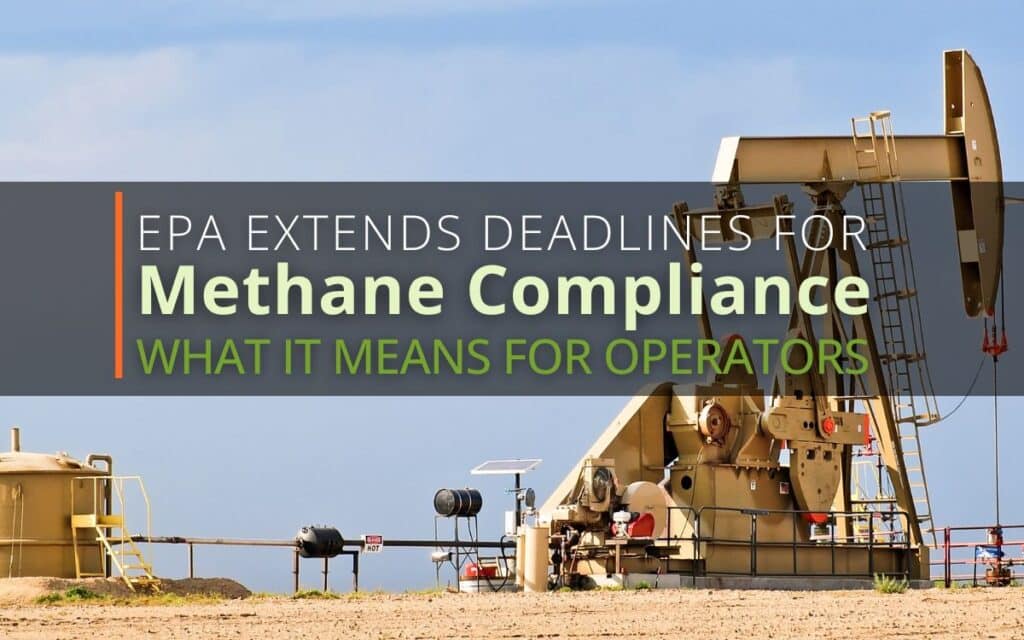
The U.S. Environmental Protection Agency (EPA) has recently finalized a rule that gives oil and gas operators more time to comply with federal methane standards first adopted in 2024. The new rule extends several key deadlines by roughly 12 to 18 months, including requirements to replace leaky equipment and perform routine monitoring for methane and volatile organic compound (VOC) emissions.
EPA projects that the extensions will affect hundreds of thousands of oil and gas sources across the country and reduce compliance costs by about $750 million over the next decade, according to reporting in World Oil on November 27th, 2025. Supporters say the change provides more realistic timelines in light of supply chain constraints and staffing challenges. Critics, including environmental groups, argue that the delay will result in avoidable methane releases and increased health risks for communities near production.
Methane remains a focal point in this discussion for a reason. It is a potent greenhouse gas that warms the atmosphere far more than carbon dioxide over a 20-year period, and oil and gas operations are one of the largest industrial sources in the United States.
What exactly did EPA change?
The November 26, 2025 final rule builds on an interim final rule EPA issued on July 28, 2025 (effective July 31, 2025), which first extended several deadlines in the 2024 New Source Performance Standards (NSPS OOOOb) and Emissions Guidelines (EG OOOOc) for existing sources. Together, these actions move many of the original 2025 and 2026 compliance dates out to 2027.
Key elements include:
- Extended equipment-level deadlines: For requirements related to control devices such as flares and enclosed combustion devices, equipment leaks from components like valves and connectors, storage vessels, process controllers, and covers or closed vent systems, EPA kept in place the 18-month extensions adopted in the July 2025 interim final rule. In practice, this means that many of these obligations now have a common compliance date of January 22, 2027, instead of the earlier 2025 or 2026 timelines in the 2024 rule.
- More time for state plans under OOOOc: Under the 2024 rule, states were originally required to submit plans for existing sources by March 9, 2026. The new rule moves that deadline to January 22, 2027, giving state agencies nearly an additional year to finalize and submit their OOOOc plans.
- More time for OOOOb reporting: For NSPS OOOOb annual reports that would have been due before the new deadline, the final rule provides an additional 360 days from the effective date of the November 2025 action to submit those reports. After that, annual reports are due no later than 90 days after the end of each annual compliance period.
- Extension of earlier interim actions: The July 2025 interim final rule had already extended the net heating value (NHV) continuous monitoring and alternative performance test requirements for flares and enclosed combustion devices to November 28, 2025. The November 2025 final rule adds another 180 days to that deadline, pushing NHV compliance into late May 2026 for affected sources.
In short, the rule changes when certain requirements apply, not whether they apply.
What did not change?
The core structure of the federal methane program that was finalized in 2024 remains in place. Operators should assume the following requirements still stand or are scheduled to be implemented:
- Regular leak detection and repair (LDAR) using approved technologies and defined survey frequencies.
- Upgrades or replacements for high-bleed or malfunctioning pneumatic equipment.
- Emission controls for tanks, compressors and associated equipment.
- Limits on routine flaring and stronger expectations around flare performance.
- The Methane Super Emitter Program, which uses advanced detection technologies and third-party data to identify large emission events and trigger corrective actions.
The compliance clock is slower, but it did not stop. Companies that treat this as a strategic planning window, rather than a chance to pause, will be better positioned as enforcement and public scrutiny continue to evolve.
Industry and public health perspectives
Industry groups have welcomed the additional time, citing concerns about equipment availability, contractor capacity and the complexity of implementing new monitoring programs across large asset portfolios.
Environmental organizations and many public health advocates see the delay very differently. They argue that weakening or postponing methane controls will increase emissions and exposure to VOCs like benzene, a known carcinogen, particularly in communities close to production and processing sites.
Your stakeholders are hearing both narratives: one focused on flexibility and cost, the other on climate and health risk. Operators that communicate clearly about their environmental strategy will be better prepared for questions from investors, regulators and the communities where they operate.
Encino’s perspective: use the time to get ahead, not to slow down
Encino Environmental Services works with operators across the U.S. to design and execute emissions monitoring programs that can flex with changing regulatory expectations. Extensions like this may relieve some short-term pressure, but they do not change the direction of travel. The industry is moving toward more transparent, data-driven environmental performance.
From our vantage point, this rule creates an opportunity to:
- Rationalize monitoring across assets by using the extra time to standardize LDAR routes, integrate optical gas imaging (OGI), satellite and continuous monitoring data, and close gaps between field practice and written programs.
- Invest in the right technologies, not just the minimum, by evaluating where advanced tools such as continuous emissions monitoring systems (CEMS), satellite-enabled screening or higher-performance control devices can reduce both emissions and product loss.
- Align compliance with operational value by designing programs that reduce re-work and callouts, improve reliability and protect throughput, instead of treating compliance as a separate, purely regulatory exercise.
- Clarify roles between operations, environmental and leadership so companies can refine who is accountable for equipment upgrades, surveys, data review, reporting and response to super-emitter notifications.
A message from our CEO
“Regulatory timelines may change, but the expectations around environmental compliance and performance are only moving in one direction globally. Our role is to help operators turn that reality into a workable plan. Our commitment is simple: stay ahead of the requirements, protect our clients’ operations and support the industry in demonstrating that responsible production and strong environmental performance can go hand in hand.”
Scott McCurdy
CEO, Encino Environmental Services, LLC
Practical questions to consider now
As your teams digest this latest rulemaking, it may be useful to ask:
- Have we mapped the new deadlines to each asset or facility type covered by OOOOb and OOOOc for NHV testing and LDAR?
- Which compliance elements are on the critical path for equipment procurement, contractor availability or data system upgrades?
- Are our current monitoring and testing vendors prepared for the extended timeline and any upcoming method or technology changes?
- Where can improved measurement help recover product and reduce flaring or venting, not just check a compliance box?
- Do we have a communication plan for investors, partners and nearby communities on how we are responding to these changes?
Encino is already working with clients to update compliance roadmaps in light of the new EPA timelines and to align testing, monitoring and reporting programs with both regulatory requirements and business objectives.
Key EPA resources
- EPA final rule extending compliance deadlines for oil and gas methane standards: https://www.epa.gov/newsreleases/epa-issues-final-rule-extend-unrealistic-biden-era-compliance-deadlines-oil-and-gas-industry-saves-hundreds-millions-costs
- 2025 Interim Final Rule to extend compliance deadlines for OOOOb/OOOOc: https://www.epa.gov/controlling-air-pollution-oil-and-natural-gas-operations/2025-interim-final-rule-extend-compliance
- EPA’s 2024 final methane rule for oil and natural gas operations: https://www.epa.gov/controlling-air-pollution-oil-and-natural-gas-operations/epas-final-rule-oil-and-natural-gas
- Actions and notices about oil and natural gas air pollution standards: https://www.epa.gov/controlling-air-pollution-oil-and-natural-gas-operations/actions-and-notices-about-oil-and-0
Related Articles
- World Oil – Oil and gas firms get more time under EPA’s revised methane rule: https://www.worldoil.com/news/2025/11/27/oil-and-gas-firms-get-more-time-under-epa-s-revised-methane-rule/