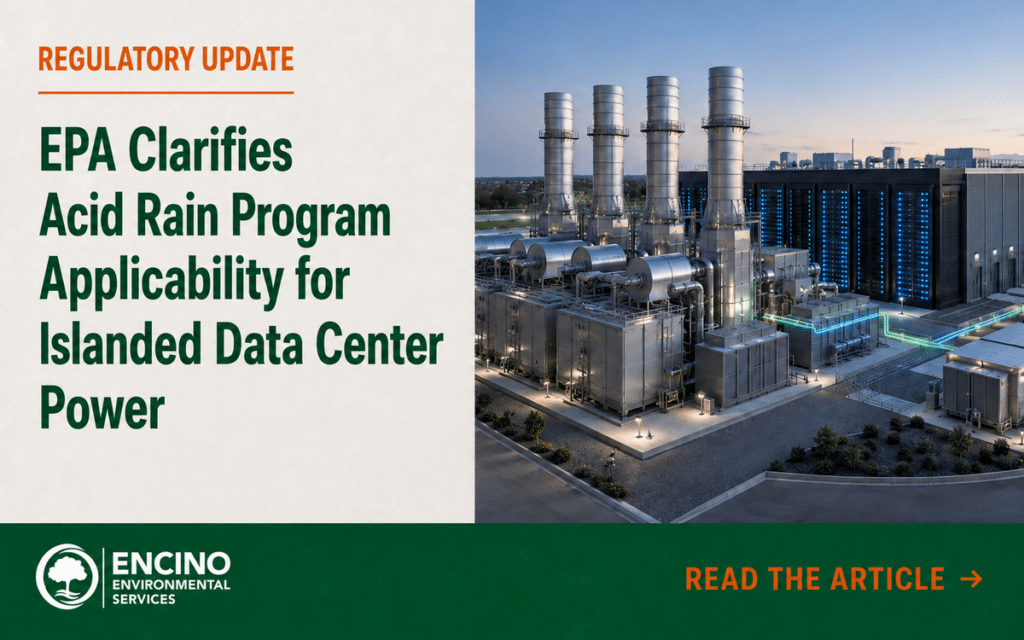
The U.S. Environmental Protection Agency has clarified how the federal Acid Rain Program may apply to fully islanded power generation facilities, including facilities developed to serve data centers. The July 16, 2026, memorandum provides useful direction for projects that plan to generate electricity exclusively for a private customer without any physical connection to the larger electrical grid.
Key Takeaways:
- EPA believes the Acid Rain Program does not apply to power generation facilities that have no physical connection to the larger electrical grid and generate electricity exclusively for a private consumer.
- The memorandum discusses a planned, approximately 500-megawatt natural gas-fired facility using combustion turbines and reciprocating engines to serve an adjacent, third-party-owned data center.
- A facility that connects to the grid in the future may become subject to Acid Rain Program requirements.
- The memorandum is general guidance. It does not determine applicability for a specific project and is not final agency action.
- Other Clean Air Act programs, state regulations and air permitting requirements continue to apply independently.
- Project teams should evaluate electrical architecture, equipment selection and air permitting strategy together during the earliest stages of development.
EPA’s position is relatively straightforward: a power generation facility that is completely disconnected from the grid and supplies electricity exclusively to a private consumer generally falls outside the scope of the Acid Rain Program. The agency also makes clear that this conclusion is narrow, fact-specific and limited to one federal program. Data center developers and power providers still need to evaluate the full range of federal, state and local air permitting requirements that may apply to their projects.
What EPA Clarified
EPA issued the memorandum after receiving questions from companies and states about Acid Rain Program applicability for “islanded” power generation facilities. In this context, an islanded facility has no physical connection to the utility grid.
One example presented to EPA involved a planned power generation facility with approximately 500 megawatts of simple-cycle natural gas-fired combustion turbines and reciprocating engines. The facility would supply electricity exclusively to an adjacent data center owned by a third party. Even though electricity would be sold from one entity to another, the generating facility would remain physically disconnected from the larger grid.
EPA concluded that the Acid Rain Program generally does not apply under those circumstances. The conclusion could resolve an important question for certain data center developments that are considering dedicated onsite or adjacent generation to meet large, continuous power demands.
That conclusion should be read carefully. EPA’s interpretation is tied to the absence of any grid connection and the exclusive use of the electricity by a private consumer. A project with backup access to the grid, the ability to export electricity or a planned future interconnection may require a different analysis.
Why a 1990 Reporting Form Is Central to EPA’s Interpretation
The Acid Rain Program was established under Title IV of the 1990 Clean Air Act Amendments to reduce sulfur dioxide and nitrogen oxide emissions from the power sector. Under the federal regulations, the program generally applies to certain fossil fuel-fired combustion devices owned or operated by a utility and serving a generator that produces electricity for sale.
The regulatory definitions create an important connection to an older federal reporting form. Under 40 CFR 72.2, a “utility” is any person that sells electricity. A “generator” is defined by reference to equipment that was or would have been required to be reported as a generating unit on the 1990 edition of U.S. Department of Energy Form 860.
The 1990 Form 860 instructions applied to electric utilities that operated, or planned to operate, power plants in the United States. For purposes of that form, an electric utility was an entity that owned or operated facilities used to generate, transmit, distribute or sell electricity primarily for use by the public.
EPA interprets the public-use language in the 1990 form as requiring a connection to the electrical grid. Based on that interpretation, equipment generating electricity exclusively for a private consumer at a facility with no grid connection would not have fallen within the reporting scope of the form. EPA therefore believes that the equipment would not meet the Acid Rain Program definition of a generator.
This reasoning is significant because the analysis does not turn solely on whether electricity is sold. The relationship between the regulatory definition of “generator,” the historical reporting form and the project’s physical connection to the grid ultimately shapes EPA’s conclusion.
What the Memorandum Does Not Resolve
The clarification addresses one defined question under the Acid Rain Program. It does not create a broad Clean Air Act exemption for islanded generation, onsite power or data center energy infrastructure.
Combustion turbines and reciprocating internal combustion engines can remain subject to other federal standards, including applicable New Source Performance Standards and National Emission Standards for Hazardous Air Pollutants. Depending on the equipment, fuel, emissions profile, location and project design, New Source Review, Prevention of Significant Deterioration, nonattainment permitting, Title V permitting and air quality modeling requirements may also need to be evaluated. EPA’s Clean Air Act Resources for Data Centers page identifies several of the programs and resources that may be relevant.
State and local requirements remain part of the analysis. EPA notes that Acid Rain Program permitting is generally implemented through state air agencies under approved programs, and state regulations may differ in some respects from the federal requirements. Early coordination with the appropriate permitting authority can help identify those differences before major engineering and procurement decisions are finalized.
The memorandum also does not provide a final determination for any particular facility or constitute final agency action. Under 40 CFR 72.6, a facility’s certifying official may petition EPA for a formal applicability determination based on the relevant project facts. EPA’s written determination is binding on the permitting authority unless the petition contains significant errors or omissions.
Future Grid Connections Require Careful Planning
EPA specifically cautions that a facility initially developed without a grid connection may become subject to the Acid Rain Program if it connects to the grid later. That possibility deserves attention during initial planning, especially when a developer wants to preserve future operational flexibility.
A design that includes infrastructure for a later interconnection, emergency grid support, electricity exports or another pathway to the public power system could affect the regulatory analysis. Ownership and commercial arrangements may also be relevant, particularly when the generating facility and the data center are controlled by separate entities.
Before relying on the memorandum, project teams should clearly document:
- Whether the generating facility will have any physical connection to the grid
- Whether electricity can be exported, transferred or sold beyond the identified private consumer
- Who will own and operate the generating equipment
- Who will purchase and use the electricity
- Whether a future grid connection is contemplated or technically preserved
- Which turbines, engines and other combustion sources are included in the project
- Which federal, state and local air requirements apply independently of the Acid Rain Program
These questions should be addressed while the project’s power strategy and site design are still taking shape. Waiting until equipment has been selected or construction schedules are fixed can limit permitting options and create avoidable delays.
Encino’s Insight: Power Strategy and Permitting Strategy Should Develop Together
EPA’s clarification may remove uncertainty surrounding one federal program for a specific category of fully islanded generation. The broader lesson for data center projects is that electrical design decisions can have direct air permitting consequences.
Whether a facility is grid-connected, fully islanded or designed for a future interconnection can influence regulatory applicability, emissions calculations, modeling assumptions, permit conditions and long-term compliance obligations. Equipment type, operating profile and project phasing can also affect the permitting path. These decisions are best evaluated together, with input from engineering, development, operations and environmental teams.
For projects considering dedicated power generation, the July 2026 memorandum offers a useful planning reference. It also reinforces the need for a project-specific review before a team relies on the clarification in its schedule, budget or permitting strategy.
How Encino Can Help
Encino Environmental Services supports data center developers, power providers and project teams with air permitting strategy, regulatory applicability reviews, emissions calculations and compliance planning. By evaluating proposed generation equipment and operating scenarios early, Encino can help teams identify applicable requirements, communicate with permitting authorities and build a practical permitting path that supports the project’s development schedule.