Illinois raises the permitting bar, while Virginia debates when “backup” can run
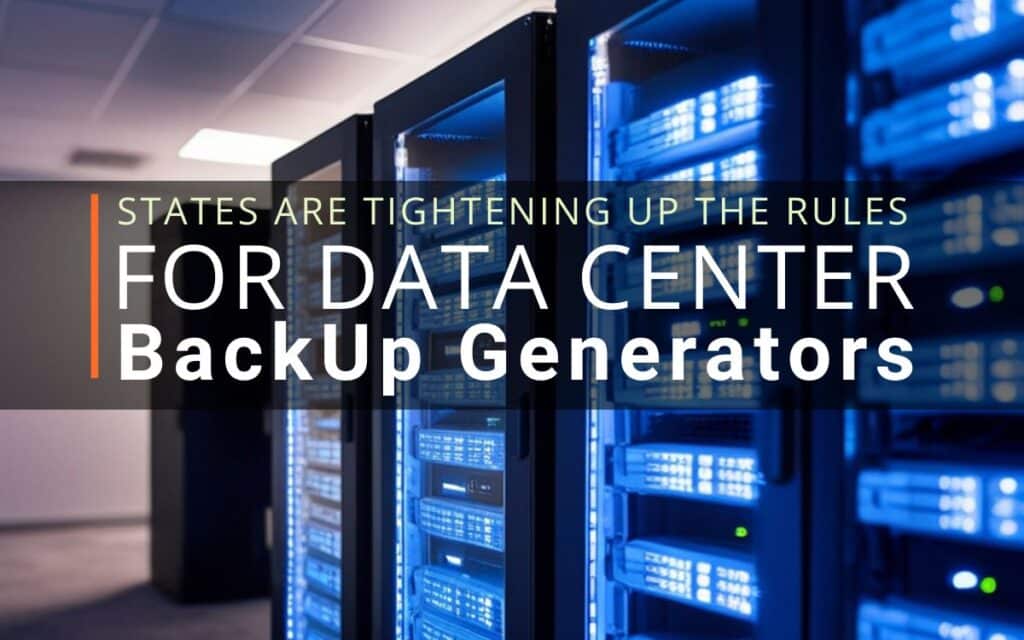
Data centers rely on backup generators for resiliency, but the scale of new development is pushing states to look harder at the air and noise impacts of those engines. Illinois and Virginia are now moving in the same direction under a shared theme: backup power at data centers is becoming a front-and-center air permitting issue, and regulators are increasingly using “Tier” level performance as the benchmark for what is acceptable. [1][2]
Illinois: New statewide air requirements tied to data center permitting
Illinois enacted the Clean and Reliable Grid Affordability Act (CRGA) as part of a broader energy reform package aimed at strengthening grid reliability and responding to projected shortages. [1]
For data centers, technical summaries of the law highlight a clear permitting shift: certain data centers will face new emissions-related requirements for backup generator sets that go beyond what many projects historically assumed for “emergency” equipment. In practical terms, new or modified diesel backup gensets at covered facilities are expected to meet emissions standards at least as protective as EPA Tier 4 standards (as codified in 40 CFR Part 1039). Natural gas backup gensets are expected to meet standards at least as protective as Tier 2 for nonroad large spark ignition engines.
For operators and compliance teams, the key takeaway is that generator selection and permitting strategy in Illinois should now be planned together. Tier-level expectations can affect equipment lead times, emissions calculations, and the overall construction permit pathway. [3][4] [5]
Virginia: Tier expectations are rising, but the bigger fight is about how often diesel can run
Virginia’s situation has become a national flashpoint because of the density of data centers in Northern Virginia. In Loudoun County, the Ashburn area often called “Data Center Alley” is home to the world’s largest concentration of these facilities, and community sensitivity to generator noise and exhaust has grown.
A recent example shows why. After a substation fire, data centers in Loudoun County relied on backup diesel generators for multiple days. Residents reported loud, continuous noise and diesel odors, prompting a surge of complaints to local officials.
Against that backdrop, Virginia’s Department of Environmental Quality (DEQ) is weighing guidance that could expand the circumstances under which dirtier diesel generators are allowed to operate. A Sept. 30 memo from Mike Dowd, director of DEQ’s Air and Renewable Energy Division, to DEQ Director Michael Rolband expands how “emergency” may be interpreted, including adding certain utility “planned outages” to the list of situations where Tier II generators could run. DEQ’s example contemplates notice of an outage within 14 days or less.
This distinction matters because Virginia’s framework treats Tier II and Tier IV generators differently. Tier II units are generally limited to emergency use, while cleaner Tier IV units can operate outside emergencies, but require more costly emissions controls. [2][6]
At the same time, Virginia is also discussing a forward-looking tightening of new permits. Starting July 1, 2026, new air permit applications for diesel generators at Virginia data centers will generally be expected to meet Tier 4-equivalent emissions controls, or the applicant will need to justify an alternative approach to DEQ. [7]
Why regulators are focused on “planned outages”
Virginia’s grid is under pressure to add transmission capacity for large data center loads. Planned upgrades often require temporarily cutting existing lines before adding new ones, which can drive outages. The debate is whether these planned events should be treated like true emergencies for purposes of allowing Tier II generator operation.
Environmental groups argue that planned outages should be planned for, not “shoehorned” into an emergency definition, and that if DEQ wants to expand the rule, it should do so through a formal notice-and-comment rulemaking process.
DEQ has said it cannot speculate on future outage timing or duration but emphasized that each data center must comply with its permitted emissions limits. [2]
The emissions and community impact questions are getting sharper
The scale is significant. Reporting cites roughly 9,000 generators in Virginia, including about 4,700 in Loudoun County. Of those statewide, around 8,000 are Tier II, according to local advocates.
Concerns are not limited to greenhouse gases. Diesel generators emit pollutants that contribute to ozone formation and particulate matter, along with toxic air contaminants and other hazardous compounds.
Virginia’s legislative research arm has examined the risk side of this equation as well. In a worst-case scenario, backup generators could release 9,000 tons of nitrogen oxides (NOx) in the region, which the report described as roughly equal to about half of what has typically been emitted annually in Northern Virginia by all sources.
This is particularly sensitive because parts of Northern Virginia have faced ozone non-attainment designations in the past, and stakeholders are watching how more frequent generator use could affect air quality on hot, high-ozone days. [2]
This is part of a broader permitting trend
Even before these state actions, EPA rules and guidance already make stationary engines and turbines a multi-program permitting issue under the Clean Air Act. EPA’s data center permitting resource hub underscores that emergency generators and their “potential to emit” can trigger more complex permitting requirements than many projects expect, especially as engine fleets grow. [8]
The combined signal from Illinois and Virginia is that states are no longer treating backup generation at data centers as a minor footnote. They are treating it as a core environmental permitting consideration.
Where Encino can provide value: permitting strategy, documentation support, and engine emissions testing
These changes are manageable, but they reward early planning and clean documentation. Encino can support data center owners and operators by helping with:
- Applicability and strategy up front: Confirming which requirements apply based on the facility’s permitting status, engine fleet size, and project phasing, and identifying where Tier-level expectations will shape the permit path.
- Permit-ready emissions planning: Developing emissions calculations, operating assumptions, and supporting documentation that align with Tier 4 or Tier 4-equivalent expectations and reduce the risk of late-stage redesigns.
- Agency coordination and defensible narratives: Building regulator-ready justifications when alternatives are proposed and supporting responses to permit reviewer questions so compliance teams can move faster with fewer surprises.
- Engine Performance Testing: Encino’s mobile engine testing labs deliver fast, accurate emissions testing for industrial engines, including near real-time data on criteria pollutants and speciated greenhouse gases like methane and CO₂. This gives operators defensible emissions data to support permit applications, verify engine performance against permit limits, and quickly identify issues that could drive noncompliance or unplanned downtime.
If your organization is planning a data center expansion, adding generator capacity, or entering a state where these expectations are evolving, the best time to align equipment decisions with permitting realities is before procurement and construction schedules are locked. Learn more about Encino’s emissions testing and compliance solutions for Data Centers on our website or contact us to discuss your project.
Sources
[1] NPR Illinois, “Pritzker signs major energy reform bill amid projected shortages” (Jan. 8, 2026):
https://www.nprillinois.org/illinois/2026-01-08/pritzker-signs-major-energy-reform-bill-amid-projected-shortages
[2] Virginia Mercury, “Virginia regulators weigh expanded use of data centers’ polluting generators” (Dec. 16, 2025):
https://virginiamercury.com/2025/12/16/virginia-regulators-weigh-expanded-use-of-data-centers-polluting-generators/
[3] Trinity Consultants, “Growing Pains: Strategic Permitting for Illinois Data Center Expansions” (Nov. 21, 2025):
https://trinityconsultants.com/resources/growing-pains-strategic-permitting-for-illinois-data-center-expansions/
[4] Quarles, “Illinois Governor Signs Wide-Ranging Illinois Energy Legislation…” (Jan. 14, 2026):
https://www.quarles.com/newsroom/publications/illinois-governor-signs-wide-ranging-illinois-energy-legislation-addressing-battery-storage-nuclear-power-renewables-and-more
[5] eCFR, 40 CFR Part 1039 (Control of Emissions from New and In-Use Nonroad Compression-Ignition Engines):
https://www.ecfr.gov/current/title-40/chapter-I/subchapter-U/part-1039
[6] VPM, “State regulators weigh expanded use of data centers’ diesel backup generators…” (Dec. 17, 2025):
https://www.vpm.org/news/2025-12-17/virginia-data-centers-diesel-backup-generators-deq-loudoun-turner-dowd
[7] MiraTech, “Virginia Moves to Cut Air Pollution from Data Center Backup Generators” (Tier 4-equivalent permitting discussion):
https://miratechcorp.com/emissions-monitor/virginia-moves-to-cut-air-pollution-from-data-center-backup-generators/
[8] U.S. EPA, “Clean Air Act Resources for Data Centers”:
https://www.epa.gov/stationary-sources-air-pollution/clean-air-act-resources-data-centers