 Why EmSat™ is the Oil & Gas Industry’s Preferred Satellite Methane Monitoring Solution
Fugitive emissions of methane from the energy sector are under increasing scrutiny from regulators, investors, and environmental activists. To stop fugitive emissions of methane from energy production facilities, they must first be detected. Because oil and gas production facilities are often located in remote areas, satellite-based detection has become an increasingly popular option for emissions monitoring and reduction strategies. Recently developed regulations, such as CFR 40 NSPS 60 Subpart OOOOb (“Quad-O”) have also authorized a process for using satellite monitoring solutions for detecting and reporting “super emitter” events.
Two prominent players in satellite emissions monitoring are Encino Environmental’s EmSat™ and MethaneSAT, developed by the Environmental Defense Fund (EDF). While both aim to enhance visibility into global methane emissions, their missions, capabilities, and approaches are markedly different—especially when it comes to meeting the operational needs of the oil and gas industry.
READ MORE: Understanding the Super Emitter Response Program: A Proactive Approach to Emissions Management
Mission and Objectives: Commercial Precision vs. Public Oversight
MethaneSAT is a nonprofit initiative with a public mission: increase global transparency around methane emissions and drive accountability across the energy sector. Designed to scan wide areas of the Earth’s surface, MethaneSAT claims to provide open-access emissions data to regulators, researchers, and the public. Its primary goal is macro-scale monitoring, especially across oil and gas regions like the Permian Basin or international production zones.
MethaneSAT recently made headlines when it reported in a press release that it had lost contact with its satellite.
EmSat, by comparison, is a commercial satellite methane monitoring service built for oil and gas operators in the upstream, midstream, and downstream sectors. Operated as a joint venture between Encino Environmental and SATLANTIS, EmSat is engineered to provide site-specific, high-resolution data directly to oil and gas companies. Its mission is not just to detect emissions, but to help clients verify compliance, track leaks, and improve environmental performance in near real-time.
The table below compares the primary differences between EmSat and MethaneSAT.
| FEATURE | EmSat™ | MethaneSAT |
|---|---|---|
| Mission Focus | Operational support for oil & gas clients | Public transparency and advocacy |
| Sensor Sensitivity | ~3x more sensitive than current satellites | Moderate sensitivity, wide-area |
| Pixel Resolution | ~7 meters | ~100 meters |
| Coverage Strategy | Facility-specific, targeted missions | Regional-wide scanning |
| Revisit Rate | Up to 3 times per month/site | Typically, once per month |
| Data Access | Private, secure to client | Public and open-access |
| Integration | Integrates with LDAR and ESG systems | Informational; non-integrated |
The EmSat Advantage – Three Key Differentiators
1. Infrared Sensor Sensitivity and Resolution
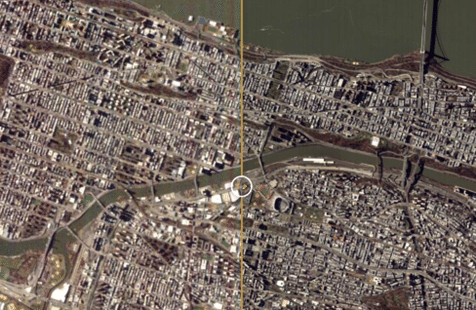
EmSat boasts a next-generation infrared sensor that is nearly three times more sensitive than existing satellites on orbit providing Ultra High image resolution. With a pixel resolution of approximately 7 meters, compared to the standard 25 meters, EmSat can detect much smaller methane concentrations—allowing operators to spot and fix leaks faster, often before they become regulatory issues or public news.
This level of detail means that even emissions from individual well pads or smaller compressor stations can be identified and quantified with precision, giving companies a major advantage in monitoring their environmental footprint.
The photo below illustrates the difference between standard resolution (on the left) and Ultra High imaging (on the right).
2. Pan and Tilt Imaging System
Unlike conventional satellites that only look straight down (nadir view), EmSat includes a pan and tilt system, enabling the sensor to angle toward specific sites. This capability dramatically improves revisit rates—allowing EmSat to monitor a facility up to three times a month, compared to roughly once a month for most static-orbit satellites.
This agility is particularly valuable for:
- Monitoring high-risk or high-priority assets more frequently
- Verifying repairs or mitigation actions post-incident
- Creating continuous emissions baselines over time
2. Mission-Tasking and Control
Because Encino operates EmSat, we have full control over its mission tasking. That means we can assign the satellite to follow specific infrastructure — such as tracking a pipeline route, monitoring specific high-emitting facilities, or conducting ongoing surveillance of suspected hotspots.
This capability provides oil and gas operators with tailored, client-specific monitoring that no general-purpose public satellite can match.
READ MORE: Advances in Satellite Methane Monitoring – The Best Defense is a Good Offense
Why Oil & Gas Operators Choose EmSat
Oil and gas operators need more than just emissions data—they need trusted, actionable insights that integrate with their operational and compliance workflows. Here’s why EmSat stands out as the preferred choice:
- High-resolution detection catches smaller leaks early, potentially before a public satellite can.
- Custom tasking ensures monitoring aligns with specific operational goals.
- Confidential, client-owned data avoids unwanted public exposure.
- Fast revisit cycles help verify repairs and demonstrate ESG performance.
- Commercial reliability with expert support from Encino Environmental.
Whether it’s achieving compliance with EPA methane rules, meeting ESG reporting obligations, or simply improving environmental performance, EmSat gives operators the tools they need to lead—not react—in a high-stakes regulatory landscape.
In a world where methane visibility is no longer optional, EmSat delivers precision, control, and clarity – exactly what today’s energy operators demand.
Contact us today to learn how to put EmSat to work for you and achieve environmental performance that generates economic results.