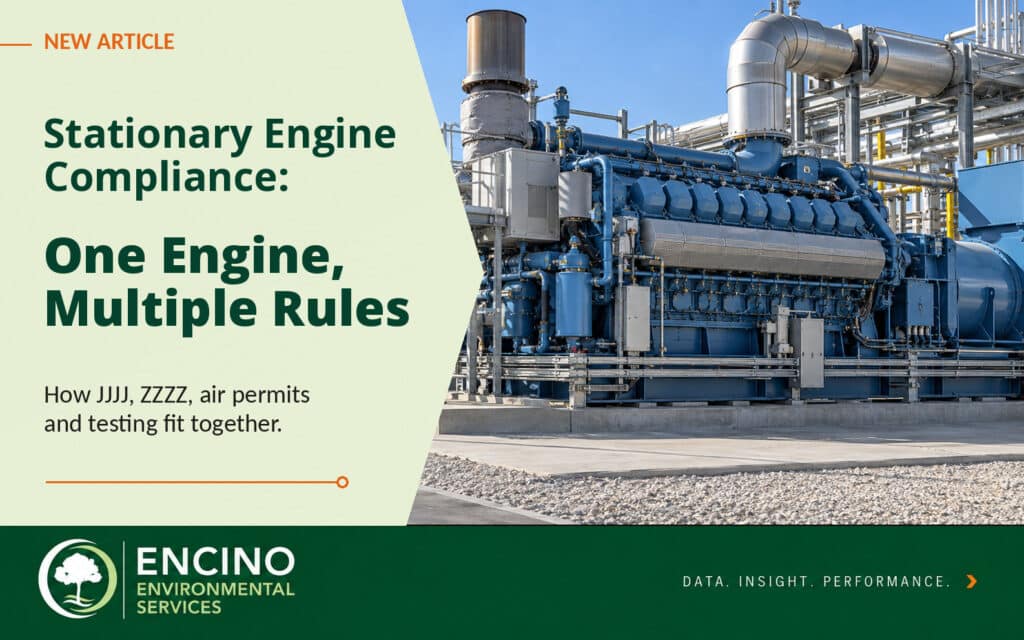
One Engine, Multiple Rules: How JJJJ, ZZZZ, Air Permits and Testing Fit Together
Key Takeaways
- Engine compliance begins with classification. Fuel, ignition type, horsepower, construction date, operating purpose and the facility’s hazardous air pollutant source classification can all affect applicable requirements.
- Subpart JJJJ and Subpart ZZZZ address different regulatory programs, and some engine categories use NSPS compliance as the pathway for satisfying RICE MACT requirements.
- State and federal air permits can add operating, monitoring, testing and recordkeeping requirements beyond the underlying engine standards.
- As facilities add onsite generation, reviewing compliance requirements during equipment selection can reduce surprises during permitting, startup and testing.
U.S. electricity demand is expected to reach record levels in 2026 and again in 2027, according to the U.S. Energy Information Administration. Reuters reported September 9 that AI-intensive data centers are a significant contributor to that growth, while natural gas is expected to maintain roughly 40% of U.S. power generation through 2027.
Equipment manufacturers are seeing the same trend. Caterpillar reported in August that expanding data center construction has increased demand for power-generation and backup equipment, contributing to 17% revenue growth in its power and energy business. Meanwhile, a September 8 Texas Tribune analysis identified dozens of proposed gas-fired power projects intended to serve data centers in Texas and elsewhere, including projects built around large fleets of reciprocating engines.
Data centers are drawing attention today, but stationary engines already support oil and gas operations, LNG facilities, landfills and RNG projects, manufacturing plants and other critical infrastructure.
As deployment grows, understanding how federal engine rules, state permitting requirements and emissions testing fit together becomes increasingly important.
Start With the Engine, Not the Rule Name
Before determining whether JJJJ, ZZZZ or another requirement applies, the facility needs an accurate description of the engine itself.
Important characteristics include whether the engine is spark ignition or compression ignition, rated horsepower, fuel type, construction or reconstruction date, emergency or non-emergency use, and whether it operates at a major or area source of hazardous air pollutants.
Those details can send otherwise similar engines down very different compliance paths.
EPA regulates stationary spark ignition engines under 40 CFR Part 60 Subpart JJJJ, while stationary compression ignition engines generally fall under Subpart IIII. EPA’s stationary engine guidance also distinguishes among lean-burn, rich-burn, landfill or digester gas, emergency and non-emergency engines.
An accurate equipment inventory therefore provides the foundation for applicability, permitting and testing decisions.
Subpart JJJJ: Start With Spark Ignition NSPS Applicability
Subpart JJJJ establishes New Source Performance Standards for stationary spark ignition internal combustion engines.
The rule regulates pollutants including nitrogen oxides, carbon monoxide and volatile organic compounds. Applicability is tied to factors such as the engine’s construction, manufacture, modification and reconstruction dates.
How an owner or operator demonstrates compliance can also vary.
For some engines, compliance may rely on purchasing an EPA-certified engine and installing, operating and maintaining it according to manufacturer instructions. Other spark ignition engines may need emissions performance testing to demonstrate compliance with the applicable standards.
An engine being subject to JJJJ therefore does not mean every affected unit follows the same testing schedule or compliance pathway.
Subpart ZZZZ Adds the RICE MACT Layer
40 CFR Part 63 Subpart ZZZZ, commonly called RICE MACT, addresses hazardous air pollutant emissions from reciprocating internal combustion engines.
Requirements depend heavily on engine classification and facility status. EPA distinguishes among existing and new engines, major and area sources of hazardous air pollutants, emergency and non-emergency operation, horsepower ranges and engine configurations.
The relationship between ZZZZ and the engine NSPS is especially important for some categories.
EPA guidance explains that new RICE at many area sources satisfy RICE MACT requirements by complying with the applicable stationary engine NSPS. Other engines, particularly certain units at major HAP sources, may face emission limits, operating requirements, performance testing or monitoring requirements directly under Subpart ZZZZ.
That is why asking whether an engine is subject to Quad Z is only the beginning of the applicability review.
The next question is what Quad Z requires for that specific engine and whether another NSPS provides the compliance pathway.
Your Air Permit Connects the Requirements to the Facility
Federal engine standards are only part of the compliance picture.
State and local permitting programs may establish additional emission limits, fuel restrictions, operating-hour limits, monitoring provisions or testing requirements. Those conditions may address local air-quality requirements or establish enforceable limits used to maintain a facility’s source classification.
For Title V facilities, the operating permit consolidates applicable Clean Air Act requirements and includes testing, monitoring, recordkeeping and reporting provisions intended to demonstrate compliance.
An engine may therefore have an NSPS requirement, a NESHAP requirement and permit-specific obligations that need to be evaluated together.
This becomes especially important when a facility relies on enforceable limits to remain below major-source thresholds.
Recent scrutiny of large onsite power projects reinforces the importance of getting those assumptions right early. The September 8 Texas Tribune analysis found a rapidly growing pipeline of natural gas generation serving data centers, including projects using hundreds of individual gas-fired engines. At that scale, equipment classification, potential-to-emit calculations, aggregation and operating limits can determine the project’s permitting pathway.
Where Does Emissions Testing Fit?
There is no single testing requirement for all stationary engines because the obligation follows the engine classification, applicable regulations and permit conditions.
Depending on the unit, compliance may involve manufacturer certification, an initial emissions performance test, recurring performance testing, catalyst monitoring, maintenance records, operating-hour records or another demonstration.
Air permits can create additional testing requirements.
Before scheduling a test, facility teams should confirm four things:
- Which requirement is driving the test? The answer may be JJJJ, ZZZZ, IIII, a state regulation, a construction permit, a Title V permit or several requirements working together.
- Which pollutants and limits apply? NOx, CO, VOC, formaldehyde and other pollutants may be regulated differently depending on the engine and compliance program.
- What operating condition must be demonstrated? The test needs to reflect the operating conditions required by the governing regulation or permit.
- What happens after the test? Reporting deadlines, electronic submission requirements and ongoing monitoring obligations should be understood before field work begins.
Encino’s Stack Emissions Testing FAQ provides additional guidance on test planning, applicable methods, site preparation and reporting.
Four Assumptions Worth Checking
Several common assumptions can create compliance risk.
An EPA-certified engine may still have separate air permit obligations. Emergency status can carry operating-hour and recordkeeping requirements. Permit conditions do not erase independently applicable federal standards. Equipment changes can also affect modification or reconstruction determinations.
For facilities adding multiple engines over time, another question becomes increasingly important: whether individual projects or units need to be evaluated together for permitting purposes.
A practical approach is to maintain an engine-specific compliance matrix that connects equipment characteristics with applicable federal, state and permit requirements.
That matrix can then identify what must be monitored, recorded, tested and reported.
Growing Power Demand Makes Early Compliance Review More Valuable
The current growth in power demand provides a useful reminder that engine compliance starts during planning.
Reuters reported that U.S. commercial electricity demand is expected to reach an all-time high in 2026, while natural gas consumption for power generation remains near record levels. Caterpillar’s growing power-equipment backlog provides another indication that new generation capacity is moving quickly from concept to deployment.
Facilities evaluating additional generation should consider environmental requirements alongside horsepower, fuel, reliability, capital cost and operating strategy.
The engine selected today determines much of the compliance program that follows.
How Encino Can Help
A strong engine compliance program should make a few fundamental questions easy to answer: What regulations apply to this engine? What operating limits have been accepted? What data demonstrate compliance? When is testing required? Where are the records supporting the facility’s position?
Encino Environmental Services supports stationary engine operators with regulatory advisory services, emissions performance testing, mobile testing laboratories and compliance reporting across oil and gas, data centers, LNG, manufacturing, landfills and other critical infrastructure.
Our industrial engine stack testing provides near real-time emissions data for criteria pollutants and greenhouse gases while helping facility teams connect test results to regulatory and operational requirements.
When one engine sits at the intersection of several requirements, getting the classification right early can make the compliance program much easier to manage. Contact us and let our experts help you connect test results to regulatory and operational requirements.
Sources
- Reuters: U.S. power use to beat record highs in 2026 and 2027 as AI use surges, EIA says, September 9, 2026
- Reuters: Caterpillar lifts 2026 sales growth forecast as AI buildout powers on, August 4, 2026
- The Texas Tribune: Texas leads nation in proposed power plants for data centers, September 8, 2026
- U.S. EPA: Compliance Requirements for Stationary Engines
- U.S. EPA: NSPS for Stationary Spark Ignition Internal Combustion Engines, 40 CFR Part 60 Subpart JJJJ
- U.S. EPA: NESHAP for Reciprocating Internal Combustion Engines, 40 CFR Part 63 Subpart ZZZZ