Frequently Asked Questions About Stack Emissions Testing
Stack emissions testing gives facility teams measured data they can use to demonstrate compliance, evaluate equipment performance and make informed operating decisions. Because every source, permit and test program is different, successful testing begins well before a crew arrives on site.
The following answers cover common questions about stack testing, also known as source testing or performance testing. Your facility’s air permit and applicable federal, state or local requirements should always guide the final test scope.
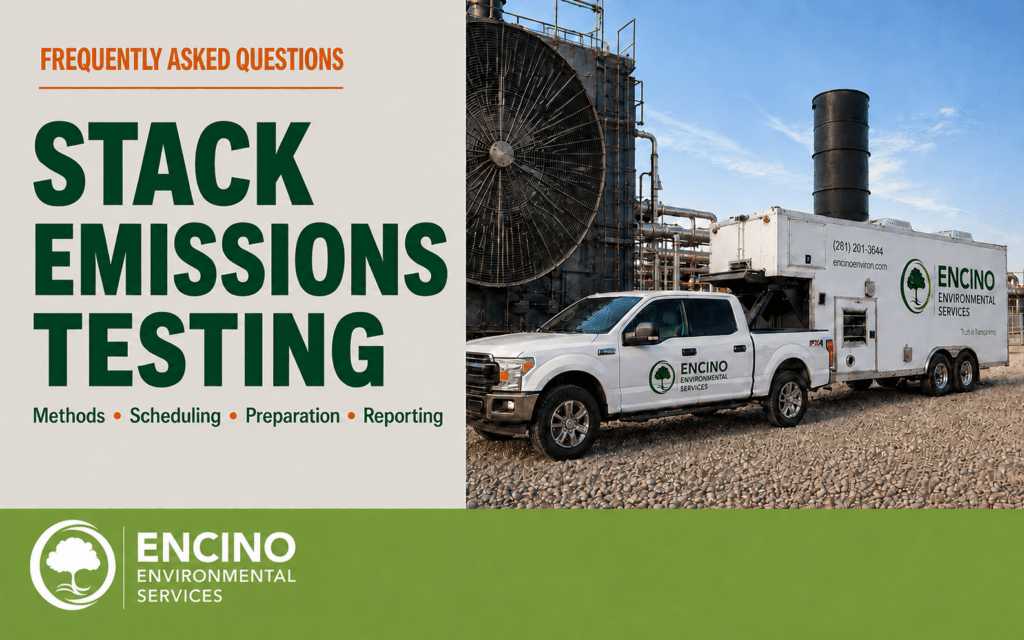
What is stack emissions testing?
Answer: Stack emissions testing is the direct measurement of pollutants and other parameters in an exhaust stream from a stationary source. A qualified testing team collects samples or uses instrumental analyzers while the equipment operates under defined conditions. The resulting data can show pollutant concentrations, mass emission rates, control-device performance and compliance with an applicable limit.
Stack testing may be required for boilers, engines, turbines, process heaters, thermal oxidizers, flares, kilns, baghouses, scrubbers, manufacturing lines and other industrial emission sources. The terms “stack testing,” “source testing” and “performance testing” are often used interchangeably.
Why do facilities need stack testing?
Answer: Facilities commonly conduct stack testing to demonstrate initial or ongoing compliance with an air permit, a New Source Performance Standard (NSPS), a National Emission Standard for Hazardous Air Pollutants (NESHAP) or another applicable requirement. Testing may also support permit applications, equipment commissioning, engineering evaluations, control-device optimization, troubleshooting and emissions-factor development.
The trigger and frequency depend on the source and the rules that apply to it. A facility may need testing after startup, after a modification, on a recurring schedule or following a request from a regulatory agency. Reviewing the permit and applicable regulations early helps define the deadline, operating conditions, test methods and reporting requirements.
What pollutants can be measured during a stack test?
Answer: The test program should be designed around the emission limits and operating requirements that apply to the source. Common measurements include:
- Nitrogen oxides (NOx)
- Carbon monoxide (CO)
- Carbon dioxide (CO2)
- Oxygen (O2)
- Sulfur dioxide (SO2)
- Volatile organic compounds (VOCs) and total hydrocarbons
- Particulate matter (PM), including size-specific fractions when required
- Formaldehyde (HCHO)
- Ammonia (NH3)
- Hydrogen chloride (HCl), hydrogen fluoride (HF), hydrogen sulfide (H2S) and total reduced sulfur (TRS)
- Mercury, metals and other hazardous air pollutants
- Opacity or visible emissions
Flow rate, moisture, temperature and other stack-gas conditions may also be measured because they are needed to calculate emission rates or confirm that the test meets method requirements.
Which EPA test method will my facility need?
Answer: The correct method depends on the pollutant, source type, applicable regulation and permit language. EPA reference methods in 40 CFR Part 60, Appendix A and other approved methods establish the procedures for sampling, analyzer operation, quality control and calculations. State or local agencies may impose additional requirements or approve an alternative method for a specific situation.
Method selection should be confirmed during permit review and test planning. Choosing a familiar method without checking the applicable requirement can lead to incomplete data, reporting problems or a retest.
How often is stack testing required?
Answer: Stack testing frequency depends on the source, applicable federal and state requirements, and the facility’s air permit. A facility may need an initial test after startup or modification, followed by annual, two-year, three-year, five-year or another recurring schedule. Some sources are tested according to operating hours, and additional testing may be triggered by an equipment change, failed test, agency request or permit condition.
Five-year testing intervals appear frequently in permits and source-specific requirements, although they do not apply to every source. The testing schedule should be confirmed from the permit and each applicable federal, state and local requirement before a compliance calendar is established.
Do Pennsylvania, Ohio and West Virginia require stack testing every five years?
Answer: Five-year testing requirements appear in all three states, but they apply through specific rules or permit conditions. Pennsylvania’s Chapter 139 establishes source-testing methods and procedures, while the recurring frequency is generally established by the applicable regulation or facility permit. Some Pennsylvania operating permits expressly require five-year testing for selected sources and pollutants.
Ohio Administrative Code 3745-14-08 requires certain NOx Budget units using an approved emission factor as an alternative monitoring method to conduct ongoing stack tests at least once every five years. West Virginia’s Division of Air Quality explains that testing may be required by a DAQ rule, permit condition or order from the DAQ Director. West Virginia permits include five-year schedules as well as shorter intervals. Facilities in each state should use their own permit and source-specific requirements to determine the deadline.
How should a facility prepare for a stack test?
Answer: Good preparation begins with the permit, applicable rule and prior test history. The facility and testing team should confirm the source, pollutants, methods, required operating rate, test duration, notification deadlines and reporting format. The team should also review test-port locations, platform access, power needs, process data, control equipment, safety requirements and any agency-approved test protocol.
Before the test date, operators should verify that the source and control equipment can run steadily at the required conditions. Maintenance issues, unstable loads, inaccessible ports or missing production data can interrupt a test and increase the chance of rescheduling.
Does the facility need to submit a test protocol or agency notification?
Answer: Many permits and regulations require advance notification, and some agencies require a written test protocol. The protocol typically identifies the source, applicable limits, proposed test methods, operating conditions, sampling locations, quality-control procedures and reporting approach.
Deadlines vary. Some agencies may also choose to observe the test. The facility should confirm the required lead time and obtain any necessary approval before testing begins. Encino can help review the requirements and coordinate the protocol, notification and agency communication.
What happens on the day of the test?
Answer: The testing team conducts a safety review, sets up equipment, confirms sampling locations and completes required pre-test checks. Facility operators bring the source to the operating condition specified by the permit, rule or approved protocol. Testers then collect samples or analyzer data during a series of runs while the facility records relevant process and control-device information.
Communication between the operators and test crew is especially important when loads change, alarms occur or a run must be paused. Encino provides preliminary field information when the method allows, followed by quality review, final calculations and a formal report.
How long does stack testing take?
Answer: The field schedule depends on the number of sources, pollutants, methods and required runs. A straightforward instrumental test may be completed in a day. Particulate, metals, complex hazardous air pollutant testing or multi-source programs can require several days. Setup, leak checks, calibrations, recovery, sample handling and equipment movement also affect the schedule.
Weather, production interruptions and access conditions can add time. Early planning allows the testing team to build a realistic schedule and coordinate laboratory turnaround or agency deadlines.
What happens if a source does not pass its stack test?
Answer: The first step is to review the field data, process conditions, control-device performance, calculations and quality-control results. A high result may point to a process issue, control-equipment problem, operating condition or test-specific factor that needs further evaluation.
The facility should promptly review its permit and applicable reporting obligations with qualified environmental and legal professionals. Diagnostic testing can help isolate the cause before a compliance retest. Encino can support the technical review, additional testing and coordination needed to develop a practical path forward.
What is included in a stack test report?
Answer: A complete report generally documents the regulatory basis, source description, operating conditions, sampling locations, test methods, field and laboratory data, quality-control checks, calculations and final results. Supporting records may include calibration data, process logs, diagrams, photographs and chain-of-custody information.
Some federal rules require performance test data to be prepared through EPA’s Electronic Reporting Tool and submitted through the Compliance and Emissions Data Reporting Interface (CEDRI). State or local submission requirements may also apply. The reporting route should be confirmed during planning so the necessary data are collected in the correct format.
What types of facilities and sources does Encino test?
Answer: Encino supports industrial and commercial facilities across the United States. Testing experience includes engines and compressor stations, data center generators, boilers, turbines, flares, thermal and regenerative oxidizers, baghouses, asphalt plants, landfills, RNG facilities, power generation, manufacturing processes and other stationary sources.
Services include compliance and diagnostic testing, instrumental testing, particulate sampling, opacity observations, trial burns, control-equipment evaluations, source characterization and diagnostic sampling. The final scope is built around the source, permit and operational objective.
How far in advance should I schedule stack testing?
Answer: Schedule as early as practical, especially when the project involves multiple sources, specialty methods, laboratory analysis or a firm regulatory deadline. Advance planning creates time to review the permit, submit notifications, prepare a protocol, address access issues and coordinate production.
If your deadline is approaching, contact Encino as soon as possible. The team can review the scope, identify critical preparation items and determine an achievable testing schedule.
Need Help Planning Your Next Stack Test?
Encino supports the full testing process, from permit and method review through field execution, quality review and final reporting. Talk with our stack testing team about your source, compliance deadline and operational requirements.