Should you build an in-house team or outsource LDAR services?
What Operators Need to Know
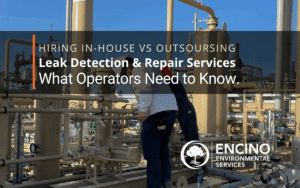 Leak Detection and Repair (LDAR) used to be a compliance checkbox. Now, it’s a high-stakes, high-scrutiny function tied directly to emissions targets, ESG scores, investor confidence, and operational efficiency. As regulatory complexity grows and public scrutiny intensifies, operators are facing a critical decision: Do we manage LDAR in-house, or outsource it to a dedicated service provider?
This question is no longer theoretical; it’s a strategic turning point. The wrong choice can lead to compliance failures, missed deadlines, or excessive costs. The right one can drive efficiency, transparency, and long-term value.
The Case for Hiring In-House LDAR Teams
Building your own LDAR team gives you full operational control. You define the protocols, develop internal talent, align with existing workflows, and make independent decisions about equipment, staffing, and execution. For operators with a relatively stable asset portfolio and low turnover, in-house programs can be efficient and cost-effective over time.
In-house LDAR works well when:
- Your asset base is consistent, and LDAR needs are predictable month to month.
- You’ve already made capital investments in the required equipment
- You can afford to recruit, train, and retain experienced LDAR technicians.
- Your internal teams are deeply familiar with regulatory frameworks like NSPS Subparts KKK, OOOOa, and OOOOb.
- You want tight alignment between LDAR, environmental compliance, and operations.
Still, this route demands significant internal resources. High-end OGI cameras are a major investment in upfront cost, training, maintenance, storage, and long-term upkeep. You’ll also need a robust quality assurance system, document control framework, and dedicated personnel to stay on top of evolving regulations. Many operators underestimate the ongoing overhead it takes to keep a program compliant and audit ready.
The Case for Outsourcing to an LDAR Partner
Outsourcing LDAR is no longer limited to small operators or short-term projects. Today, even large-scale oil and gas companies are turning to third-party specialists to handle expanding compliance needs, regulatory volatility, and workforce shortages.
Outsourced LDAR is often the smarter move when:
- You’re expanding assets – rapidly adding well pads, processing units, or gathering systems.
- New or updated regulations (e.g., Quad OB, OGMP 2.0) are adding complexity at a fast pace.
- You need scalable resources to support quarterly or semi-annual inspections.
- Your internal staff is already stretched thin with other compliance or operations priorities.
- You want fast access to reporting and documentation that meets third-party audit requirements.
A proven partner like Encino Environmental brings experienced technicians, high-performance OGI camera technology, and deep regulatory and industry expertise directly to your site. There’s no need to purchase expensive equipment, onboard new employees, or manage complex training schedules. Instead, you get turnkey support that delivers results without added friction.
LDAR Hybrid Program Models Are on the Rise
You don’t have to choose one path. Many operators are adopting hybrid LDAR models that combine internal resources with strategic outsourcing. This might mean using in-house staff for routine monthly checks while engaging a partner like Encino for baseline surveys, compliance audits, or startup inspections.
Hybrid approaches offer flexibility and reduce risk. You maintain institutional knowledge in-house while gaining access to outside expertise and capacity when it matters most. This model is especially effective for companies managing diverse assets across multiple jurisdictions.
What to Ask Before You Decide
Choosing between hiring and outsourcing LDAR services starts with a clear-eyed assessment of your current capabilities and growth trajectory. Ask yourself:
- Do we have the budget and time to build a fully staffed, compliant LDAR team from scratch?
- Are our internal staff trained on the latest OGI and Method 21 protocols?
- How well do we understand the latest emissions regulations and how they apply to our specific facilities?
- Can we scale our LDAR coverage quickly if our asset base grows or compliance timelines tighten?
- What happens if we fall short on documentation, timeliness, or leak repair follow-ups?
- Do we have the budget to invest-in, track and maintain certified OGI camera equipment?
If any of these questions raise uncertainty, it may be time to explore outsourcing or a hybrid model that builds flexibility into your LDAR strategy.
How Our Expert LDAR Team Can Help
Encino Environmental Services delivers full-spectrum LDAR support tailored to the specific needs of oil and gas operators. Whether you’re looking to fully outsource, support a new asset ramp-up, or enhance your existing program, we provide:
- Expert technicians trained on EPA and state-level regulations
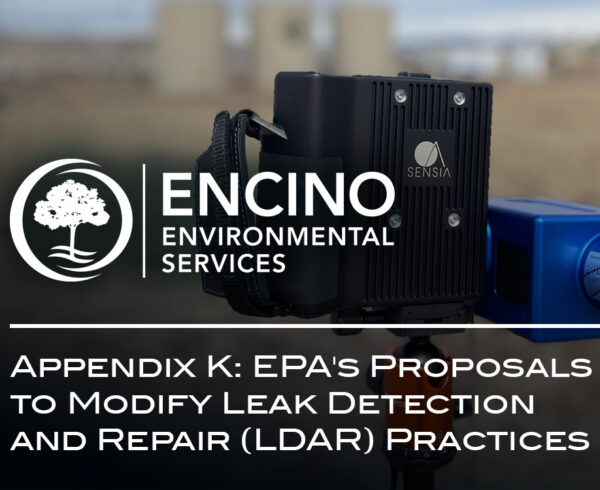
- High-end detection tools, including SENSIA OGI cameras and high-volume samplers
- Deep regulatory fluency across NSPS, Subpart W, OGMP 2.0, and local air district rules
- Streamlined, audit-ready reporting
- Rapid deployment for new sites, scheduled inspections, or emergency coverage
With Encino, you’re securing a trusted partner with the tools, knowledge, and agility to help you navigate the growing complexity of LDAR requirements.
Learn more about our LDAR Services.
Let’s Find the Right Fit for Your LDAR Program
Ready to explore your LDAR path forward? We’ll walk through your asset profile, regulatory pressures, and growth plans to help you determine whether to hire, outsource, or build a hybrid approach that delivers results, today and into the future. Contact us today!