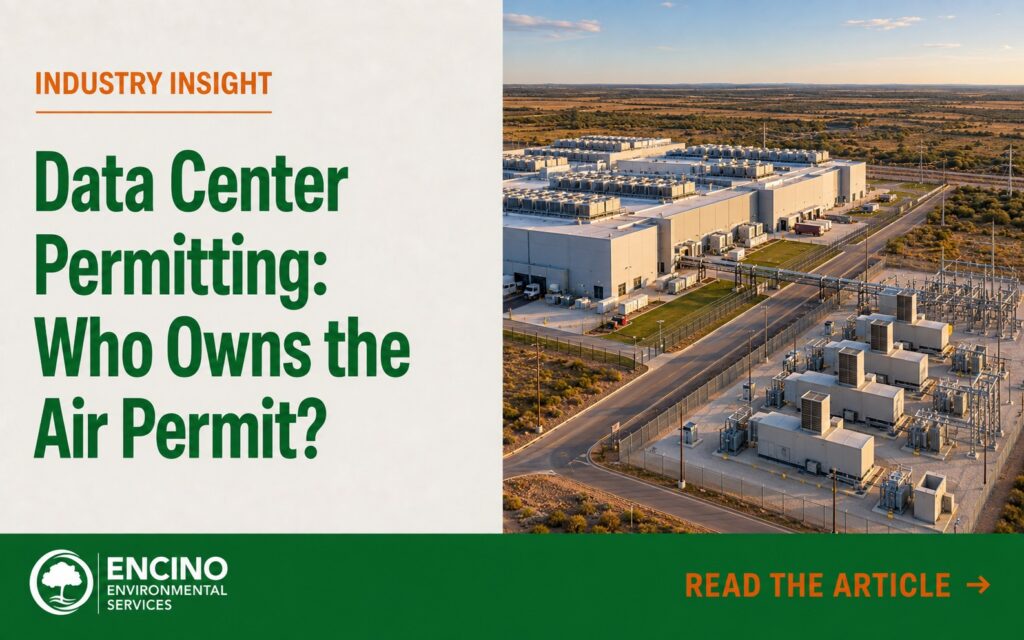
Data centers are no longer just large electricity consumers. With emergency generators and an expanding fleet of behind-the-meter gas turbines and reciprocating engines, their air emissions can rival those of a small industrial facility. That means an air permit — and a clear answer to who holds it — is a core piece of data center due diligence.
The answer to that question, however, isn’t always obvious on a modern data center campus. Different legal entities may own the buildings, IT equipment, and power-generation assets. Air permits generally follow the legal owner or operator of the equipment that produces emissions — not necessarily the company running the facility day to day.
Getting this wrong can lead to permitting delays, compliance penalties, or generators intended for backup power later being classified as a major source, creating significant regulatory obligations.
That’s why identifying who will hold the air permit should happen early in project development—not be left as an afterthought for the environmental consultant.
This article covers why permit responsibility gets murky on data center campuses, why the question has to be resolved before contracts and equipment orders are finalized, the ownership and operating arrangements that most often complicate it, and what to look for in state-specific requirements.
Why Permit Responsibility Can Be Unclear
Air permits aren’t issued to a facility or a physical structure — they’re issued to the legal “owner or operator” of a stationary source. On a data center campus, identifying that party can be complicated.
The general rule is straightforward enough: whoever owns or operates the emission units — the generators, turbines, boilers, or cooling towers with regulated emissions — is the permittee of record. On a single-tenant campus built and run by one company, this is simple: the data center operator holds the permit for its own generators, both prime and backup power.
Once the ownership of key infrastructure, such as the building and generation equipment, responsibility can become ambiguous. Distributed ownership, however, is increasingly the norm as developers turn to colocation arrangements, third-party power producers, and leased or rented equipment to meet compute demand faster than the grid can interconnect them.
Why Permit Responsibility Must Be Resolved Early in Project Planning
U.S. data center power demand is projected to double from 31 gigawatts (GW) in 2025 to 66 GW by 2027, and many developers are turning to on-site generation — first as backup, then increasingly as primary or bridge power while grid interconnection is pending. That shift has put pressure on regulators to clarify the rules, and the rules keep moving.
EPA’s January 15, 2026, final rule (91 FR 1910) revised the New Source Performance Standards (NSPS) for stationary combustion and gas turbines, sorting turbines into subcategories based on size, utilization rate, design efficiency, and fuel type, with NOx limits set accordingly. Combustion controls alone suffice for most turbines, but large, high-utilization units must add selective catalytic reduction (SCR).
The rule also created a new regulatory subpart (KKKKa) with specific standards for “temporary” turbines firing natural gas versus other fuels — directly relevant to data centers using short-term or rented turbines during interconnection delays.
Subpart KKKKa, however, is more than just a broad carve-out for “temporary turbines” as it establishes a new applicability framework, more granular NOx subcategories based on size and a 12-month utilization rate of 45% (Table 1 to Subpart KKKKa of Part 60, Title 40) to distinguish low- from high-utilization units. Most relevant to data centers using rented or short-term equipment during interconnection delays, KKKKa sets a distinct standard for temporary turbines firing natural gas versus other fuels (Table 2 to Subpart KKKKa of Part 60, Title 40). The pollutants regulated by this subpart are nitrogen oxide (NOX) and sulfur dioxide (SO2).
Importantly, Subpart KKKKa governs any stationary combustion turbine ≥10 MMBtu/hr that commenced construction, modification, or reconstruction after December 13, 2024. Turbines that began construction before that date remain under the older Subpart KKKK (2006) or Subpart GG (1977–2005) instead, and turbines subject to KKKKa are no longer subject to those earlier subparts. This December 13, 2024 cutoff — not the rule’s January 15, 2026 effective date — is the operative trigger, which matters for any data center turbine project already under construction or with a permit application in progress before the rule published.
EPA subsequently issued a July 2026 correction fixing drafting errors, including reverting a size threshold back to its original 30 MW standard.
For data centers, the net effect cuts both ways.
- Large-turbine projects now have more certainty on required pollution controls, which helps with early-stage budgeting and equipment sizing.
- But the rule doesn’t create a broad permitting exemption for equipment labeled “temporary” or “portable” — such turbines remain regulated as stationary sources, reinforcing EPA’s separate January 2026 guidance eliminating a provision some companies had previously used to deploy gas turbines without full permitting review.
Separately, in May 2026, EPA proposed changing the definition of when the “Begin Actual Construction” milestone begins subject to New Source Review (NSR) pre-construction permitting, aimed at speeding up data center and power plant projects. Under the proposal, developers could begin building non-emitting components — concrete slabs, wiring, plumbing, and supporting structures — before obtaining a major NSR permit, letting non-emitting infrastructure move forward in parallel with the air permitting process.
Regulations keep evolving, but the underlying structure of who is responsible for securing the permit and ensuring compliance has stayed consistent. Getting that right before shovels break ground avoids discovering, mid-construction or mid-operation, that the compliance obligation landed somewhere no one planned for.
Common Ownership and Operating Arrangements
The general rule. Whoever owns or operates the emission units — the generators, turbines, boilers, or cooling towers with regulated emissions — is the permittee of record.
On a single-tenant campus built and run by one company, this is straightforward: the data center operator holds the permit for its own generators – both prime and backup power.
A few recurring arrangements are where permit ownership questions most often surface:
- Multi-tenant and colocation facilities. When a colocation provider owns the building and shared generator plant but individual tenants own their own IT load (and sometimes their own dedicated backup units), the permit typically sits with whoever owns and controls the combustion equipment — usually the colocation operator — even though tenants are the ones actually driving the emissions through their power draw.
- On-site power plants under separate ownership. Some data centers contract with an independent power producer to build and operate an on-site power plant using gas turbines or reciprocating engines, with power sold to the data center under a power purchase agreement (PPA). Here, EPA’s “common control” doctrine becomes central: when two entities are treated as a single source, and thus a single permittee, when one has the power to dictate the other’s compliance decisions, even without shared corporate ownership. If a data center’s contract effectively controls how and when the generation asset operates, permitting authorities may treat the two facilities as commonly controlled and require them to be aggregated for major source determinations, even if they sit on separate deeds.
- Adjacency and aggregation. Under New Source Review (NSR) and Title V permitting, activities constitute a single source only if they satisfy three tests: common control, location on contiguous or adjacent properties, and a shared major group SIC code. For all industries except oil and gas, EPA interprets “adjacent” based on physical proximity alone — a leased generator yard across the access road from the main building doesn’t automatically escape aggregation.
- Leased and rented equipment. Temporary or rented generators, common during construction, commissioning, or grid interconnection delays, still need to be accounted for on someone’s permit — usually the site owner’s, since the equipment operates under their control regardless of who holds title to it.
Questions Teams Should Answer Before Contracts and Equipment Decisions Are Finalized
Before signing a power arrangement — a shared generator plant, a leased turbine, or a third-party on-site power producer — get explicit answers to these questions from your environmental/permitting team and qualified consultants:
- Who will hold the permit, and has that been confirmed in writing? Get a documented common-control and aggregation analysis whenever a third party owns or operates any generation asset — turbine, engine, or fuel cell — serving the site, especially under a PPA.
- Has each generation unit’s intended use been classified from day one? Decide, in writing, whether each unit is emergency-only, bridge/temporary power, or primary power, and permit it accordingly. Retrofitting an “emergency” designation after the equipment gets used for peak shaving or demand response creates real enforcement exposure.
- Has aggregation been modeled across current and future phases? Run potential-to-emit calculations across all commonly controlled and adjacent equipment, including planned future phases, before committing to a permitting pathway. Discovering mid-construction that a “minor source” project is actually major — because of an adjacent leased generator yard or a future campus phase — can stall a project for months.
- Are operating limits built into the permit itself, not just internal policy? Hour caps, fuel throughput limits, and monitoring/recordkeeping commitments need to be enforceable permit conditions to legally support a minor source or synthetic minor designation.
- Is equipment specified to the strictest standard likely to apply, not just the current minimum? Specifying Tier 4-equivalent engines or best-available combustion controls now can avoid a costly re-permitting exercise later, and positions the facility for demand response programs that often require certified — not merely compliant — emission tiers.
- Are operating logs being kept from day one? Detailed run-hour, fuel, and maintenance logs are the primary evidence of compliance during any inspection, and are what separates a defensible emergency classification from a reclassification dispute.
- Is permitting counsel engaged during site selection, not after equipment orders? Given how fast federal and state rules are shifting in 2026, a permitting strategy locked in during early planning can already be outdated by the time construction starts.
State-Specific Considerations and Related Guides
Federal streamlining proposals don’t preempt more stringent state requirements, and states are moving at their own paces. A few examples:
- Virginia has established its own common-control and adjacency rules (APG-204) that directly address the landlord-tenant question on multi-tenant campuses, and the state is also tightening Tier requirements for future engine and turbine applications. Read our guide to Air Permitting for Data Centers in Virginia.
- Illinois applies its own source aggregation review, and developers there should expect state-specific timelines and documentation requirements independent of federal rulemaking. Illinois Air permitting guide coming soon.
- Texas, home to a fast-growing share of new data center capacity, has its own permitting pathways through the Texas Commission on Environmental Quality (TCEQ), including standard permits and permits by rule (PBRs) that can apply differently to prime power and emergency equipment than the federal framework alone would suggest. Read our guide to Air Permitting for Data Centers in Texas.
Assume every state agency where you’re developing sets its own pace and requirements, and confirm the current rules rather than relying on a prior project’s playbook. Encino has developed state-specific data center air permitting resources covering these and other key jurisdictions — reach out to our team for the guide relevant to your project’s location.
How Encino Supports Critical Infrastructure Projects
Know who owns your air permit before you own the compliance risk. Contact Encino to build your permitting strategy from day one.
Encino employs a full-time Permitting and Compliance staff of air quality professionals with critical infrastructure industry backgrounds. Our team understands the needs of data center, power generation, and other critical infrastructure projects, and has the experience to implement the right permitting strategy for complex, multi-party developments. Ask us about our state-specific data center air permitting guides, including coverage of Virginia, Illinois, Texas, and other key markets.
Contact one of our air permitting consultants today.
This article summarizes general regulatory trends as of August 2026 and is not legal advice. Air permitting requirements vary significantly by state and locality and change frequently; consult qualified environmental counsel and air quality permitting professionals for project-specific guidance.