What Stack Test Data Can Tell You Beyond Compliance
Key Takeaways
- Stack test data can support more than a comparison against an emission limit. It can help facility teams evaluate equipment performance, control efficiency and emissions assumptions.
- Operating conditions provide essential context. Load, fuel, process rate, control settings and other conditions influence how test results should be interpreted.
- Recent regulatory developments continue to link emissions testing with broader monitoring and recordkeeping requirements.
- A stack test measures performance during a defined period, so facilities should understand the limits of the data before extrapolating results to other operating conditions.
On September 14, 2026, an EPA action establishing a source-specific nitrogen oxides limit for three oil-fired stationary engines in New York became federally enforceable.
EPA approved the source-specific Reasonably Available Control Technology determination in August. In addition to the NOx emissions limit, the requirements call for the facility to submit a testing protocol to the New York State Department of Environmental Conservation at least 90 days before stack testing and retain records for five years.
The action involves one facility and a specific regulatory determination, but it illustrates a much broader principle: a stack test rarely exists in isolation.
The test sits within a larger framework of permit conditions, operating data, monitoring requirements, testing protocols and records that collectively demonstrate compliance.
That makes the information collected during a source test useful beyond whether the source passed.
Recent Requirements Reinforce the Role of Performance Testing
EPA’s New York action is not the only recent example of regulators placing testing within a broader compliance structure.
Virginia revised its permitting guidance for emergency and non-emergency diesel generator sets at data centers in 2026. For permit applications received on or after July 1, Virginia’s presumptive BACT approach includes Tier 4-equivalent controls, and the revised guidance contains performance-testing requirements intended to confirm emissions performance. Virginia DEQ’s current data center permitting records show continued permit activity under this framework through August.
The facilities and rules differ, but the common thread is clear: regulators want more than an equipment specification or calculated emissions value. They may require field data demonstrating how the source actually performs.
Once those measurements have been collected, facilities can use them for more than completing the compliance report.
1. Compare Measured Emissions with the Assumptions Behind the Permit
Air permit applications and emissions inventories often rely on manufacturer information, engineering calculations, emissions factors or previous testing to estimate emissions.
A stack test provides source-specific measured data under the operating conditions present during the test.
That gives environmental teams an opportunity to compare actual measured performance with assumptions used elsewhere in the compliance program.
The comparison requires context. EPA recognizes source-test data as potentially more representative than generalized emissions factors when the testing is properly performed and reflects the operating conditions being evaluated.
A short-duration test should not automatically be extrapolated across an entire year when production, fuel, controls or operating conditions vary.
Used appropriately, the results can help a facility determine whether its existing emissions assumptions still reflect equipment performance.
2. Evaluate Control Equipment Performance
Stack testing can also provide information about emissions control systems.
Depending on the source and test design, inlet and outlet measurements can help determine capture efficiency or destruction and removal efficiency for catalytic controls, oxidizers, scrubbers, baghouses and other pollution-control equipment.
For engines using catalytic controls, emissions results can be reviewed alongside catalyst temperature, engine load, pressure drop, maintenance history and other operating information.
One data point may not identify the cause of a change in emissions. It can indicate where additional investigation should begin.
That distinction becomes increasingly useful as more facilities deploy advanced controls to meet tighter permit conditions. Virginia’s 2026 generator guidance, for example, identifies SCR, diesel oxidation catalysts and diesel particulate filters, or equivalent technologies, as the presumptive BACT approach for certain data center generator sets.
Testing provides a way to determine whether installed equipment is achieving the performance expected under actual operating conditions.
3. Establish a Documented Operating Benchmark
A performance test captures more than pollutant concentrations.
A complete testing program generally documents the source configuration and relevant operating conditions during testing. Depending on the source, that information can include production rate, engine load, fuel use, temperatures, exhaust flow, control-device settings and other parameters.
Some NESHAP and permit requirements use performance testing to establish operating parameters that become part of ongoing compliance demonstrations.
That gives the facility a documented benchmark connecting emissions performance with defined operating conditions.
When later data are reviewed, facility teams have a stronger reference point for understanding what conditions were associated with the demonstrated result.
EPA’s recent New York engine action shows this connection clearly. The emissions limit, testing protocol and recordkeeping provisions work together as part of one federally enforceable compliance framework.
4. Identify Changes Worth Investigating
Comparable test results collected over time can reveal changes in source performance.
An increase in CO, NOx, VOC, particulate matter or another pollutant can have several possible explanations. Equipment condition, combustion settings, fuel characteristics, production rate, control-device performance and test conditions can all influence the result.
The trend does not establish the cause by itself.
It tells the facility where additional investigation may be useful.
For combustion equipment, diagnostic testing can provide emissions data while operating settings are evaluated. This can help maintenance and operations teams determine whether tuning, repairs or control-system evaluation should be considered before the next required compliance test.
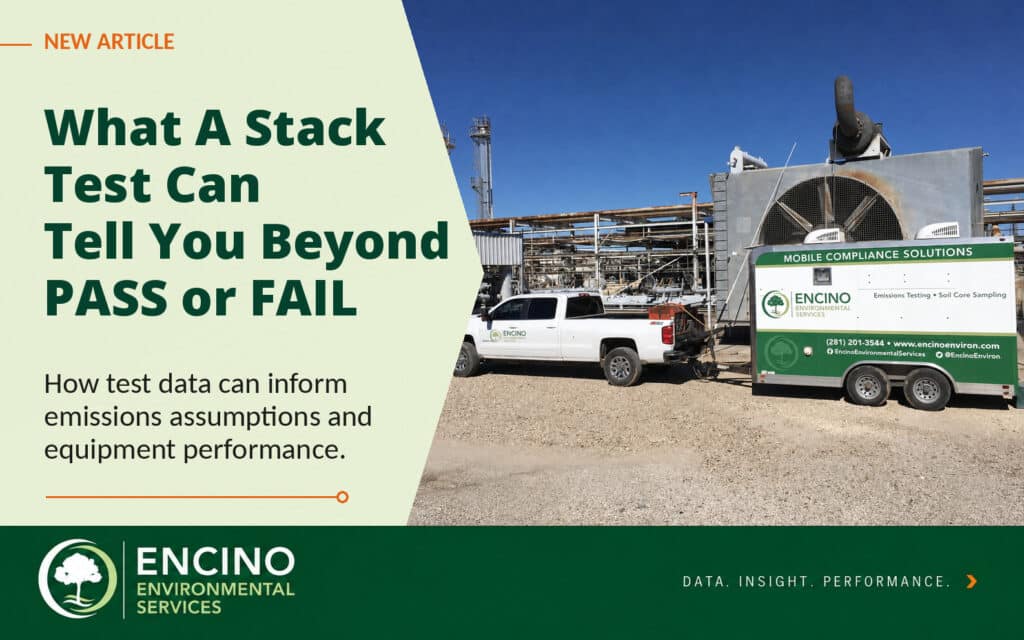
Encino’s Industrial & Commercial Stack Emissions Testing services include compliance and diagnostic testing capabilities for engines, turbines and a range of industrial stationary sources.
5. Strengthen Maintenance and Troubleshooting Decisions
A passing result that sits close to an emission limit deserves attention.
The appropriate response depends on the equipment, pollutant, operating conditions and applicable permit. A smaller compliance margin can prompt a closer review of maintenance history, control equipment, process changes or operational variability before the next required test.
Near real-time emissions data can be particularly useful during diagnostic work because technicians and facility personnel can observe how measured emissions respond as operating conditions change.
Compliance testing itself must still be conducted under the conditions required by the applicable rule or permit.
Diagnostic testing gives teams an opportunity to understand equipment performance before a required compliance demonstration becomes the first time a developing problem appears in the data.
6. Improve the Next Testing Program
Every source test also creates information that can improve future planning.
Sampling access, stack geometry, flow characteristics, operating variability, test duration and equipment configuration can all affect the testing approach.
EPA Methods 1 through 5 address fundamental elements of particulate testing, including sampling location, velocity, gas composition, moisture and particulate measurement. Representative sampling locations and safe access are therefore part of the compliance infrastructure, not simply logistics for the testing contractor.
Facilities planning new equipment or stacks can use lessons from previous testing to improve sampling-port locations, access and site preparation.
Virginia DEQ’s current permitting guidance reinforces that point by requiring data center generator installations to accommodate emissions testing, including appropriate sampling ports and safe access where required.
For more on test preparation, Encino’s Stack Emissions Testing FAQ covers test methods, scheduling, site preparation, reporting and common pre-test questions.
What a Stack Test Alone Cannot Tell You
Good data also requires understanding its limits.
A stack test measures emissions during a defined testing period. It does not automatically describe every operating condition a source may experience throughout the year.
It may also be insufficient to identify the root cause of an unexpected result without additional process, maintenance or diagnostic information.
Where continuous monitoring is required, periodic source testing does not replace ongoing monitoring obligations.
The test method, source operation and compliance basis all influence how results should be interpreted.
That is why operating context belongs alongside the final emissions number.
How Encino Can Help
EPA’s recent New York engine action is a useful example of how regulators connect an emissions limit with testing protocols and records. Virginia’s evolving generator requirements provide another.
The compliance test still has an essential job: demonstrate whether the source meets its applicable requirement under the prescribed test conditions.
The underlying data can also give environmental, operations and maintenance teams a clearer view of how the equipment and controls performed during that test.
Encino Environmental Services provides compliance and diagnostic stack testing for engines, turbines, baghouses, oxidizers, boilers and other stationary sources. Our teams support clients from test planning and field measurement through reporting and regulatory submission.
A strong testing program answers the compliance question and leaves facility teams with data they can use to prepare for what comes next. Contact our experts and lets develop a testing program that helps you optimize your operations.
Sources
- U.S. EPA / Federal Register: Approval of Source-Specific Air Quality Implementation Plan; New York; Big Six Towers Inc., August 14, 2026; effective September 14, 2026
- Virginia Department of Environmental Quality: Air Permits and Data Center Generator Guidance
- Virginia Department of Environmental Quality: Issued Air Permits for Data Centers
- U.S. EPA: Clean Air Act National Stack Testing Guidance
- U.S. EPA: Promulgated Test Methods for Air Emission Sources
- U.S. EPA: Procedures for the Development of Emissions Factors from Stationary Sources