Williams has released its 2025 Sustainability Report, identifying Encino Environmental Services as one of the technology partners contributing to its advanced emissions monitoring and quantification efforts.
Key Takeaways:
- Williams named Encino Environmental among the technology partners supporting emissions monitoring and sensing for its NextGen Gas program.
- The report also identifies Encino as a collaborator helping develop tools that can detect emissions at nearly real-time speeds.
- The recognition reflects the growing importance of measured, transparent and actionable emissions data across the natural gas value chain.
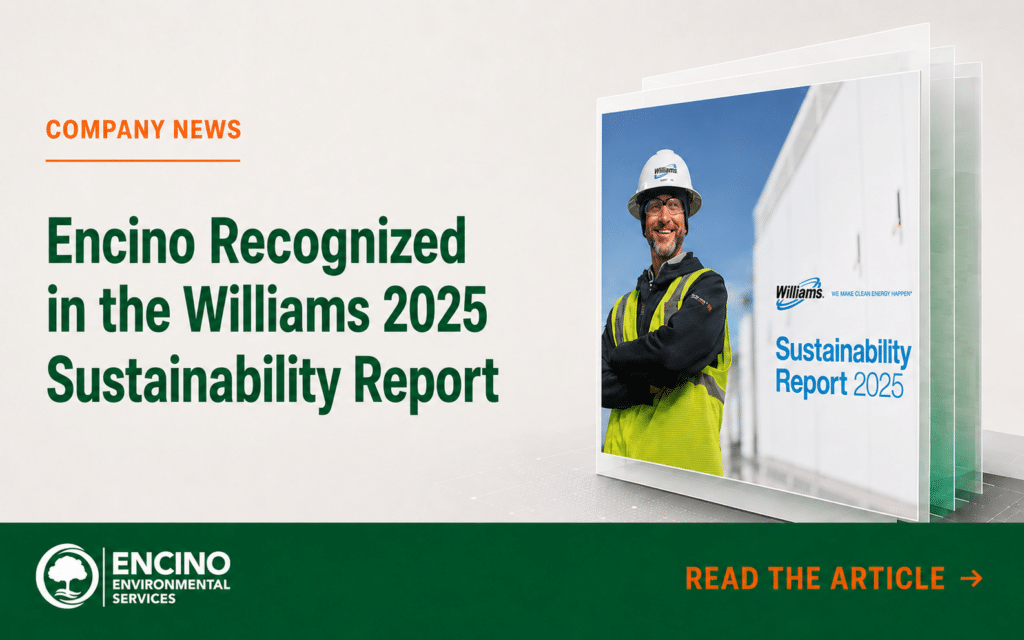
Encino is named in two sections of the report addressing Williams’ NextGen Gas program and its approach to quantification, monitoring, reporting and verification, or QMRV. Together, the references highlight the role that advanced sensing, measurement technologies and integrated emissions data can play in supporting operational improvements and credible environmental reporting.
Supporting a broader NextGen Gas measurement strategy
Williams describes NextGen Gas as a program designed to provide emissions-intensity information across the natural gas value chain. The approach incorporates measurement, monitoring, reporting and verification to create a clearer view of emissions associated with natural gas production, gathering, processing and transmission.
Within that discussion, Williams reports that it has invested in or deployed multiple emissions monitoring and sensing technologies to enhance the program through partnerships with Context Labs, Encino Environmental and LongPath Technologies.
The reference is significant because it places Encino within a broader technology ecosystem focused on improving how emissions are detected, quantified and communicated. It also reinforces an important industry shift: credible emissions performance increasingly depends on measured data supported by multiple monitoring methods, rather than a single technology or data source.
Faster detection can make emissions data more useful
Encino is mentioned again in the report’s QMRV section. Williams states that it collaborates with Context Labs, Encino Environmental and LongPath Technologies to develop tools that help detect emissions at nearly real-time speeds.
Faster detection can shorten the time between an emissions event and field awareness. That can help operators prioritize investigation, determine the appropriate response and maintain stronger records of what occurred and how it was addressed.
Detection alone does not reduce emissions. Its value comes from giving operations and environmental teams timely information they can use to investigate, repair, verify and document. When monitoring data is connected with operational context, it becomes more useful for both day-to-day decision-making and longer-term performance analysis.
Credible reporting begins with credible measurement
Williams describes QMRV as the foundation of its greenhouse gas tracking and reporting programs. The company reports that 143 facilities had been onboarded into its QMRV program by the end of 2025, creating a growing dataset of bottom-up emissions measurements. Williams also expanded its aerial flyover campaign during the year.
This layered approach reflects a practical reality: no single monitoring method answers every emissions question. Component-level inspections can identify specific leaks. Fixed monitoring can provide ongoing awareness at selected locations. Aerial and satellite observations can help screen larger areas. Quantification, operational records and data reconciliation provide additional context needed to interpret findings and support reporting.
The strongest programs bring these inputs together. A coordinated monitoring strategy can help teams identify potential emissions, understand their significance, direct field resources and create a more defensible record of performance.
Collaboration supports better emissions intelligence
Modern emissions management crosses several disciplines, including field operations, environmental compliance, measurement science, software, analytics and reporting. Williams’ recognition of multiple technology partners reflects the need for collaboration across those functions.
For Encino, the recognition also reflects the work our teams continue to do to help operators move from isolated observations toward more complete emissions intelligence. The goal is to make data timely, understandable and useful to the people responsible for operational performance and environmental compliance.
Turning emissions observations into action
Encino helps energy and critical infrastructure operators develop practical emissions monitoring strategies using field services, continuous monitoring and satellite capabilities, quantification and environmental data management. Our teams help organizations turn emissions observations into actionable information that supports compliance and operational performance.
Williams’ 2025 Sustainability Report provides a public example of how advanced monitoring technologies and industry collaboration are becoming part of a more measured and transparent approach to emissions management.