A Practical Guide to Regulations, Risks, and Real-World Solutions
LNG emissions compliance has become one of the most critical challenges facing liquefied natural gas operators in the United States. As regulatory scrutiny intensifies, especially concerning methane and greenhouse gases, LNG operators must navigate a complex web of federal, state, and local requirements while maintaining safe, efficient operations.
For many operators, compliance is no longer just about permits and reporting—it’s about real-time visibility, operational control, and risk reduction.
The Importance of LNG
LNG can play a strategic role in both reducing global emissions from the energy sector and strengthening energy security. A report published by the International Energy Agency (IEA) in June 2025 found:
- When all direct and indirect greenhouse gas emissions are factored in, more than 99% of the LNG consumed in 2024 had lower lifecycle emissions than coal.
- Emissions from LNG supply could be cut by more than 60% using today’s technologies – and many measures could be implemented at low or moderate cost.
- Reducing methane leaks alone could cut annual emissions by close to 90 Mt CO2-eq, or 25% of total LNG emissions, and around half of that reduction could be realized at no net cost.
LNG exporters, including those in the U.S., offer relatively stable and secure energy supply to Europe and other regions. As a clean burning alternative to coal, LNG represents an important energy resource for importing consumers and an economic opportunity for exporters.
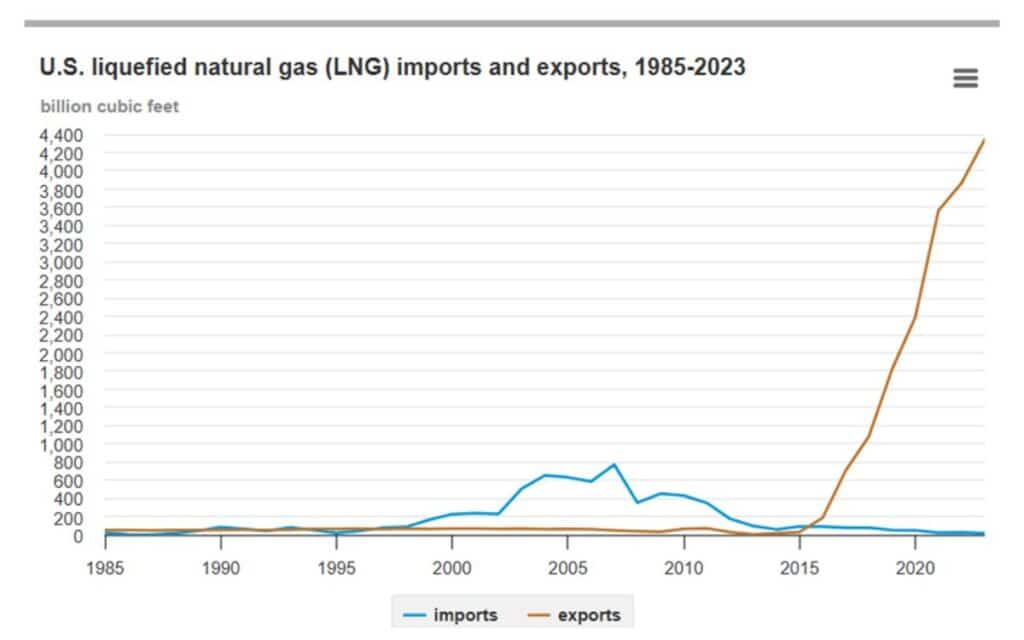
The U.S. Energy Information Administration (EIA) reports that burgeoning natural gas production in the U.S. has resulted in significant increases in LNG exports from America. The chart below illustrates the dramatic increase in LNG exports, facilitated by an increase in U.S. LNG baseload export capacity from approximately 1 billion cubic feet per day (Bcf/d) in 2016 to about 11.44 Bcf/d at the end of 2023.
The top five destination countries of U.S. LNG with their percentage of total exports include The Netherlands (14%), France (11%), United Kingdom (10%), Japan (7%), and South Korea (6%).
Clearly, LNG can play an important role in both reducing global emissions from the oil and gas sector and providing increased energy security for U.S. allies.
LNG facility operators in the U.S., however, are subject to a complex web of federal, state, and local regulations and compliance obligations related to emissions. In this article, we cover the primary regulations impacting LNG facilities in America and solutions for transforming compliance into a competitive advantage.
Understanding LNG Emissions Compliance in the U.S.
There is no single regulation governing LNG emissions compliance. Instead, operators must comply with multiple overlapping programs, primarily under the Clean Air Act, along with greenhouse gas reporting and permitting requirements – making compliance a complicated matter and prone to mistakes.
Even the EPA’s LNG Regulatory Roadmap admits “Permitting requirements vary on a project-by-project basis. For this reason, not all LNG projects apply for the same permits or are subject to the same requirements.” As a result, it is challenging for operators to know exactly what their compliance requirements are.
Clean Air Act (CAA): The Backbone of LNG Emissions Compliance
The Clean Air Act establishes the foundation for LNG emissions compliance through several key programs:
- New Source Performance Standards (NSPS). Regulate methane, VOCs, and combustion emissions from compressors, engines, and flaring systems.
- National Emission Standards for Hazardous Air Pollutants (NESHAP). Require Maximum Achievable Control Technology (MACT) for hazardous emissions.
- Title V Operating Permits. Mandate continuous monitoring, recordkeeping, and reporting for major sources, which includes most LNG facilities.
Depending on its relative position in the value chain, location, size, and equipment, an LNG facility may be subject to multiple CAA provisions. For example, an LNG facility is not mentioned by name as an affected facility under NSPS OOOOb. However, if it operates within the crude oil and natural gas source category, such as in the production, processing, or transmission and storage segments upstream of the local distribution company (LDC) custody transfer point, then any covered equipment at the site (e.g., controllers, pumps, storage vessels, or compressors) must comply with NSPS OOOOb.
By contrast, if the LNG facility is located downstream of the LDC custody transfer point in the distribution segment, NSPS OOOOb does not apply, since the rule does not cover the distribution segment.
The EPA’s LNG Regulatory Roadmap outlines the many stages where its statutory and regulatory responsibilities require the Agency’s involvement in LNG project approval and permitting. The roadmap is not inclusive of all potential requirements but is a good starting point for LNG operators seeking to permit a new liquefaction plant or identify potential compliance requirements.
LEARN MORE: EPA’s Liquified Natural Gas Regulatory Roadmap
Methane Regulations: A Defining Factor in LNG Emissions Compliance
Methane is now at the center of LNG emissions compliance strategies.
Recent EPA rules require:
- Routine Leak Detection and Repair (LDAR)
- Reduction of venting and flaring
- Use of low- or zero-emission equipment (e.g., controllers that use instrument air instead of natural gas).
For LNG facilities, this means tighter control over emissions from liquefaction, storage, and transfer systems.
Greenhouse Gas Reporting (GHGRP)
Under Subpart W, if an LNG facility generates more than 25,000 mt CO2e or more per year, then it must:
- Quantify CO₂ and methane emissions
- Submit annual reports
- Maintain auditable data records
The Natural Gas Transmission & Storage segment is covered by Subpart W, which includes transmission compressor stations, underground storage, and LNG storage, among other types of facilities.
Permitting: NSR and PSD Requirements
New construction or expansions trigger:
- Prevention of Significant Deterioration (PSD) reviews
- Best Available Control Technology (BACT) implementation
- Air modeling and emissions impact analysis
These requirements can significantly impact project timelines and costs if not managed proactively.
LEARN MORE: New Source Review (NSR) Permitting
State-Level Complexity
State agencies often impose stricter standards, adding another layer to LNG emissions compliance. Requirements may include:
- More aggressive methane limits
- Increased monitoring frequency
- Additional reporting obligations
The Reality of LNG Emissions Compliance: Operational, Not Theoretical
LNG emissions compliance is not just a regulatory exercise; it’s an operational discipline.
Facilities must:
- Monitor emissions continuously across multiple sources
- Detect and repair leaks quickly
- Validate flare performance and combustion efficiency
- Generate accurate, defensible data for regulators
LNG facility operators are subject to ongoing emissions monitoring, testing, and reporting requirements across all major systems, from liquefaction trains to storage and transfer points.
How Encino Environmental Simplifies LNG Emissions Compliance
At Encino Environmental Services, LNG emissions compliance is approached as a data-driven, end-to-end solution, not a fragmented set of services.
Encino helps operators move from reactive compliance to proactive emissions management and performance.
LEARN MORE: Emissions Testing & Compliance Solutions for LNG Facilities from Encino Environmental
Permitting Support
Encino maintains a dedicated, full-time Permitting and Compliance team composed of seasoned air quality professionals with deep industry experience. We understand the operational and regulatory demands of the energy sector and leverage that expertise to develop and execute effective permitting strategies for even the most complex projects.
LEARN MORE: Permitting and Regulatory Reporting
Engine and Stack Testing for Compliance Assurance
Encino delivers:
- On-site engine and turbine emissions testing
- Stack testing aligned with EPA protocols
- Measurement of regulated pollutants and GHGs
This ensures operators maintain accurate emissions inventories and defensible compliance data.
LEARN MORE: Industrial & Commercial Stack Emissions Testing
LEARN MORE: Industrial Engine Emissions Performance Testing Services
Advanced Methane Detection & Monitoring
To meet evolving LNG emissions compliance standards, Encino provides:
- Optical Gas Imaging (OGI) for leak detection
- Satellite-enabled monitoring for facility-wide visibility
- Real-time emissions quantification
This enables faster response times and reduces both regulatory risk and product loss.
LEARN MORE: OGI Cameras: Handheld & Fixed Camera Solutions
LEARN MORE: EmSat™ Satellite Emissions Detection
LDAR Programs Built for LNG Facilities
Encino’s LDAR services:
- Meet EPA and state regulatory requirements
- Detect fugitive methane and VOC emissions
- Provide complete, audit-ready documentation
The result is a repeatable, scalable compliance process.
LEARN MORE: Professional LDAR Services
Flare Monitoring & Optimization
Encino ensures flare systems meet LNG emissions compliance standards through:
- Continuous pilot monitoring
- Combustion efficiency tracking
- Automated alerts for non-compliant conditions
LEARN MORE: Advanced Flare Monitoring Systems
Continuous Emissions Monitoring Systems (CEMS)
Encino’s CEMS solutions provide:
- 24/7 emissions data
- Real-time analytics and alerts
- Integrated regulatory reporting
This gives operators the ability to identify issues before they become violations.
LEARN MORE: EmVision™ Quantitative Optical Gas Imaging (QOGI) CEMS system
Consulting & Compliance Strategy
Given the complexity of the regulatory landscape, seeking expert advisory is highly recommended to ensure full compliance.
Encino supports LNG emissions compliance at every stage with:
- Regulatory applicability analysis
- Permitting and compliance planning
- System integration and reporting support
Their experts work directly with your team to ensure full alignment between operations and regulatory requirements.
LEARN MORE: Advisory Services from Encino Environmental
Evolving European Methane Regulations Impacting U.S. Exporters
In May 2024, the European Union adopted a sweeping regulation to reduce methane emissions across the energy sector. The EU Methane Regulation (EUMR) goes into effect on January 1, 2027, requiring LNG importers into the EU will be required to demonstrate that their gas complies with the same monitoring, reporting, and verification (MRV) standards imposed on EU-based producers or face potential penalties and market restrictions.
The EUMR does not define what information importers will be required to present, but it refers to the possibility of demonstrating equivalency with the EU standards through compliance with OGMP 2.0.
Will Jordan, EQT’s chief legal and policy officer told S&P Global “The rules as currently designed make it impossible for any US operator, even ones like EQT, to have confidence that they will qualify. The needed clarity will not come until the rules are revised to address the realities of the US natural gas value chain.”
The IEA reported that the EUMR contains several measures to minimize methane emissions, including but not limited to:
- Mandatory measurement, reporting and verification (MRV) requirements for emissions at the source level, including non-operated assets.
- Emissions must be classified by source type and location.
- Mandatory leak detection and repair (LDAR) of equipment for all oil and gas facilities.
- Obligation for oil, gas and coal sectors to complete inventory, emissions monitoring and mitigation plans for closed, inactive, plugged and abandoned assets.
The EUMR is an evolving issue, and we expect further clarification from regulators as the effective date approaches.
Turning LNG Emissions Compliance into a Competitive Advantage
Forward-looking operators understand that LNG emissions compliance is more than a regulatory burden, it’s an opportunity to:
- Reduce methane losses and increase product recovery
- Improve operational efficiency
- Strengthen environmental performance
- Minimize downtime and compliance risk
With the right systems in place, compliance becomes a driver of performance, not a constraint.
Take Control of Your LNG Emissions Compliance Strategy
The regulatory landscape isn’t getting simpler, but your approach can.
Encino Environmental Services provides the technology, expertise, and field execution needed to simplify LNG emissions compliance and keep your operations ahead of evolving regulations.
Start with a compliance assessment
Whether you’re preparing for new methane rules, upgrading monitoring systems, or navigating permitting, Encino can help you build a smarter, more resilient compliance strategy.
Contact us today to schedule a consultation and take the next step toward confident LNG emissions compliance.