Key Highlights
- EPA finalized the repeal of three major elements of its 2024 Carbon Pollution Standards: the emission guidelines for existing fossil fuel-fired steam generating units, carbon capture requirements for coal units undergoing a large modification, and Phase 2 carbon capture requirements for new base load combustion turbines.
- The 2024 efficiency-based Phase 1 standards for new combustion turbines and the 2015 greenhouse gas New Source Performance Standards remain in effect for now.
- A separate supplemental proposal would repeal all remaining federal greenhouse gas standards for fossil fuel-fired electric generating units under Clean Air Act Section 111.
- The final rule will take effect 60 days after publication in the Federal Register. The proposal will accept comments for 45 days after publication. As of September 16, the official publication dates and deadlines had not been announced.
- Facilities should confirm unit-specific applicability and review other permitting, testing, monitoring, and reporting obligations before changing a compliance plan.
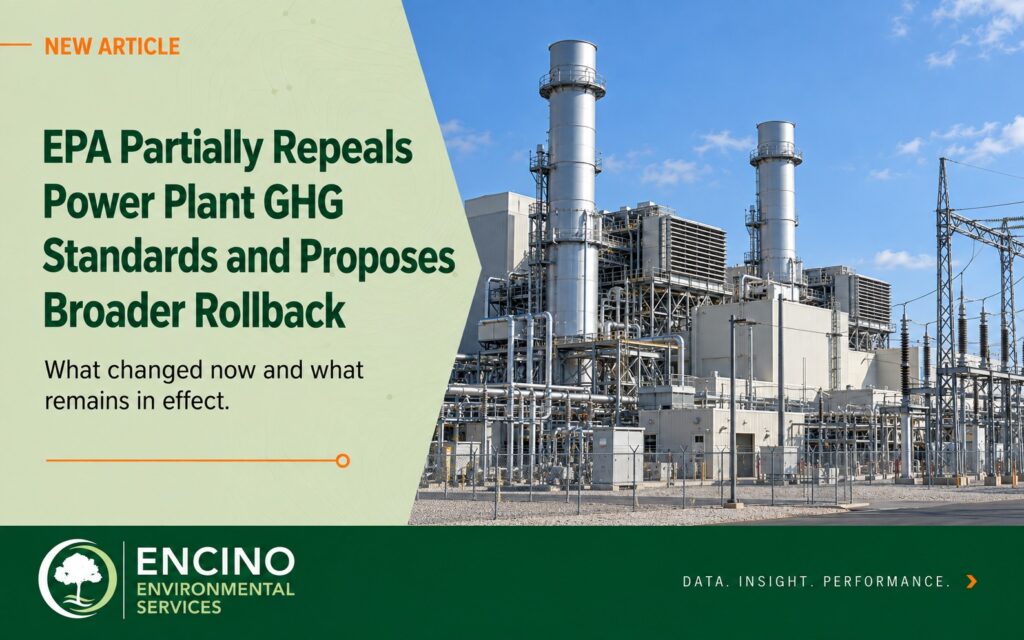
On September 14, 2026, EPA finalized a rule removing most of the 2024 greenhouse gas requirements for fossil fuel-fired power plants. The agency also proposed eliminating the remaining federal standards. For power generators and facilities planning new on-site generation, the immediate question is which requirements changed now and which remain in effect.
The answer depends on which of EPA’s two actions is under review. The partial repeal is final and will take effect after publication in the Federal Register. The broader rollback must complete the public comment and rulemaking process before it can change the remaining requirements.
What EPA Finalized
The 2024 rule used Clean Air Act Section 111 to establish greenhouse gas requirements for existing fossil fuel-fired steam generating units and new or modified electric generating units. Its most significant requirements relied on carbon capture and sequestration or storage, commonly called CCS, and natural gas co-firing as the best systems of emission reduction for certain units.
EPA’s September 2026 final rule repeals:
- The emission guidelines for existing coal-, oil-, and natural gas-fired steam generating units under 40 CFR Part 60, Subpart UUUUb, including the framework that would have required states to develop implementation plans.
- The CCS-based requirements for coal-fired steam generating units undergoing a large modification under Subpart TTTTa.
- The Phase 2 CCS-based requirements for new base load stationary combustion turbines under Subpart TTTTa.
EPA based the repeal on a new evaluation of whether the technologies qualify as the best system of emission reduction under Section 111. The agency concluded that 90 percent CCS has not been adequately demonstrated at the required scale, that its costs are unreasonable, and that the necessary capture, pipeline, and storage infrastructure is unlikely to be available by the January 1, 2032, compliance date established in the 2024 rule.
EPA also concluded that 40 percent natural gas co-firing for certain existing coal units would constitute impermissible generation shifting and would use natural gas inefficiently. The agency cited concerns about whether enough pipeline infrastructure could be placed in service by the January 1, 2030, compliance date.
What Remains in Effect for Now
The final rule does not remove every federal greenhouse gas requirement for power plants. EPA retained the 2024 Phase 1 efficiency-based standards for new stationary combustion turbines. Those standards apply to affected turbines that began construction or reconstruction after May 23, 2023, and set carbon dioxide emission limits according to operating category and unit characteristics.
The 2015 greenhouse gas standards for certain new, modified, and reconstructed fossil fuel-fired electric generating units also remain in place. EPA’s concurrent supplemental proposal would repeal these remaining 2015 standards and the retained portions of the 2024 rule. Until EPA finalizes that proposal and the resulting rule takes effect, affected facilities must continue to evaluate and comply with the standards that remain on the books.
EPA Is Also Proposing a Full Repeal
The proposal goes beyond EPA’s technical reassessment of CCS and natural gas co-firing. It addresses the agency’s underlying authority to regulate power plant greenhouse gas emissions under Clean Air Act Section 111. EPA proposes that Section 111 does not authorize those regulations in response to global climate change concerns and would rescind the findings it made for fossil fuel-fired power plants in 2015 and retained in 2024.
The legal argument follows EPA’s February 2026 rescission of the 2009 greenhouse gas Endangerment Finding for motor vehicles. The agency also cites recent Supreme Court decisions, including West Virginia v. EPA and Loper Bright Enterprises v. Raimondo, in support of its revised interpretation of federal authority.
If finalized as proposed, the action would eliminate the remaining Section 111 greenhouse gas standards for fossil fuel-fired electric generating units, including the Phase 1 efficiency requirements for new combustion turbines and the 2015 standards for units constructed, modified, or reconstructed during the earlier applicability period.
EPA Projects Cost Savings and Higher Emissions
EPA’s public announcement highlights $310 billion in estimated savings from the final partial repeal. According to the agency’s Regulatory Impact Analysis, that figure represents an estimated reduction in economy-wide social costs from 2026 through 2047. The model does not account for changes in environmental quality.
The direct power-sector compliance savings are lower. EPA estimates a present value of $160 billion using a 3 percent discount rate and $95 billion using a 7 percent discount rate. For the broader supplemental proposal, the agency estimates an additional $370 million in present-value compliance cost savings at a 3 percent discount rate through 2047.
The analysis also projects higher power-sector carbon dioxide emissions compared with a baseline in which the 2024 standards remain in place. The estimated annual increases are 20 million metric tons in 2030, 406 million metric tons in 2035, 533 million metric tons in 2040, and 486 million metric tons in 2045. EPA did not monetize the climate effects of the additional carbon dioxide or the health and welfare effects associated with changes in other emissions. The analysis lists those effects as nonmonetized impacts.
The projected effect on retail electricity prices also varies by year. EPA’s model shows a 0.7 percent national increase in 2030, followed by decreases of 5.8 percent in 2035, 1.1 percent in 2040, and 2.6 percent in 2045. These figures are model projections rather than guaranteed changes in customer rates.
The Change Arrives During Rapid Growth in Power Demand
The timing is especially relevant for utilities, power developers, and large energy users. On September 9, the U.S. Energy Information Administration forecast record U.S. electricity generation in 2026 and additional growth in 2027. EIA identified data center development and increased manufacturing activity as leading drivers of higher commercial and industrial demand, with the West South Central region contributing the largest regional share of electricity sales growth in its forecast.
EIA expects natural gas to provide about 40 percent of U.S. electricity generation in both years. As utilities and critical infrastructure operators evaluate new generation, the September 14 rule removes a future CCS requirement for certain new base load turbines. The remaining Phase 1 efficiency standards still require an applicability review while EPA considers the broader repeal.
What Owners and Operators Should Review
Power plant owners, project developers, and facilities considering on-site generation should separate the requirements removed by the final rule from those that remain. Applicability depends on factors that include unit type, design capacity, construction or reconstruction date, operating profile, and electric sales. A behind-the-meter project should still evaluate whether each unit meets the regulatory definition of an affected electric generating unit.
The September action addresses greenhouse gas requirements for a defined source category under Clean Air Act Section 111. It does not automatically remove separate obligations under facility permits, New Source Review or Prevention of Significant Deterioration programs, Title V, standards for criteria pollutants or hazardous air pollutants, or state and local rules. Testing, monitoring, recordkeeping, and reporting requirements should remain in place unless the facility confirms that their specific legal or permit basis has changed.
The final rule is a prepublication version as of this draft. Its effective date will be 60 days after Federal Register publication. EPA plans a virtual public hearing on the supplemental proposal after publication and will accept comments for 45 days. Reuters also reported that legal challenges are expected. Facilities should track the official publication, any litigation or court orders, and subsequent guidance before relying on the announcement for compliance decisions.
Encino Perspective
Federal policy for power-sector greenhouse gas emissions has shifted quickly, while facility-level obligations still depend on the details of each unit and permit. A current applicability review can help owners distinguish repealed requirements from active federal, state, and permit conditions before making design, operating, or compliance-calendar changes.
Encino Environmental Services supports power generation and critical infrastructure projects with air permitting regulatory applicability reviews, engine/stack testing, and emissions monitoring. Our team can help facilities identify which requirements changed, document the basis for applicability decisions, and maintain the testing and reporting programs that continue to apply.
Sources
- U.S. EPA, Greenhouse Gas Standards and Guidelines for Fossil Fuel-Fired Power Plants, updated September 14, 2026
- U.S. EPA, Partial Repeal of the Carbon Pollution Standards for Fossil Fuel-Fired Electric Generating Units, signed September 14, 2026
- U.S. EPA, Supplemental Proposal on Greenhouse Gas Findings and Power Plant Regulations, signed September 14, 2026
- U.S. EPA, Regulatory Impact Analysis for the Final Partial Repeal, September 2026
- U.S. EPA, Economic Impact Analysis for the Supplemental Proposed Rule, September 2026
- U.S EPA, Final Rule Rescinding the 2009 Greenhouse Gas Endangerment Finding, February 12, 2026
- U.S Energy Information Administration, EIA Expects Record Electricity Generation in 2026 and 2027, September 9, 2026
- Reuters, U.S. EPA Repeals Carbon Emission Limits for Power Plants at G20 Meeting, September 14, 2026