New Mexico’s Proposed Super-Emitter Program: New Timelines for Methane Detection, Investigation and Repair
A new stakeholder draft would connect remote methane detection with rapid investigation, repair and reporting requirements for oil and gas operators.
Key Takeaways
- New Mexico’s July 16 stakeholder draft would create a state methane super-emitter response program built around certified third-party remote sensing.
- The proposed super-emitter threshold is 50 kg/hr of methane, half the 100 kg/hr threshold used by EPA’s federal Super Emitter Program.
- After NMED notification, operators could have just three calendar days to complete an investigation and required repairs, followed by a 15-day reporting deadline.
- If existing records do not identify the source, the draft could require facility screening using EPA Method 21 or optical gas imaging (OGI), increasing the importance of rapid source attribution and field readiness.
- A separate provision would require zero methane emissions from applicable natural gas-driven process controllers at specified facilities beginning January 1, 2031.
- The rule is still a stakeholder review draft. NMED is accepting comments through July 29, 2026, and the requirements may change through rulemaking.
A methane plume detected from the air or from space could eventually trigger a formal investigation and repair timeline for oil and gas operators in New Mexico.
On July 16, 2026, the New Mexico Environment Department (NMED) released a stakeholder review draft of a new Methane Abatement Rule, 20.2.51 NMAC. The proposal would establish a state super-emitter response program built around remote methane detection and create a zero-methane-emission standard for certain natural gas-driven process controllers beginning in 2031.
Under the current draft, a qualifying detection reported by a certified third party could lead to NMED notification, facility investigation, leak identification and repair, verification and regulatory reporting within defined timelines. The rule is still early in the regulatory process, and the requirements could change before a final rule is adopted.
A New Framework for Responding to Super-Emitter Events
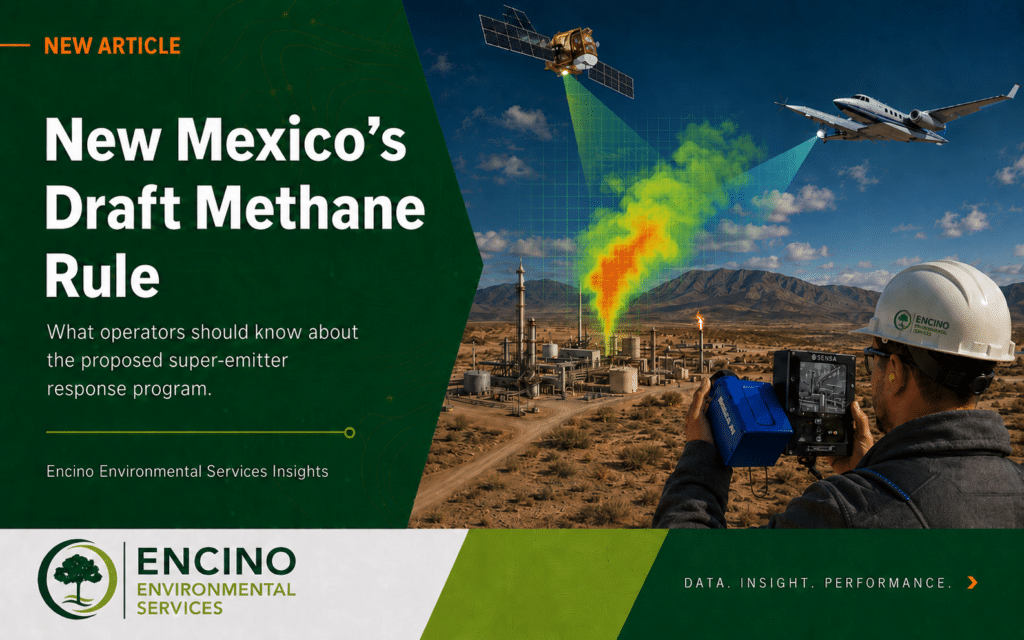
The draft defines a super-emitter event as a methane emissions event detected using an NMED-approved remote sensing technology and detection method with an emission rate of 50 kilograms per hour or greater. That threshold is notably lower than the 100 kg/hr threshold used by EPA’s federal Super Emitter Program.
NMED would establish a certification process for third-party organizations using approved remote methane sensing technologies, including:
- Satellite detection
- Remote methane sensing equipment on aircraft
- Other remote methane sensing technologies approved by NMED
The state draft outlines an application and certification process, but key implementation details remain worth watching, including how NMED may treat technologies or third parties already approved under the federal program. Encino previously covered the federal certification framework in Understanding the Super Emitter Response Program: A Proactive Approach to Emissions Management.
Certified third-party notifiers could submit qualifying detections to NMED along with the measured methane emission rate and uncertainty, geographic coordinates, detection technology, supporting imagery and other required information. This creates a regulatory pathway that directly connects advanced remote sensing with operator response.
The Response Timeline Could Move Quickly
A certified third-party notifier would generally have seven calendar days from the date of detection to submit a qualifying super-emitter event to NMED. That window could require rapid processing, validation and review of detection data before submission.
NMED would then notify owners or operators of sources located within 50 meters of the detected event location within three business days of receiving the third-party notification. Under the draft, a source falls within that radius when any portion of its property boundary lies within 50 meters of the event location. NMED would also make the notification publicly available on its website.
The 50-meter notification framework puts added emphasis on accurate geolocation and source attribution. For satellite-based detections, factors such as pixel size, spatial resolution and plume localization can influence how confidently an event can be associated with a particular facility or source.
Once an operator receives a notification from NMED, the proposed response window becomes much tighter. The current draft would require the operator to complete the super-emitter investigation and required repairs within three calendar days of receiving the department’s notification. That timeline could place a premium on established response procedures, access to qualified field personnel and reliable emissions data before a notification arrives.
From Remote Detection to Field Investigation
Operators would first verify whether their source falls within the specified 50-meter area. If it does, they would investigate whether activity at the facility could explain the emissions detected. The investigation would include reviewing at least 30 days of relevant information preceding the detection, including:
- Maintenance and process activities
- Monitoring data
- Fugitive emissions surveys or periodic screenings
When those records do not identify the source of the super-emitter event, the draft would require screening of the facility to identify potential emission sources. That investigation could include EPA Method 21 or optical gas imaging (OGI) to identify leaking components, along with visual, audio and olfactory inspections.
This is where remote detection and field-level emissions management converge begin to converge. A satellite or aircraft may identify the presence and approximate location of a significant methane plume across a large area. Field investigation is then needed to determine what is happening at the equipment level and identify the specific source or sources responsible for the emissions.
Detection → Location → Investigation → Source Assessment → Repair → Verification → Documentation
The effectiveness of that response depends on how quickly an operator can connect information gathered from different technologies and translate it into action in the field.
Repair and Verification Requirements Could Be Broad
The proposed repair provisions are also important:
- When an operator can attribute the super-emitter event to a specific leak or group of leaks by quantifying the associated emission rate, the identified leak or leaks would need to be repaired.
- When the operator cannot attribute the super-emitter event to a specific leak or leaks, the draft would require the operator to repair all leaks identified during the investigation.
- Repairs would then need to be substantiated through re-monitoring using EPA Method 21 or OGI.
Finding methane at a facility may only be the first step. Being able to identify, quantify and document the sources associated with a large emissions event could help operators build a clearer technical record of what occurred and how the event was addressed.
Reporting Would Follow the Field Response
Operators that receive a super-emitter notification and conduct the required investigation would have to submit a super-emitter event report within 15 calendar days of receiving the original NMED notification. The report would include information about the facility, investigation, identified leaks and repair actions, and a company representative with knowledge of the investigation would certify its accuracy and completeness.
Records associated with super-emitter notifications, investigations and repairs would have to be retained for at least five years. Taken together, the proposed requirements reinforce the connection between emissions detection, field response and defensible documentation.
A Second Major Provision Targets Natural Gas-Driven Process Controllers
The proposed super-emitter program is only one part of the draft rule. Beginning January 1, 2031, designated facilities would have to operate applicable natural gas-driven process controllers with zero methane emissions to the atmosphere.
The proposed requirements would apply to collections of natural gas-driven process controllers at:
- Well sites
- Tank batteries
- Gathering and boosting stations
- Natural gas processing plants
- Transmission compressor stations
Under the draft, operators could comply by routing emissions back to a process through a closed vent system or by using self-contained natural gas-driven process controllers designed to prevent methane emissions to the atmosphere. Routing emissions to a control device alone would not meet the proposed standard.
The draft also includes inspection, monitoring, reporting and recordkeeping requirements to demonstrate ongoing compliance. These controller requirements are distinct from other methane sources at the same facilities, including tank-related emissions, so operators may need to consider them as part of a broader site-wide emissions strategy.
While the 2031 implementation date gives operators more time to prepare for the process-controller provisions, the proposed super-emitter program presents a more immediate question: how prepared is an organization to respond when a significant methane event is detected from outside the facility?
Remote Detection Is Becoming More Connected to Operational Response
The broader signal from New Mexico’s proposal is the growing connection between top-down methane intelligence and bottom-up field investigation. Satellites, aircraft and other remote sensing technologies can help identify emissions across large operating areas. OGI, Method 21 and other field-level technologies can then help locate and characterize emissions at individual facilities and equipment.
Together, these perspectives can provide a more complete operational picture. Top-down systems help operators identify where to look, while field-level technologies help determine what is happening at the source and support targeted response.
As these technologies become more integrated into regulatory programs, operators may need processes that allow them to move efficiently from a large-scale detection to a targeted field response while maintaining the data and records needed to explain what was found and what actions were taken.
New Mexico’s draft Methane Abatement Rule provides a clear example of how that connection could work in practice. A remote detection could begin the process. The operator’s ability to investigate, verify, repair and document the event would determine what happens next.
What Operators Should Be Watching
The July 16 document is still a stakeholder review draft, and NMED may revise the proposal based on feedback before beginning formal rulemaking.
NMED is accepting comments through 11:59 p.m. on July 29, 2026. The department currently plans to petition the New Mexico Environmental Improvement Board to adopt 20.2.51 NMAC on August 12 and request that the Board consider the petition at its August 28 meeting. NMED anticipates requesting a formal public hearing beginning around December 7, 2026.
Operators should watch several areas as the proposal develops, including third-party certification and technology approval requirements, source-attribution expectations, investigation and repair timelines, and any revisions to the process-controller provisions.
The details may change through rulemaking. The direction is already worth watching closely: advanced methane detection is increasingly being connected to faster, more structured operational response.
From Detection to Documentation: How Encino Can Support New Mexico Operators
If the proposed rule moves forward largely as drafted, operators may need a response strategy that connects remote detection, source attribution, field investigation, repair verification and documentation. Encino Environmental Services can support New Mexico operators with regulatory, sustainability and technical strategy; EmSat™ satellite methane monitoring; fixed and mobile OGI monitoring; LDAR using OGI and EPA Method 21; emissions quantification; and field-based leak investigation.
Encino also offers technologies that can strengthen broader methane management across affected facilities, including EmVision™ fixed continuous monitoring, the Enviromech™ Composite Thief Hatch and SNITCH™ Tank Vapor Intelligence System for tank-related emissions, and MOLE-DAS™ Combustion Intelligence System where combustion sources are part of the emissions profile. Together, these services and technologies can help operators build a more connected approach to detecting, understanding and addressing emissions while maintaining a clear, defensible record of the actions taken.