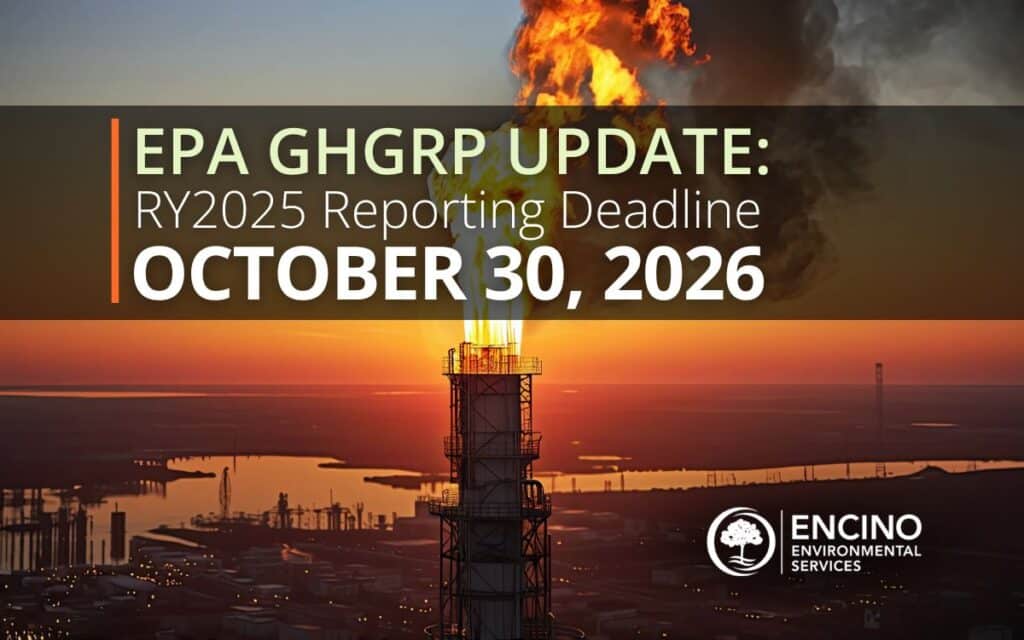
The U.S. EPA has finalized a rule extending the Greenhouse Gas Reporting Program (GHGRP) reporting deadline for reporting year 2025. Instead of the usual March 31, 2026 deadline, facilities and suppliers subject to 40 CFR Part 98 now have until October 30, 2026, to submit their annual greenhouse gas reports.
For companies that rely on accurate emissions data, internal coordination, and timely reporting, this extension creates additional breathing room. It also introduces an important planning consideration: while the deadline has moved, the underlying need for strong data, documentation, and reporting readiness remains unchanged.
What the Final Rule Does
In this final action, EPA amended the general provisions in 40 CFR 98.3(b) to add a new paragraph extending the reporting deadline for calendar year 2025 to October 30, 2026. EPA made clear that this extension applies only to the RY2025 reporting deadline.
This distinction matters because the EPA did not finalize the broader set of changes discussed in its earlier GHGRP reconsideration proposal as part of this action. Instead, the Agency separated the deadline extension from the rest of the proposal, giving regulated entities more certainty while EPA continues evaluating the broader package.
Why EPA Extended the Deadline
EPA explains that the extension is intended to give the Agency time to review comments on its broader GHGRP reconsideration proposal and take any additional final action before the revised reporting deadline. The Agency also notes that the additional time could allow regulated entities to benefit from any burden-reduction revisions that may still be finalized for reporting year 2025, while also giving reporters adequate time to prepare and submit their reports.
According to EPA, the Agency received more than 50,000 comments on the 2025 GHGRP reconsideration proposal, though only a small number addressed the reporting deadline specifically. EPA states that those comments were supportive of an extension. Some commenters emphasized the importance of certainty for the regulated community, while others pointed to the need for adequate time to work in the e-GGRT system and avoid unnecessary cost and effort. EPA ultimately concluded that extending the deadline to October 30, 2026, would better provide certainty and appropriate compliance time than the earlier proposed date of June 10, 2026.
Who This Impacts
The GHGRP applies to a wide range of entities, including certain direct emitters, suppliers of greenhouse gases and fossil fuels, and industries involved in CO2 sequestration. EPA states that the program generally covers certain industrial facilities, primarily large facilities emitting at least 25,000 metric tons of CO2e, as well as upstream suppliers and CO2 injection or sequestration operations.
The reach of 40 CFR Part 98 extends across a broad mix of industrial sectors, including fuel combustion sources, electric power generation, petroleum and natural gas systems, refineries, hydrogen production, landfills, and industrial wastewater treatment, among others. That broad applicability is one reason this deadline change is relevant to a wide cross-section of reporting entities.
What This Means for Reporting Teams
At first glance, a seven-month extension may feel like a reason to move greenhouse gas reporting lower on the priority list. In practice, it is better viewed as an opportunity to improve reporting quality, strengthen documentation, and prepare for whatever additional GHGRP changes may follow.
EPA explains that annual reports are submitted through the electronic Greenhouse Gas Reporting Tool, or e-GGRT, and then undergo a multi-step verification process. If EPA identifies a potential issue, the reporter may need to explain why the item is not an error or submit a corrected report.
That means successful reporting is not just about meeting a deadline. It also depends on having defensible calculations, complete records, the right internal inputs, and enough time to resolve issues if they surface.
Why This Matters for Oil and Gas and Other Industrial Operators
For operators managing multiple assets, reporting obligations can already be complex. Emissions data may come from several systems, operational teams, and service providers. Internal reviews can take time. And when rules are in flux, teams must often prepare for multiple scenarios at once.
EPA specifically states that the extension is meant to give regulated entities time to react to later final decisions. If EPA ultimately retains many current reporting obligations, reporters will need enough time to comply. If EPA later finalizes rescissions or revisions, reporters will need enough time to adjust their compliance efforts without wasting time and resources.
In other words, the extension buys time, but it also reinforces the need for a thoughtful compliance strategy.
Where Encino Can Add Value
Encino helps clients build confidence in the data behind their greenhouse gas reporting through emissions measurement, testing, monitoring, and advisory support. Better data supports stronger compliance, but it can also provide valuable insight into how systems are actually performing.
When an emissions issue is investigated thoroughly, it often reveals more than a number for a report. It may point to inefficient combustion, equipment deterioration, process variability, control issues, or other operational conditions that are contributing to emissions. Understanding and correcting those causes can help improve reporting accuracy while also supporting more efficient and reliable operation.
Encino’s approach is grounded in comprehensive, actionable, and auditable data. That means helping clients not only prepare for reporting obligations but also get more value from the measurement process itself. With the extended deadline now in place, facilities have a chance to do more than complete a report. They have time to strengthen the quality of their reporting inputs and gain a clearer picture of where operational improvements may exist.
For facilities subject to GHGRP requirements, that is a practical opportunity worth using.