
What Asphalt Plant Operators Need to Know About Air Emissions Compliance
Under the Clean Air Act (CAA), hot mix asphalt (HMA) plants must comply with federal air emissions regulations, including periodic stack testing to verify compliance. In addition, many states and local jurisdictions impose their own requirements, creating a layered regulatory landscape that can be challenging for plant operators to navigate.
This article reviews the federal regulations governing asphalt plant emissions and the critical factors operators should consider when planning compliance and testing programs.
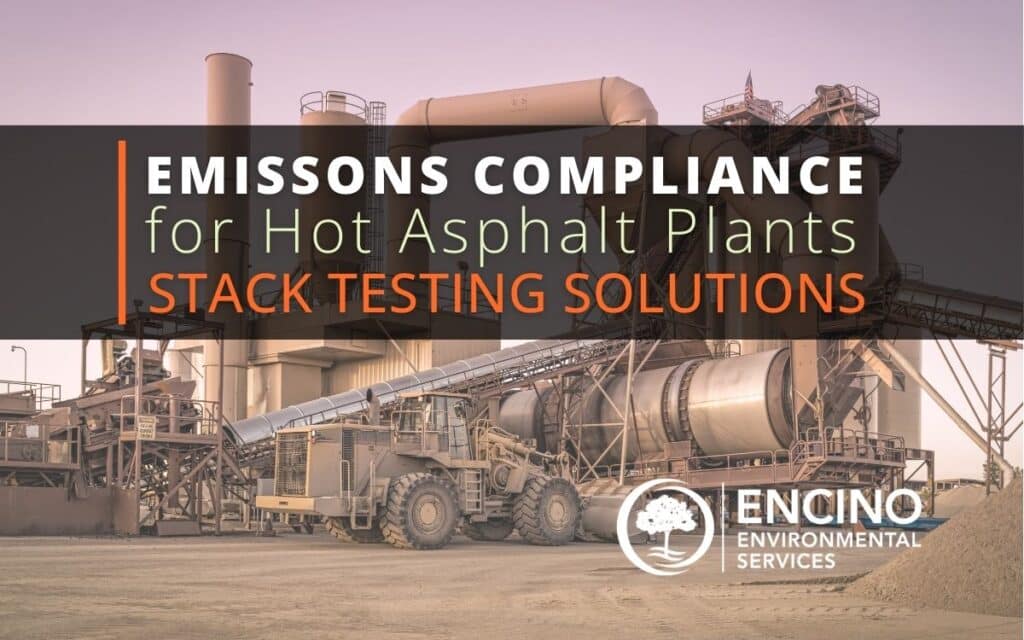
Federal Stack Testing Requirements (EPA)
New Source Performance Standards NSPS Part 60 Subpart I is the core federal regulation governing air emissions from hot mix asphalt plants. The regulation applies to any HMA facility that commences construction, modification, and/or expansion after June 11, 1973.
The rule defines a hot mix asphalt facility as any facility used to manufacture hot mix asphalt by heating and drying aggregate and mixing with asphalt cements.
This includes any combination of the following: dryers; systems for screening, handling, storing, and weighing hot aggregate; systems for loading, transferring, and storing mineral filler, systems for mixing hot mix asphalt; and the loading, transfer, and storage systems associated with emission control systems.
Additionally, a HMA plant can be constructed as a permanent plant, a skid-mounted (easily relocated) plant, or a portable plant. All plants can have Reclaimed Asphalt Pavement (RAP) processing capabilities.
READ MORE: EPA – Hot Mix Asphalt Facilities: New Source Performance Standards (NSPS)
What Gets Measured and How?
The primary pollutant subject to testing is Particulate Matter (PM) as measured from the aggregate dryer exhaust stack or baghouse stack. Opacity (visible emissions) is regulated separately and is not measured by stack testing.
Standard for Particulate Matter
Under NSPS Subpart I, stack emissions must contain particulate matter less than or equal to 0.04 grains per dry standard cubic foot (gr/dscf).
- EPA Method 5 is used to measure PM concentration with the sampling time and sample volume for each run must be at least 60 minutes and 0.90 dry standard cubic meter or dscm (31.8 dscf).
Standard of Opacity:
- Any emissions must exhibit 20% opacity or less.
- EPA Method 9 is used to determine opacity from Stack Emissions.
- EPA Method 22 is used to determine opacity for fugitive emissions.
SOURCE: 40 CFR Part 60 Subpart I (up to date as of 12/12/2025)
How Often Are Stack Tests Required for Hot Mix Asphalt Plants?
An initial performance test is required after startup of an affected facility within 60 days of achieving normal production capacity (can vary by state), but not later than 180 days. The purpose of this test is to demonstrate initial compliance with PM emission limits.
Federal NSPS rules do not mandate routine periodic stack testing, however, states have their own requirements.
State Periodic Stack Testing Requirements
It is important to keep in mind that federal NSPS Subpart I sets the baseline (initial PM test using EPA Method 5 with a 0.04 gr/dscf limit), but periodic testing schedules are set by state rules, permit templates, or local air district rules.
Additionally, states may require testing on more substances than PM and opacity as required by the EPA, and state permit limits for regulated substances (including PM and opacity) may be even more restrictive than federal requirements but cannot be less.
The table below summarizes some of the state requirements for Hot Mix Asphalt plants as of December 17, 2025.
| STATE | TYPICAL PERIODIC TESTING REQUIREMENT | SOURCE/WHERE SPECIFIEC |
|---|---|---|
| Texas | Permit-driven; many TCEQ permit templates and guidance call for performance testing at initial startup and thereafter at least every 5 years unless monitoring/data in lieu is accepted. TCEQ also allows “data in lieu of testing” under conditions. | TCEQ guidance & rule language referencing 5-year testing and DILOT guidance. (TCEQ) |
| New York | State rulemaking and individual permits require initial testing and recordkeeping; Subpart 220-3 and facility permits specify testing/monitoring and may require periodic tests on permit renewal or for compliance determinations. | NY Subpart 220-3 rule and example facility permit/summary. (New York State DEC External Applications) |
| Pennsylvania | Department source-testing protocol for HMA (SP-013) defines operating/test conditions; permits commonly require initial test and routine re-testing tied to permit terms or when operating conditions change (permit language in GP templates). | PA DEP Standard Protocol SP-013 and Hot Mix General Permit materials. (Pa DEP Files) |
| Minnesota | Clearly prescriptive by rule (Minn. R. 7011.0920): frequency tied to production: every 3 years for ≤100k tons, every 2 years for 100–200k tons, immediate testing after >200k tons production, special rules for very small plants. (Exact production thresholds and timing are in the rule.) | Minn. R. 7011.0920 performance test requirements. (Revisor Minnesota) |
| North Carolina | DAQ Emission Testing Frequency Policy sets a baseline of once every 120 months (10 years) unless other factors (non-attainment, equipment changes, complaints) require more frequent testing. | NC DEQ / DAQ Emission Testing Frequency Policy. (NC Department of Environmental Quality) |
| Arizona | ADEQ Hot Mix Asphalt General Permit includes explicit testing/monitoring conditions; frequency is permit-specified (permit attachments set monitoring and when tests are required). Many facilities operate under this GP which sets the enforceable testing obligations. | AZDEQ HMAP General Permit (permit attachments & testing requirements). |
| Colorado | Testing is permit/permit-renewal driven; CDPHE guidance/fact sheets note testing and monitoring expectations, with permit conditions determining periodicity (often required at initial startup and on a case-by-case basis thereafter). | CDPHE HMA fact sheet and AQCC rules referencing test methods and permit authority. (CSU Digital Repository) |
| Florida | Plants operate under an Air General Permit; the AGP and permit conditions govern performance testing and recordkeeping — periodic performance testing is generally permit-driven/triggered (AGP materials and handouts explain when testing or records are required). | Florida DEP Asphalt Concrete Plant AGP information and SIP/AGP materials. (FDEP) |
| Georgia | State permit templates and EPD permit conditions set performance testing schedules; Georgia frequently uses permit-driven testing (initial test + follow-up testing frequency can be reduced if monthly Method 22 checks show no visible emissions). | Georgia EPD permit templates, rules and testing/monitoring procedures. (Environmental Protection Division) |
Please note that this list is not all-inclusive, regulations are subject to change at any time without notice, and Encino does not represent it will update this table in a timely manner or at all. Readers are encouraged to seek qualified guidance from Encino.
The best way to know what your periodic testing requirements are is to read your air permit!
READ MORE: The Top 10 Essentials for Optimal Stack Testing Services
Why Choose Encino Environmental for Hot Mix Asphalt Plant Stack Testing
Stack testing is complex and seldom straightforward, but Encino’s deep expertise and proven track record ensure you’re guided through every step to help achieve compliance with confidence. Our combination of expert personnel, mobile testing labs, rigorous QA protocols, positive rapport with regulatory agency staff, and customer-focused service ensures that every test is:
- Accurate and defensible
- Compliant with EPA and state regulations
- Delivered with minimal disruption to your operations
- Completed with minimal need for you to interact with regulatory agencies
We take the headache out of emissions testing by managing the entire process, from preparation to regulatory submission, and answering questions from regulatory staff so your team can focus on running your facility safely and efficiently.
