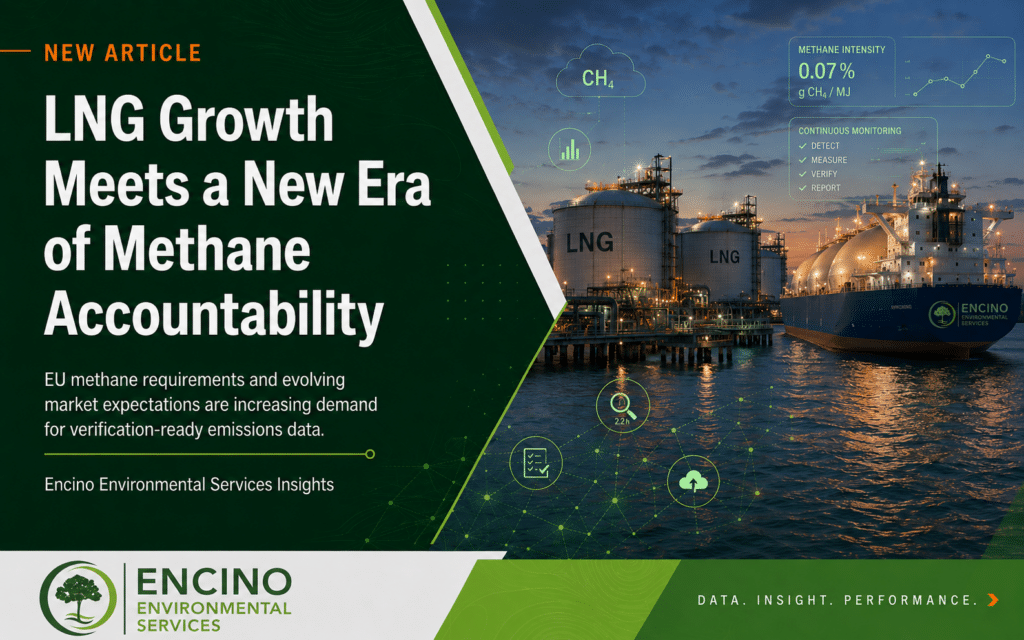
EU methane requirements and evolving market expectations are increasing demand for verification-ready emissions data.
U.S. LNG exports are expected to keep growing in 2026 and 2027, even as methane reporting and verification expectations become more complex for companies supplying global markets.
That combination is creating challenges for the natural gas value chain. Export demand continues to rise, while buyers, regulators, and international markets are focusing on how methane emissions are measured, documented, and verified.
For operators, the question is no longer limited to whether methane emissions are being managed. The question is whether emissions performance can be supported with data that is consistent, traceable, and ready for review.
LNG Demand Continues to Grow
The U.S. Energy Information Administration expects U.S. LNG exports to continue increasing over the next two years. In its June 2026 Short-Term Energy Outlook, EIA projected U.S. LNG exports at 15.1 billion cubic feet per day in 2025, 17.2 billion cubic feet per day in 2026, and 18.6 billion cubic feet per day in 2027.
That growth reflects the continuing role of U.S. natural gas in global energy supply. LNG remains an important fuel source for countries working to balance reliability, affordability, and emissions reduction goals.
At the same time, LNG growth is bringing more scrutiny. As gas moves through production, processing, transport, liquefaction, shipping, and import markets, methane performance is becoming part of the broader conversation around energy security, environmental accountability, and commercial access.
Many operators are already familiar with the broader compliance implications of LNG growth. In a previous Encino article, LNG Emissions Compliance: What U.S. Operators Need to Know to Stay Ahead, we explored how evolving emissions expectations are influencing LNG supply chains. This discussion takes that conversation a step further by focusing on the growing importance of methane documentation and verification-ready data.
Learn more: LNG Emissions Compliance: What U.S. Operators Need to Know to Stay Ahead
EU Methane Requirements Are Adding Pressure
The European Union’s methane regulation is one of the clearest examples of how international expectations are changing.
The regulation phases in several requirements for imported oil, natural gas, and coal. Importers began qualitative reporting requirements in 2025, including information related to origin, route, and the monitoring, reporting, verification, and leak detection and repair measures applied to imported fuels.
Beginning January 1, 2027, importers must demonstrate that imported crude oil, natural gas, or coal was produced in a jurisdiction with monitoring, reporting, and verification requirements equivalent to those applied in the EU. For oil and gas, another pathway is OGMP 2.0 Level 5 reconciliation plus verification.
Additional methane intensity reporting requirements begin in 2028, followed by methane intensity requirements scheduled for 2030.
For U.S. LNG suppliers and their customers, this creates commercial uncertainty. Reuters reported in May that U.S. gas exporters are asking Europe for more clarity around implementation, warning that regulatory uncertainty is already affecting long-term contract discussions with European customers.
This is where the issue extends beyond regulation. Methane documentation is becoming part of how LNG is evaluated in the marketplace.
Measurement Expectations Are Moving Forward
Methane reporting has historically relied on a mix of emissions factors, engineering calculations, operating assumptions, inspection records, and direct measurement. Those tools still have a role, but market expectations are moving toward stronger documentation and better reconciliation between reported emissions and observed field conditions.
The International Energy Agency’s Global Methane Tracker 2026 reinforces the scale of the issue. The IEA estimates that the energy sector, including oil, natural gas, coal, and bioenergy, accounts for around 40 percent of methane emissions from human activity. The report also points to the growing role of updated data sources, including satellite observations and measurement campaigns.
This trend aligns with themes discussed during the most recent OGMP 2.0 Annual Conference, where industry leaders emphasized the shift toward measurement-informed methane management. As highlighted in Encino’s conference recap, operators are increasingly expected to support emissions inventories with stronger measurement data and reconciliation practices. Those same expectations are beginning to influence LNG markets, where buyers and importers are paying closer attention to how methane performance is documented.
For operators, this creates a practical takeaway: methane performance needs to be measured, managed, and documented in a way that can withstand closer review.
That does not mean every operator needs the same technology, the same monitoring cadence, or the same reporting framework. It does mean that disconnected data, incomplete records, and inconsistent field documentation can create risk when customers or regulators request support for emissions claims.
Readers interested in the broader industry shift toward measurement-based methane management can find additional context in Encino’s article, OGMP 2.0 Annual Conference Signals a More Measurement-Driven Future for Methane Management.
The Data Trail Is Becoming Part of LNG Readiness
As LNG exports expand, methane documentation will likely become more connected to commercial access, customer confidence, and long-term supply agreements.
A strong methane data trail may include:
- Clear records of monitoring activities
- LDAR program documentation
- OGI or QOGI inspection results
- Source-level emissions data
- Facility-level emissions assessments
- Flare and combustion performance records
- Maintenance and corrective action documentation
- Verification-ready reporting support
- Alignment between field activity, compliance records, and customer-facing documentation
This level of organization can help operators respond more confidently when requirements change or when commercial partners request emissions information.
It can also support better internal decisions. When operators have a clearer view of emissions sources, equipment performance, and recurring issues, they are better positioned to prioritize repairs, reduce product loss, improve combustion performance, and plan future monitoring needs.
Field Records Still Carry Weight
Methane documentation is not only about market-facing reports or customer requests. It is also built from everyday field activity.
LDAR inspections, OGI findings, flare performance data, combustion records, maintenance notes, and corrective actions all contribute to the larger emissions picture. When these records are organized and connected, they can help operators support compliance, improve visibility, and answer questions more quickly.
This concept extends beyond LNG markets. In Encino’s recent article, OOOOb Flexibility Still Comes Down to Measurement and Records, we discussed how regulatory flexibility under EPA methane rules ultimately depends on having reliable measurements and defensible records. The same principle applies here: operators are in a stronger position when they can clearly demonstrate what occurred in the field and support emissions-related decisions with documented evidence.
For LNG-linked operators, this is especially important. The documentation needed to support methane performance may not come from one system or one report. It may come from multiple field programs, service providers, monitoring tools, and internal teams.
Additional perspective is available in our recent blog: OOOOb Flexibility Still Comes Down to Measurement and Records.
Why Preparation Should Start Before 2027
The January 2027 milestone is close enough that operators should be evaluating their readiness now.
The challenge is not simply meeting a future requirement, It’s building the systems, field practices, and records that make future reporting easier to support. Waiting until a customer, importer, or regulator asks for documentation can create unnecessary pressure.
For companies connected to LNG supply chains, preparation may include reviewing current methane detection practices, identifying documentation gaps, evaluating how field data is stored, and determining whether current records can support future verification or customer requests.
This is especially important for companies supplying gas into markets where methane performance is becoming part of procurement, contracting, or import review.
Encino’s Perspective – Help customers move from uncertainty to readiness.
Methane management is becoming more data-driven, more market-facing, and more connected to operational performance. The companies that prepare now will have a clearer path when methane documentation becomes part of the next commercial conversation.
We advise our customers that the strongest position starts with understanding what is happening in the field and maintaining records that clearly support what the data shows. Through emissions testing and compliance support services, Encino helps customers build that visibility.
As LNG demand grows and methane expectations continue to evolve, operators that invest in stronger data practices will be better prepared to respond to regulatory requirements, customer expectations, and operational challenges. Encino helps customers move from uncertainty to readiness with emissions testing, LDAR services using state of the art SENSIA QOGI cameras, monitoring services including EmSAT™ Satellite Methane Detection, and advisory support services that strengthen visibility and support defensible decision-making.