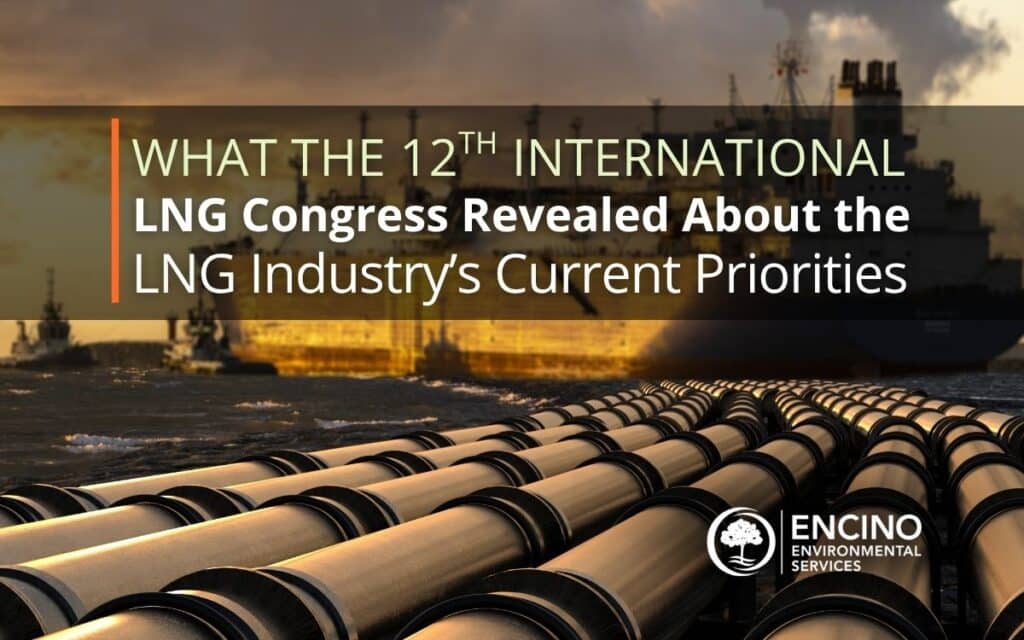
The 12th International LNG Congress (LNGCON 2026) held March 9–10 in Barcelona, brought together LNG leaders from across the value chain to discuss a familiar but increasingly urgent challenge: how to balance energy security, infrastructure investment, and decarbonization in a market facing mounting regulatory and operational pressure.
What stood out from this year’s congress was not just the range of topics discussed, but the direction of the conversation. LNG is still being positioned as a practical fuel in today’s energy mix, but the emphasis is shifting toward lower-emissions operations, better data, and more credible pathways for compliance. Those themes are especially relevant for LNG facility operators who are under growing pressure to document emissions, reduce methane risk, and maintain regulator-ready environmental programs.
Key Themes Discussed at LNGCON 2026
LNG’s role in energy security is still central
One of the clearest takeaways from LNGCON 2026 was that LNG remains strategically important to Europe’s energy system. Spain’s extensive regasification network and flexible gas infrastructure were highlighted as a reason Barcelona was a fitting host city, especially as Europe continues to think carefully about supply resilience and import capacity. Conference discussions reinforced that LNG is still viewed as an important piece of the near- and medium-term energy picture, even as the industry works toward lower-carbon operations.
Decarbonization is no longer a side conversation
The event’s opening executive panel, focused on LNG as a path to net zero, reflected a broader industry reality: decarbonization is now embedded in commercial and operational decision-making. Speakers addressed the tension between maintaining reliable energy supply and meeting environmental expectations, with discussion touching on infrastructure coordination, underground storage, and the need for stronger integration across Europe’s gas system. In other words, the industry is no longer talking only about expansion. It is also talking about how to operate more transparently and more efficiently.
Maritime compliance is shaping fuel strategy
Shipping was another major topic. LNGCON discussions pointed to maritime transport as a major demand driver for LNG and bio-LNG, especially as compliance obligations tighten.
That focus aligns with the current European regulatory landscape. The EU’s FuelEU Maritime regulation is designed to promote renewable and low-carbon fuels for ships, and it requires vessels above 5,000 gross tonnes calling at European ports to reduce the greenhouse gas intensity of onboard energy use by 2% in 2025, with steeper reductions phased-in over time. At the same time, the EU ETS is already being applied to maritime emissions, with the share of emissions covered ramping from 40% in 2025 to 70% in 2026 and 100% in 2027 and beyond which pushes LNG market participants beyond fuel availability and into a much more data-driven operating environment.
Bio-LNG and lower-carbon pathways are gaining attention
LNGCON 2026 also highlighted growing interest in bio-LNG and adjacent low-carbon solutions. Speakers discussed biomethane, carbon utilization, and the potential for bio-LNG to support emissions reductions in hard-to-abate sectors, especially maritime transport. While commercial adoption will vary by region and application, the direction is clear: the market is looking for practical lower-carbon options that can work with existing LNG infrastructure where possible.
Emissions performance and operational visibility are becoming more important
Beyond headline strategy, the conference also emphasized practical technologies for reducing emissions and improving facility performance. Discussions covered transport applications, maritime operations, and emissions-reduction technologies, while the technical visit to Enagás’ Barcelona LNG Terminal gave delegates a look at operating infrastructure including metering, odorization systems, vaporizers, compressors, and berthing capabilities.
The subtext is important: operational visibility matters. Facilities need reliable insight into what their systems are doing, where emissions risk exist, and how to respond quickly if an issue is identified.
What This Means for LNG Facility Operators
For LNG operators, LNGCON 2026 reinforced that the industry is being asked to do several things at once: maintain reliability, support throughput, reduce emissions, respond quickly to methane-related risks, and keep up with evolving regulations and stakeholder expectations. That is a complicated assignment, especially for facilities managing multiple emissions sources across liquefaction, regasification, compression, flaring, storage, and transfer operations.
Strong programs depend on integrated emissions testing, methane detection, data management, and advisory support that can hold up under regulatory scrutiny while still supporting day-to-day operations.
How Encino Can Add Value to LNG Operators
Encino supports LNG facilities with emissions testing, monitoring, and compliance solutions designed to meet both compliance goals and operational realities. Our work includes emissions testing, methane detection, flare monitoring, continuous emissions monitoring, permitting support, diagnostics, and technical services tailored to LNG operations.
That matters because better measurement can create value beyond regulatory readiness. When emissions data is paired with the right technical expertise, it can help uncover the reason behind recurring emissions events, failed tests, erratic readings, or unexpected performance issues. In many cases, solving the underlying cause improves both environmental performance and operational efficiency.
Encino’s LNG capabilities are built to help operators do exactly that. From identifying fugitive methane emissions and monitoring flare systems to supporting diagnostics and reporting, our services help facilities improve data quality, protect up time, and make more informed operational decisions. Emissions testing is only one piece of the puzzle, but when used effectively, it can become a practical tool for improving how a facility runs.
As LNG operators navigate evolving regulations, infrastructure demands, and performance expectations, the companies that treat emissions measurement as both a compliance function and an operational advantage will be better positioned for what comes next.
Sources
- LNG Industry — Global LNG industry meets in Barcelona at LNGCON 2026 for strategy, dialogue, and collaboration
- Eurogas — 12th International LNG Congress: LNGCON 2026
- European Commission, Mobility and Transport — Decarbonizing maritime transport – FuelEU Maritime
- European Commission, Climate Action — FAQ: Maritime transport in EU Emissions Trading System (ETS)
- European Commission, Climate Action — Reducing emissions from the shipping sector