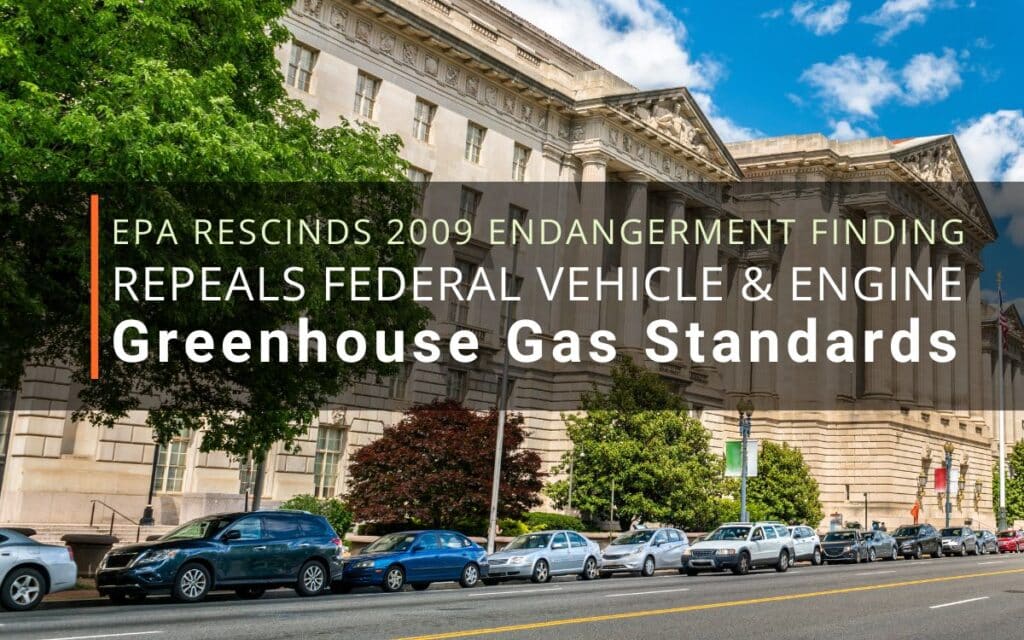
EPA has finalized a rule that rescinds the agency’s 2009 greenhouse gas endangerment and contribution findings and repeals federal greenhouse gas emission standards for vehicles and engines that were developed under Clean Air Act Section 202(a)(1). EPA frames this as a change in how it interprets its authority to regulate greenhouse gas emissions from new motor vehicles and engines at the federal level. [1][2][5]
For operators and compliance managers, the takeaway is less about politics and more about planning. Requirements can change, but the need for defensible emissions data and consistent testing practices often remains, especially when obligations come from multiple directions.
The 2009 Endangerment Finding in plain English
In 2009, EPA concluded that certain well mixed greenhouse gases threaten public health and welfare and that emissions of those gases from new motor vehicles and new motor vehicle engines contribute to air pollution. That finding served as the foundation for multiple federal greenhouse gas standards for vehicles and engines over the years that followed. [1][3]
What the final rule changes for vehicles and engines
EPA’s final rule rescinds the 2009 findings and repeals the greenhouse gas standards for light duty, medium duty, and heavy-duty vehicles and engines that were promulgated under Section 202(a)(1). The rule also removes program elements tied specifically to greenhouse gas standards, including certification related requirements and test procedures that were built around greenhouse gas compliance, as described in EPA’s rule materials as described in EPA’s rule materials and summarized in the Babst Calland legal alert. [1][2][3]
What this does not change automatically
This action is focused on greenhouse gas standards for mobile sources under Section 202(a)(1). It does not automatically rewrite other emissions programs or every requirement that may apply to a fleet or an engine driven operation.
One important distinction is that fuel economy standards, commonly referred to as CAFE, are administered by NHTSA under separate statutory authority rather than EPA’s Section 202 greenhouse gas framework. [1][3]
Practical implications for operators and compliance managers
Even if federal greenhouse gas standards for vehicles and engines are repealed under this rule, many organizations will still maintain emissions tracking and testing practices because they support day-to-day operational and compliance needs.
Practical items to consider include:
- Confirm what requirements still apply to your operations. Federal rules are only one part of the picture. State programs, permit conditions, customer standards, and internal governance can still drive emissions monitoring expectations. [3][7]
- Keep testing and documentation practices consistent. When programs change, the most common pain point is not the testing itself, it is inconsistent documentation across sites, contractors, or business units. A consistent testing approach helps support audit readiness and internal reviews.
- Watch for changes in enforcement posture and guidance. When major rules shift, agencies and stakeholders often issue follow-on guidance, and legal challenges can affect what happens next. [4][6]
- Maintain a defensible baseline. Engine testing and emissions testing data can still be valuable for performance verification, maintenance planning, ESG reporting, customer due diligence, and proactive compliance planning.
Stated simply, a change in one federal program does not always eliminate the operational value of data. It often changes how that data is used and what it needs to support.
Legal challenges and why teams should watch closely
The final rule is expected to face legal challenges, and litigation has been reported following EPA’s publication of the action. Court decisions can affect timing, enforcement posture, and long-term durability. For compliance teams, this points to a familiar reality: regulatory change can be immediate while also being contested over time. [4][6]
Encino’s perspective as engine testing and emissions testing leaders
Regulations evolve, but strong compliance programs do not rely on assumptions. They rely on data, documentation, and repeatable methods.
For operators managing engines across field operations and industrial sites, engine testing remains a practical tool to understand performance, verify emissions related parameters, and support defensible recordkeeping.
Encino will continue tracking developments and translating updates into practical guidance. We help clients maintain high quality testing practices and reporting integrity so they can make informed decisions as the regulatory landscape shifts.
Sources
[1] Federal Register. Rescission of the Greenhouse Gas Endangerment Finding and Motor Vehicle Greenhouse Gas Emission Standards Under the Clean Air Act. February 18, 2026.
https://www.federalregister.gov/documents/2026/02/18/2026-03157/rescission-of-the-greenhouse-gas-endangerment-finding-and-motor-vehicle-greenhouse-gas-emission
[2] U.S. Environmental Protection Agency. Final rule page with final rule documents, fact sheet, and timeline.
https://www.epa.gov/regulations-emissions-vehicles-and-engines/final-rule-rescission-greenhouse-gas-endangerment
[3] Babst Calland, Clements and Zomnir, P.C. In a Significant Step Towards Deregulation, EPA Repeals 2009 Endangerment Finding and Federal Greenhouse Gas Standards for Vehicles and Engines. February 16, 2026.
https://natlawreview.com/article/significant-step-towards-deregulation-epa-repeals-2009-endangerment-finding-and
[4] Reuters. Environmental groups challenge Trump decision to revoke basis of U.S. climate regulations. February 18, 2026.
https://www.reuters.com/legal/litigation/environmental-groups-challenge-trump-decision-revoke-basis-us-climate-2026-02-18/
[5] U.S. Environmental Protection Agency. News release on the final action. February 2026.
https://www.epa.gov/newsreleases/president-trump-and-administrator-zeldin-deliver-single-largest-deregulatory-action-us
[6] Reuters. California, Connecticut preparing legal challenge against repeal of basis of U.S. climate regulation. February 18, 2026.
https://www.reuters.com/sustainability/climate-energy/california-connecticut-preparing-attack-against-trumps-repeal-basis-us-climate-2026-02-18/
[7] Spencer Fane. Rescission of The Clean Air Act Endangerment Finding. Practical Implications in the Spotlight. February 18, 2026.
https://www.spencerfane.com/insight/rescission-of-the-clean-air-act-endangerment-finding-practical-implications-in-the-spotlight/