Stack Emissions Testing for Dust Collectors: Methods, Compliance Drivers, and Best Practices
Insights from The Stack Testing Experts at Encino Environmental
Baghouses, also commonly known as “dust collectors,” are a critical element of industrial air pollution control, capturing particulate matter (PM) and hazardous air pollutants (HAPs) from process emissions. While a baghouse or dust collector itself isn’t directly regulated, it plays an important role in helping facilities comply with federal, state, and local air quality regulations. Understanding the regulatory landscape is essential for operators, engineers, and environmental compliance teams.
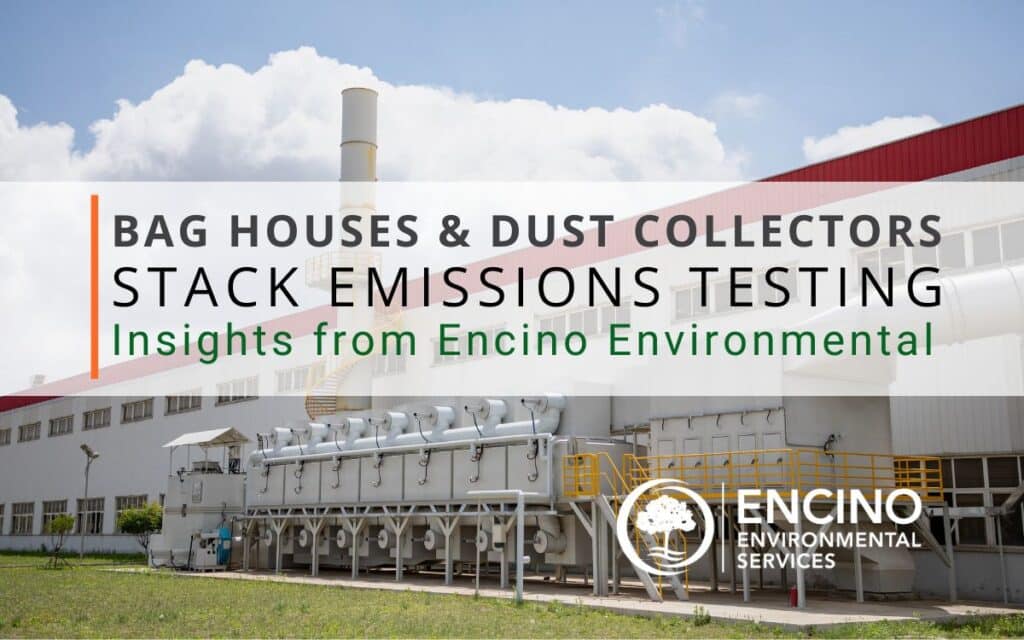
What is a Baghouse (Dust Collector)?
A baghouse is an industrial air-pollution control system used to capture dust and other particulate matter from exhaust gases before they are released into the atmosphere. It’s essentially a large, heavy-duty filtration system designed for industrial processes. A baghouse works like a giant vacuum cleaner – dirty air goes in, dust is trapped on fabric filter bags, and clean air exits the stack.
Baghouses are used in facilities and processes that generate significant particulate matter, including asphalt and concrete plants, cement kilns, steel mills and foundries, wood products and sawmills, grain handling and food processing, and chemical and pharmaceutical plants. A baghouse is a high-efficiency industrial dust collector that removes particulate matter from exhaust air so facilities can operate cleanly, safely, and in compliance with environmental regulations.
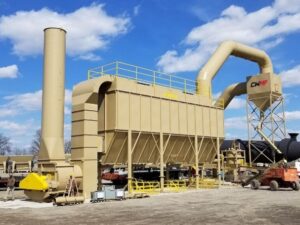
Baghouse in operation
(Photo credit: CWFM Asphalt Plant Equipment)
Federal Regulations: The Clean Air Act
The Clean Air Act (CAA) provides the framework for regulating air pollutants in the United States. Facilities must control emissions of particulate matter (PM), including PM₁₀ and PM₂.₅, as well as certain hazardous air pollutants such as lead, mercury, and chromium.
Baghouses are among the most effective technologies for capturing these pollutants before they are released into the atmosphere.
Key regulated pollutants include:
- PM (Total Particulate Matter)
- PM₁₀ and PM₂.₅
- Metal HAPs (e.g., lead, mercury, chromium, arsenic)
- Process-specific toxics (depending on industry)
New Source Performance Standards (NSPS)
The NSPS (40 CFR Part 60) applies to new, modified, or reconstructed industrial sources. Industries where baghouses are commonly required include:
- Cement manufacturing
- Steel mills
- Foundries
- Mineral processing
- Grain handling
- Asphalt plants
Under NSPS, baghouses help facilities meet mass-based PM limits, opacity limits (often ≤10–20%), and may be subject to periodic performance testing and monitoring.
Additionally, the EPA maintains National Emission Standards for Hazardous Air Pollutants (NESHAPs) for stationary sources (e.g., a steel mill or foundry) that effectively require the use of baghouses or similar control equipment as part of achieving compliance with particulate matter (PM) and hazardous air pollutant (HAP) emission limits.
Although NSPS 40 CFR Part 60 does not specifically list “baghouses” by name, it does set emission limits on PM and opacity that generally necessitate the use of control devices such as baghouses for compliance. In the regulatory language, baghouses fall under the definition of a “control technology” that collects particulate matter by filtering the contaminated air or gas stream through fabric filters (bags).
National Emission Standards for Hazardous Air Pollutants (NESHAP/MACT)
NESHAP standards regulate major and area sources of HAPs (40 CFR Parts 61 and 63) and are stationary source standards for hazardous air pollutants. Facilities in sectors such as secondary metals processing, chemical manufacturing, and wood products often rely on baghouses to meet Maximum Achievable Control Technology (MACT) standards in 40 CFR 63.43.
These requirements may include:
- Outlet PM or metal concentration limits
- Bag leak detection systems (BLDS) or continuous opacity monitoring
- Maintenance of pressure drop and cleaning cycles
- Startup, shutdown, and malfunction (SSM) procedures
State and Local Regulations
Each state is responsible for enforcing an EPA-approved State Implementation Plan (SIP), which often includes stricter requirements than federal regulations.
State rules may define:
- Maximum allowable PM emissions
- Required control efficiency (typically ≥99%)
- Inspection and maintenance schedules
- Reporting and deviation response procedures
Local air districts, such as the California Air Resources Board (CARB) or the Texas Commission on Environmental Quality (TCEQ), may also impose additional standards.
Title V Operating Permits
Facilities classified as major sources must obtain a Title V operating permit, which consolidates all applicable federal, state, and local requirements.
Title V Permits often specify:
- Emission limits the baghouse must achieve
- Monitoring requirements, including pressure drop or BLDS (Bag Leak Detection Systems) alarms
- Recordkeeping and reporting obligations
- Corrective actions for excursions or equipment failures
Opacity and Visible Emissions
Even if mass-based PM limits are met, visible emissions are regulated. Opacity limits typically range from 0–10%, with exceptions allowed during startup or maintenance, depending on permit conditions.
Compliance is often monitored via EPA Method 9 visual observations or by a Continuous Opacity Monitoring Systems (COMS) as defined in 40 CFR 60.13.
Regulatory Complexity
Your regulatory requirements are based on the industry in which you operate, the location of your operation/facility, and its potential emissions levels. Those variables determine the relevant jurisdictions and permit requirements.
The table below summarizes the major federal and state emissions regulations impacting facilities (sources) and baghouses.
| Jurisdiction / Rule | Pollutants / Parameters Covered | Testing Frequency / Requirements | Test Methods / Notes |
|---|---|---|---|
| Federal – NSPS (40 CFR Part 60) | Particulate matter (PM), opacity, and control device parameters for specific NSPS subparts | Initial performance test required to demonstrate compliance; periodic re-testing or continuous monitoring depending on subpart. (US EPA) | PM: EPA Method 5 or 5D; opacity: Method 9; baghouse operation/inspection procedures must be documented and followed. (40 CFR 60.124) |
| Federal – NESHAP / MACT (40 CFR Part 63) | PM and surrogate HAP monitoring for affected sources; control device monitoring | Initial performance test, then monitoring of operating parameters (pressure drop, bag leak detection, opacity) per standard. (US EPA) | Reference EPA Method 5/5D for PM, Method 9 for opacity, plus continuous bag leak detection systems where specified. (40 CFR 63.1656) |
| Federal – Clean Air Act Stack Testing Guidance | Applies to all stack tests used to demonstrate compliance with NSPS/NESHAP/SIP | Guidance encourages consistent use of stack testing practices, supports states and EPA in enforcing performance tests. (US EPA) | Not a regulation itself but influences stack test interpretation and uniformity. (US EPA) |
| Texas (TCEQ) | Emissions from stationary sources (PM, VOC, etc.) as required by state rules/permits | Stack/emission testing triggered by permit conditions and state/federal rules – common in Texas permits; notifications and reports required. (TCEQ) | Encourages use of EPA reference methods (e.g., Method 5) or TCEQ methods where applicable; test scheduling and submittal must follow permit/State guidance. (TCEQ) |
| California (South Coast AQMD / SCAQMD Rule 1155 example) | Particulate matter control (baghouses), visible emissions, bag leak detection systems | Visible emissions monitoring (Method 22) weekly/monthly, source tests (e.g., PM testing) at initial and every 5 years and/or when exceedances occur. (AQMD) | Rule includes EPA Method 5.1/5.2/5.3 for source tests; bag leak detection system (BLDS) and corrective actions tied to monitoring. (AQMD) |
| Ohio (OAC Rule 3745-17-07) | Visible particulate emissions from stacks | Limits opacity to ≤20% averaged over 6 minutes with exceptions; enforced via compliance testing when required. (Ohio Laws) | States often adopt EPA Method 9 or equivalent visible emissions requirements in SIP-enforceable rules. (Ohio Laws) |
| Florida (Chapter 62-297 SIP/State rule) | Stack testing for particulate and visible emissions to meet SIP limits | Typical SIP framework requires annual or periodic formal compliance tests, including visible emissions and PM. (US EPA) | Stack testing uses EPA reference methods; specific frequencies and procedures are spelled out in state rules and air permits. (US EPA) |
Please note that this list is not all-inclusive, regulations are subject to change at any time without notice, and Encino does not represent it will update this table in a timely manner or at all. Readers are encouraged to seek qualified guidance from Encino for their specific situation(s).
Why Choose Encino Environmental for Baghouse Stack Testing
Stack testing and compliance is complex and seldom straightforward, but Encino’s deep expertise and proven track record ensure you’re guided through every step to help achieve compliance with confidence. Our combination of expert personnel, mobile testing labs, rigorous QA protocols, positive rapport with regulatory agency staff, and customer-focused service ensures that every test is:
- Accurate and defensible
- Compliant with EPA and state regulations
- Delivered with minimal disruption to your operations
- Completed with minimal need for you to interact with regulatory agencies
TEST TIP
Particulate matter (PM) stack testing is significantly easier when ambient temperatures are above freezing. In colder conditions, the sampling area must be heated, often at elevation on the stack, adding complexity, cost, and time to the testing process.
We can perform stack tests in all temperatures; however, cold-weather conditions require additional coordination and sometimes creative solutions for maintaining adequate sampling area temperatures and prevent freezing. Because this can increase complexity, time, and cost, the most efficient approach is to schedule your testing during warmer weather.
We take the headache out of emissions testing by managing the entire process, from preparation to regulatory submission, and answering questions from regulatory staff so your team can focus on running your facility safely and efficiently.
Don’t risk your compliance – or your reputation – on a bad stack test. A single error in emissions testing or reporting can lead to failed audits, costly fines, operational downtime, or even forced shutdowns. Regulators don’t accept “almost right.”
Protect your permit, your production, and your peace of mind. Contact Encino Environmental today to schedule your next stack test before compliance deadlines catch up with you.
READ MORE: Industrial & Commercial Stack Emissions Testing
Conclusion
Baghouses are an essential tool for industrial facilities seeking to comply with air quality regulations. While the equipment itself is not directly regulated, it ensures that facilities meet federal, state, and local standards, including PM limits, opacity rules, and HAP restrictions. Proper design, operation, and maintenance of baghouses, combined with robust monitoring and reporting, are critical for regulatory compliance and environmental stewardship.