What EPA’s NSPS OOOOb Flare Rule Means for Emissions Accountability in Oil and Gas
The environmental compliance landscape is changing. With the introduction of the EPA’s NSPS OOOOb and Emissions Guideline OOOOc, the standards for flare performance and enclosed combustion devices (ECD) in the oil and gas industry have been significantly elevated. These updates signal a firm regulatory shift, one that prioritizes measurable methane mitigation and holds operators to a much higher standard of accountability.
For leadership teams in exploration, production, and midstream, the implications are clear. Compliance will no longer hinge on manufacturer specifications or legacy monitoring practices. Moving forward, success will depend on the ability to demonstrate real-time, consistent and accurate performance with verifiable data.
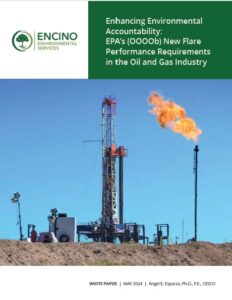
Encino Environmental Services has developed a white paper that outlines what operators need to know. Enhancing Environmental Accountability: EPA’s (OOOOb) New Flare Performance Requirements in the Oil and Gas Industry provides a detailed breakdown of the rule, practical steps for achieving compliance, and the role that advanced monitoring technologies can play in both regulatory alignment and operational improvement.
Why This Rule Matters
Unlit and malfunctioning flares have long been recognized as a major contributor to fugitive methane emissions. Recent studies have shown effective destruction rates well below the EPA’s required threshold, particularly in high-production regions like the Permian Basin and Eagle Ford. These findings have prompted the agency to tighten requirements across several dimensions.
Under OOOOb, operators are no longer allowed to assume combustion efficiency based on design. They must prove it. That means continuous monitoring, validated performance metrics, and proactive system oversight.
Among the new mandates:
-
Pilot flames must be continuously lit and verifiable
-
Destruction and removal efficiency must meet or exceed 95 percent
-
Visible emissions must remain within strict time limits
-
Monitoring systems must record flare status at least every five minutes
-
Alternative technologies must meet defined accuracy and reliability standards
This rule is not just a compliance formality. It’s a signal that environmental performance, especially around methane control, is becoming a strategic business imperative.
Technology is the Differentiator
The white paper outlines a range of methods for demonstrating compliance—from traditional inspections to advanced digital monitoring systems. Operators who embrace validated, technology-driven solutions will be positioned to meet regulatory expectations with confidence and agility.
Encino’s SENSIA Agni Optical Gas Imaging (OGI) camera, featured in the white paper, is one such solution. Built specifically for 24/7 flare surveillance, Agni enables continuous measurement of combustion efficiency, real-time flame verification, and automated alerts in the event of failure. These capabilities can not only satisfy the new rule’s requirements but also reduce the burden of manual inspections and improve overall site safety.
The EPA has also created a path for operators to implement alternative monitoring methods such as Video Imaging Spectro-Radiometry (VISR). These emerging tools, when properly validated, may allow operators to replace certain manual inspection requirements with automated, high-frequency data.
A Strategic Shift in Accountability
Operators can no longer rely on assumptions or outdated estimates. Regulators, investors, and the public now expect continuous proof of performance. This requires more than just installing equipment. It demands a data strategy that is accurate, transparent, and aligned with both compliance goals and corporate ESG frameworks.
Encino’s white paper emphasizes that this transition is not just about avoiding penalties. It’s an opportunity to streamline compliance, reduce risk, improve asset integrity, and enhance trust with key stakeholders. For private operators, it can make assets more attractive in potential transactions. For public companies, it strengthens credibility in an increasingly data-driven investment environment.
Practical, Actionable Guidance
The white paper provides clear, practical insights on topics including:
-
Determining the applicability of OOOOb and OOOOc rules to your operations
-
Requirements for specific flare types, from unassisted to perimeter air assist
-
Clarifying the difference between destruction and combustion efficiency
-
How to document performance using approved or alternative methodologies
-
The role of advanced monitoring systems in minimizing inspection burdens
It also includes a summary of combustion efficiency metrics, flare configuration requirements, and EPA’s position on emerging technologies that may offer long-term value.
The Encino Perspective
Encino Environmental Services supports operators across all major oil and gas basins in navigating these changes. Our team combines regulatory expertise with field-tested monitoring solutions, offering an integrated approach that helps clients reduce emissions, verify performance, and maintain compliance with confidence.
Whether through Continuous Emissions Monitoring Systems (CEMS), Leak Detection and Repair (LDAR) programs, satellite-based methane detection, or AI-enabled Flare Monitoring, Encino delivers measurable results grounded in science and aligned with regulatory requirements. We work with clients to design strategies that anticipate change, reduce complexity, and align environmental performance with business outcomes.
Download the White Paper
Enhancing Environmental Accountability: EPA’s (OOOOb) New Flare Performance Requirements in the Oil and Gas Industry is available as a free download.
If you are preparing for compliance with EPA’s new OOOOb flare requirements or rethinking how combustion performance is managed across your operations, this white paper offers the strategic guidance you need.